Author Archives: Dennis Hill

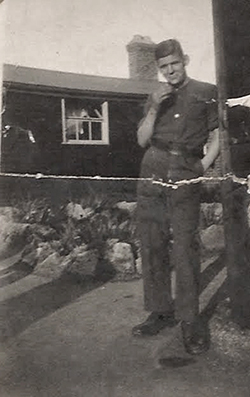
Eric Rockliff Sanderson

sanderson-card-1_r72

sanderson-card-2_r72

Front and back of a Christmas postcard Eric Sanderson sent to his nieces in Doncaster, Yorkshire (England) from P.G. 59 on November 11, 1942

Yesterday I received a note from David Sanderson, who lives in Esher, Surrey (England).

David wrote, “I recently visited Campo 59 with the Escape Lines Memorial Society (ELMS) on their Tenna Valley Trail for 2016.

“My dad, Eric Rockliff Sanderson, was at Campo 59 during WW2.

“Dad was a tank driver with the Fourth Hussars, and was captured in Greece on 28th October 1941. Like many others, he had been left behind in Greece in April 1941 during the evacuation to Crete. Dad escaped into the Taygetos Mountains (for six months), until finally being captured by the Italians in October. He was transferred via Bari to Campo 59, where he was imprisoned from—I think—November 1941 until July 1943.

“In July 43 he was moved to Bolzano in northern Italy. When the Italians surrendered in September 1943, he was captured by the Germans and taken to Germany. In Germany he was in Stalag IV B at Lamsdorf for around six weeks, and then sent to Stalag IV F (near Chemnitz) where he remained until the end of the war.”

Eric’s details are as follows:

Army Number – 320875
Rank – Trooper
Enlisted on June 20, 1938 in the Cavalry of the Line (4th Hussars)
Medals received – Africa Star, 1939–45 Star, and War Medal 1939–45

The postcard pictured above reads:

“Breezy greetings send this ship
On a pleasant Christmas trip,
Bringing you kind thoughts sincere
With its cargo of good cheer,
And of lucky wishes true.
Joy and health and peace to you.
Love Eric”

I directed David to a post on this site with a holiday postcard featuring a full-rigged ship drawn Robert Dickinson (see “The Christmas Ship.”) Robert’s postcard was also sent in November 1942.

David wrote, “It does seem likely that the same person drew/penned the two cards. Certainly my dad’s handwriting was not so neat, so his card would I’m pretty sure have been drawn and written for him. Perhaps by Bob or maybe a third party?”

I noticed that the art is initialed—a further suggestion his dad was the artist.

“You may be right, he replied. “I still think it likely that someone other than my dad drew it. However, I’ll keep an open mind.”
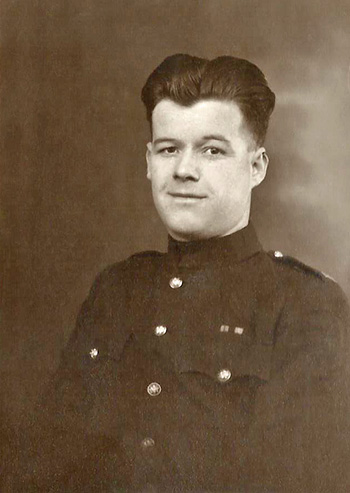
eric-sanderson_r72

Eric Rockliff Sanderson

Dedication in Comunanza

comunanza-5

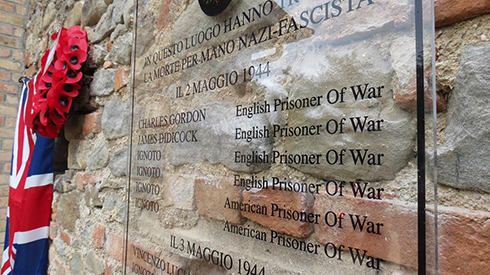
A new memorial plaque

In the Italian village of Comunanza last Sunday, May 15, a plaque was installed to commemorate the killing of escaped Allied prisoners of war in 1944.

See “An Execution at Comunanza” on this site.

The men killed were English, American, and Scottish (Private Charles Gordon was from Gartochorn, Dunbartonshire, and Driver James Didcock was from Bridgend, Linlithgow—both in Scotland, although the official military inquiry into the case referred to them simply as “British soldiers.”

To the best of my knowledge, some of the dead to this day remain unidentified.

comunanza-1

Attendants at the memorial ceremony

For other photos of the dedication, visit the La Casa della Memoria Facebook post regarding the ceremony.

This event was on the final day of the Freedom Trails 2016 walk (May 11–15)—sponsored by Monte San Martino Trust, WW2 Escape Lines Memorial Society, and La Casa della Memoria di Servigliano.

Jimmy Feehan and Thomas Penman

australians-r72

Escaped P.O.W.s arrive at Royal Park, Victoria, Australia, 1944. From left: Private J. W. Feehan from W.A. (Western Australia), Sergeant E. J. Brough from Victoria, Lance Corporal L. Worthington from W.A., Mrs. T. G. McClounan from the Red Cross, Private H. A. Lockie from Queensland, and Private J. A. Allen from W.A. (Argus Newspaper Collection of Photographs, State Library of Victoria)

Helen McGregor directed me to the above photo, which she found among the digitalized images of the State Library of Victoria. She had been searching for information on Jimmy Feehan, a friend whom her father, Scottish soldier Thomas Penman, spent time with after the men escaped from Camp 59.

I was pleased to see other P.G. 59 escapees in this photo: Leslie Worthington (see “Les Worthington—an Australian’s Adventure” and “A Timeline of Les Worthington’s Service“, and John Albert Allen (see “Conversations with Vaughan Laurence Carter and “Simmons’ Address Book—the Lone Australian.”

Les Worthington’s son, Ray Worthington, wrote to tell me he has been able to narrow the date of the photo: “I can tie the date of it down fairly closely from my record of Dad’s service which shows:

10/9/1944 – Disembarked at Melbourne (report of 25/9/1944)
14/9/1944 – Entrained at Victoria. Vic L of C Area (report of 25/9/1944).

“So it was between the 10th and 14th of September 1944.

“And Dad then arrived back in Perth on the 17th of September, so the first time 7 years old me had seen him in nearly 4 years!”

American readers should note the day precedes the month in the above dates. For example, 10/9/1944 is September 10, 1944.

Thomas Penman’s Service Record

The following dates and locations for Thomas Penman are from a British military record for Thomas that Helen McGregor shared with me.

This information is in the left column of the form:

Deemed to have been enlisted March 19, 1940.

DSR. – September 8, 1940

Posted I.T.C. [Infantry Training Centre] Royal Scots – Private – March 19, 1940

Posted June 28, 1942 – Pte [Private]

Missing – Pte – June 28, 1942

Prisoner of War (Italian)
Escaped (Now in Allied Hands, S/Italy)

In another area, “Service at Home and Abroad” indicates:

Home – March 19, 1940 to June 25, 1940
Egypt – June 26, 1940 to December 15, 1940
Sudan – December 16, 1940 to July 9, 1941
Egypt – July 10, 1941 to June 27, 1942
ITALY (P.W.) [prisoner of war] – June 28, 1942 to August 10, 1944
NS. Y/167/44 HOME – August 11, 1944 to September 26, 1946

I assume the span of June 28, 1942 to August 10, 1944 is inclusive of Thomas’ time “on the run” after escape from Camp 59—and his involvement with the Yugoslavian partisans that Helen mentions in “Scottish Escapee Thomas Penman.”

The last entry apparently covers the period from his return to the UK in August 1944 through his lengthy recovery at Camp 197 (“The Mount”) in Chepstow, Monmouthshire, Wales.

After 72 Years—Dewey Gossett Home at Last

bilde-1

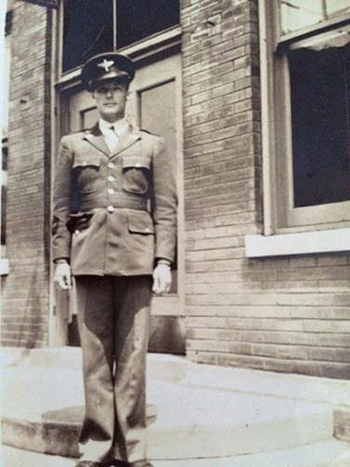
Dewey L. Gossett, a World War II soldier whose A-36A Apache fighter/bomber crashed in Italy 72 years ago, was laid to rest with full military honors six days ago at Fort Prince Memorial Gardens in Wellford, South Carolina.

bilde-2

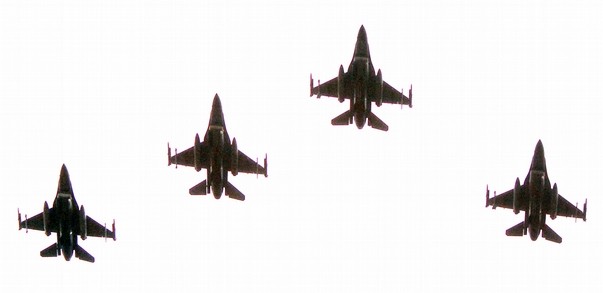
A fighter jet flyover shook the ground before Dewey Gossett’s burial service.

Photos courtesy of TIM KIMZEY, photographer/Spartanburg Herald-Journal/GoUpstate.com

Read the Spartanburg Herald-Journal coverage of Dewey Gossett’s service at http://www.goupstate.com/article/20160411/articles/160419945.

On September 27, 1943, Dewey Gossett, a member of the 86th Fighter Group, U.S. Army Air Force, was the pilot of a single-seat A-36A Apache aircraft accompanied by three other pilots on a strafing mission in Italy. The planes encountered bad weather and poor visibility after take-off, and Dewey’s plane crashed into Mount Accellica, near the village of Acerno in southern Italy.

Human remains were discovered by avian archaeologists of the Italian Salerno 1943 organization (the “Salerno Air Finders”) in 2014 during their excavation at the crash site. Through extensive DNA testing by members of the United States Defense POW/MIA Accounting Agency and other organizations, the remains were identified as belonging to Dewey.

Dewey was laid to rest with full military honors in his home state of South Carolina this past Monday, April 11, 2016.

Dewey’s great niece Nora Messick wrote to me this evening that—in addition to the newspaper coverage—CBS affiliate WSPA Channel 7 did a news story on Dewey’s return. You can watch a video of their coverage, “Remains of WWII pilot returned to Upstate after 72 years,” at WSPA.com.

Nora asked me to share this comment:

“On behalf of the family, we are truly grateful to everyone involved in bringing Dewey home. We especially would like to thank DPAA and the Association Salerno Air Finders for their work in finding Dewey. He’s finally back home and the memorial service was a beautiful, fitting tribute to our hero.”

For further details on the crash and the effort to identify the pilot’s remains, read “Lost Airman Dewey Gossett.”

A full account of the case, from the plane’s discovery by the Salerno 1943 team to the return and burial of Dewey’s remains is posted—partly in Italian and partly in English—on the Salerno 1943 website, “IL CACCIABOMBARDIERE NORTH AMERICAN A-36A APACHE 42-83976.”

You can also read the entire page in English by means of Google Translate.

gossett

Dewey L. Gossett

Scottish Escapee Thomas Penman

penman-1946_r72

A hale and hearty Thomas Penman in 1946, after medical treatment for malnourishment in Chepstow, Wales— a “fattening up” gradually on small amounts of food, chocolate, and milk

I received a note from Helen McGregor, who lives just outside Glasgow, Scotland, last month.

She wrote, “My father was one who escaped from the camp at Servigliano and lived with an Italian family for at least one year.

“He is dead now, but I know he was mentioned in dispatches and given a hero’s welcome home. His name was Thomas Penman and he was from Glasgow, Scotland.”

Thomas Penman, Highland Light Infantry, was captured in North Africa between El Alamein and Tobruk and shipped to Italy. He escaped capture twice.

The following accounts are among those Helen’s father shared with her older siblings over different periods of time. Although the details are sketchy, the stories are nonetheless compelling.

Continue reading

In Print—New Escape and Evasion Devices Book

phil-froom-cover_r72

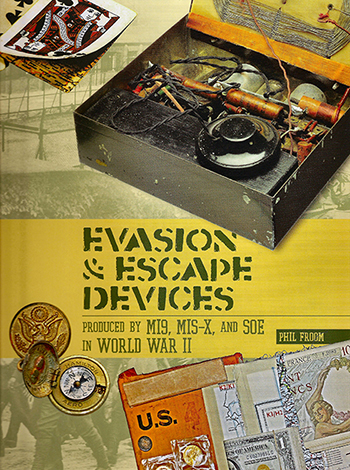
British researcher and author Phil Froom recently told me about his new book, Evasion and Escape Devices Produced by MI9, MIS-X, and SOE in World War II.

The book concerns the profusion of covert E & E devices produced during WW II by the British intelligence agency M.I.9 (Military Intelligence–Section 9, the parent organization of I.S.9, or Intelligence School 9), its mirror U.S. agency MIS-X (Military Intelligence Service–X), and SOE (British Special Operations Executive).

These organizations were responsible for the invention, production, and distribution of a huge variety of these ingenious devices issued to Allied air crew and Special Forces, which would enable them to evade capture after being forced down, or cut off behind enemy lines in occupied Europe.

Published by Schiffer Publishing, Ltd, the book was released in the UK in January of this year.

Continue reading

Letter from P.G. 59 Chaplain “Niel” Nye

robinson-nye-letter1_r72

robinson-nye-letter2_r72

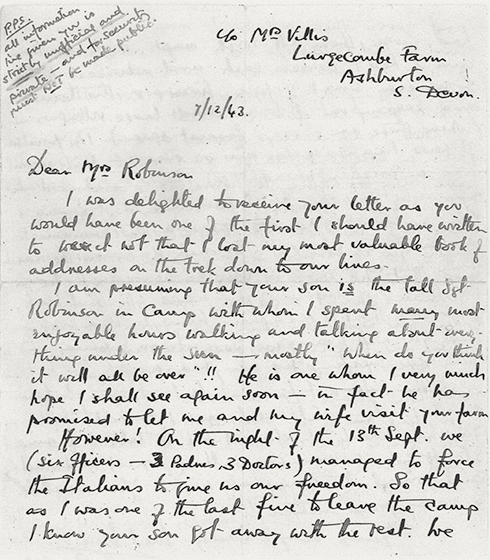
Georgina Stewart, daughter of Don Robinson, who was a prisoner in P.G. 59, shared a letter with me that was written by Reverend Nathaniel “Niel” Nye to her mother during the war.

The letter offered reassurance as to the likely current situation of Don Robinson, then missing in Italy after the breakout from P.G. 59 in September 1943. It also offers us insight into the character of Niel Nye, and it provides details about the breakout.

Nathaniel “Niel” Kemp Nye was an Anglican chaplain in the British Royal Air Force.

The London Gazette of February 6, 1940 indicates Niel (service number 77267) was granted a commission “for the duration of hostilities with the relative rank of Squadron Leader” on January 18, 1940.

After his capture, Niel was interned in Camp 59.

Here is the text of the letter:

c/o Mrs Villis
Lungecombe Farm
Ashburton
S. Devon.

7/12/43. [December 7, 1943]

Dear Mrs Robinson

I was delighted to receive your letter as you would have been one of the first I should have written to were it not that I lost my most valuable book of addresses on the trek down to our lines.

I am presuming that your son is the tall Sgt. Robinson in Camp with whom I spent many most enjoyable hours walking and talking about everything under the sun — mostly “When do you think it will all be over”!! He is one whom I very much hope I shall see again soon—in fact he has promised to let me and my wife visit your farm.

Continue reading

Trading Weapons for Ploughshares

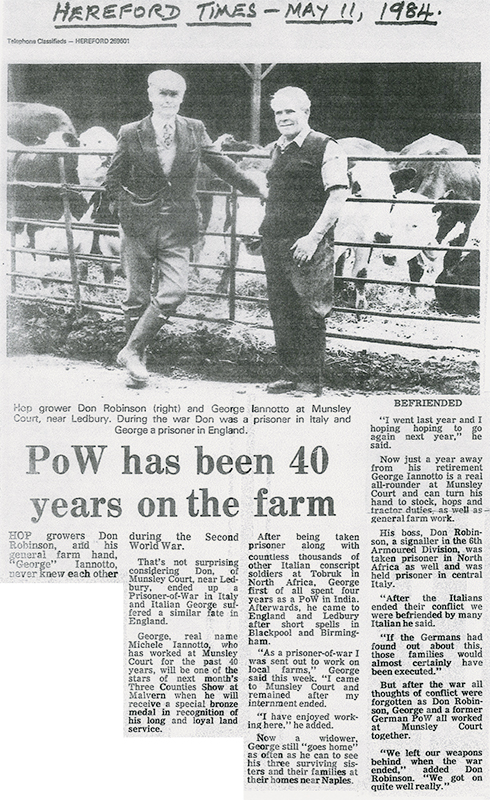
Former Camp 59 internee Don Robinson’s daughter, Georgina Stewart, sent me the heartwarming news story featured in this post, which appeared in the Hereford Time (Herefordshire, England) in 1984.

See also “Sergeant Don Robinson—Captive and Escapee.”

robinson-article-r72

PoW has been 40 years on the farm

Hereford Times
May 11, 1984

Caption: Hop grower Don Robinson (right) and George Iannotto at Munsley Court, near Ledbury. During the war Don was a prisoner in Italy and George a prisoner in England.

HOP growers Don Robinson, and his general farm hand “George” Iannotto, never knew each other during the Second World War.

That’s not surprising considering Don, of Munsley Court, near Ledbury, ended up a Prisoner-of-War in Italy and Italian George suffered a similar fate in England.

Continue reading

Sergeant Don Robinson—Captive and Escapee

robinson-africa-sm_r72

Algiers, late 1942. Don Robinson is on the far right.

Sergeant Donald George Robinson, Royal Artillery, was captured on January 21, 1943 during a night skirmish with Rommel’s Afrika Korp at Bou Arada in Tunisia. From North Africa, he was transferred to P.G. 59 in Servigliano.

In September 1943, Don escaped with the other prisoners during the general breakout from camp that followed the signing of the armistice.

For several months, he was protected by the Luciani and Dezi families who lived in the countryside near the camp.

Through the help of local partisans, Don returned to Allied control in May 1944.

Don and his wife Monica returned to Italy in the 1960s. They stayed with the Dezi family and visited with members of the Luciani family as well.

Don died in 1992, at the age of 76.

Twenty-two years later, Don’s daughter, Georgina Stewart, traveled to the Marche with her husband John. Aided by Ian McCarthy and his wife Gabriella, they succeeded in finding members of both the Luciani and Dezi families.

Georgina recounted this adventure in a story she wrote for the Monte San Martino Trust website. See “Where Donald Robinson Hid.”

robinson-visit-5_r72

Nino Dezi with his wife Josephine. Georgina writes, “As as eight-year-old, Nino used to take food down the hill to my father, who was staying with the Luciani family. When my father and mother visited in the sixties, they stayed with the Dezi family.”

Continue reading

Update—Search for the Soldier Hidden in Petritoli

Petritoli-Monica-Vitali_r72

The comune of Petritoli in the Italian Marche. Photograph by Monica Vitali (Wikimedia Commons).

There is a new development in the search for information about the escaped POW who was helped in the comune of Petritoli during the war. (See “Escaped Prisoner Sheltered in Petritoli.”)

My earlier post explained that Roberto Lucci is attempting to make contact with the family of an escaped prisoner who was sheltered by his great-grandfather, Luigi Lucci, in 1943–44.

Recently, Roberto was told by elders in Petritoli that William and David were part or all of the first or last names, so the soldier’s last name might have been something like David Williams or William Davidson.

However, since I published the earlier post, a document has surfaced in Petritoli identifying the escapee as “David Grif. prigioniero inglese” (David Grif. English prisoner).

Although the first name was recorded as David, is is conceivable that William was his middle name, or that William was his first name and David his middle name and that he preferred to be called David.

Grif is not a common English name, and the period suggests the name might be abbreviated. The “Alphabetical List” sent to me by Brian Sims, contains 81 soldiers with names beginning with “Grif”—Griffin, Griffith, and Griffiths.

Continue reading