
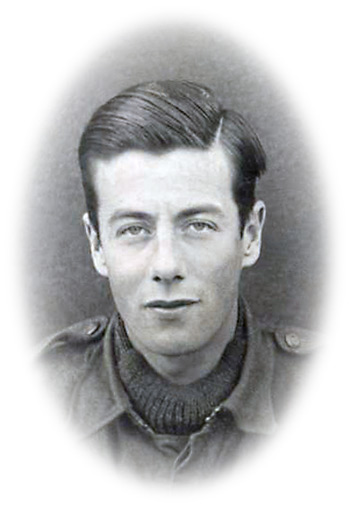
Welsh POW Ronald McCurdy’s daughters Rona Crane and Jeannie Hendra made a physical and emotional journey early this summer that they had long anticipated.
With the help of Janet Kinrade Dethick and Professor Giuseppe Zucca, their adventure led them on a search for the internment camp where their father labored and from which he escaped, as well as to places where he hid while he was on the run.
Finally, they followed his passage through the Alps to safety in neutral Switzerland. (Read “Ronald McCurdy—Escaped to Switzerland.”)
Janet recounts the days they spent together in the following essay.
A Strange Coincidence
Janet Kinrade Dethick, July 2025
Several years ago, as a result of a contact I made through the WW2Talk forum, I got to know Professor Giuseppe Zucca, whose book about prisoners of war in Lomellina—the rice-growing area to the south west of Milan in Lombardy—I subsequently translated. It tells the story of how his mother, Giovanna Freddi, had helped three escaped South African prisoners of war to reach neutral Switzerland after the declaration of the Armistice on 8 September 1943.
Prof. Zucca’s second book on this theme, I Giusti di Lomellina, (The Righteous of Lomellina) which examines the role local people had played in hiding and helping the escaped prisoners, came out late in 2022, and my husband Enzo and I were invited to its presentation in Vigevano in January 2023. Not only did this visit strengthen the professional link between myself and Prof. Zucca, we have now become firm friends.
Towards the end of 2024 I began helping Penny Hayes, the daughter of Trooper John Richard Shaw, to find out who had assisted her father before he left Lomellina for Switzerland on 14 November 1943. Trooper Shaw had been transferred from PG 59 Servigliano to Lomellina in June 1943. In this case the name Angelo Comelli, cited in Trooper Shaw’s Escape Report, appears in a list held in the Commune of Vigevano of persons who had been awarded the Alexander Certificate. Prof. Zucca had obtained a copy of the list when researching his book, and he soon found Carla Liliana Comelli, granddaughter of Angelo, who is now corresponding with Penny.
This success led me to ask the professor if he could look into another case, that of Private Donald Frederick Guiver, 2/5 Essex Regiment, formerly detained in PG 59, whose great-grandson had submitted a post to the WW2Talk forum asking about a family named Manzino of Mortara. Again, the search proved fruitful and the Guiver and Manzino families are in now planning a meeting later this summer.
I looked in The Righteous of Lomellina to see if anyone in the Manzino family (also referred to in some documents as Manzini) had been awarded the Alexander Certificate. I found the name of Angela Rattegni, whom I knew to be the wife of Battista Manzini, so I visited the website of the Allied Claims Commission at the U.S. National Archives (NARA), from which a copy of the compensation claim made by families can be requested. Not only did the name Rattegni Angela in Mazzini appear in the online card index but the family’s address was also given—Cattanea di Mortara, Pavia.
Being a geographer, and having the necessity of knowing exactly where places lie in relation to one another, I went immediately to look for Cattanea on my copy of the 1943 map. Unbelievably, it is less than one kilometre away from Casoni de’ Peri, where I knew that, after having escaped from PG 146/19 Vigevano, Gunner Ronald Edmund McCurdy, like ex-Servigliano prisoner Private Guiver, had been helped by a person he called Luigi Moscara.
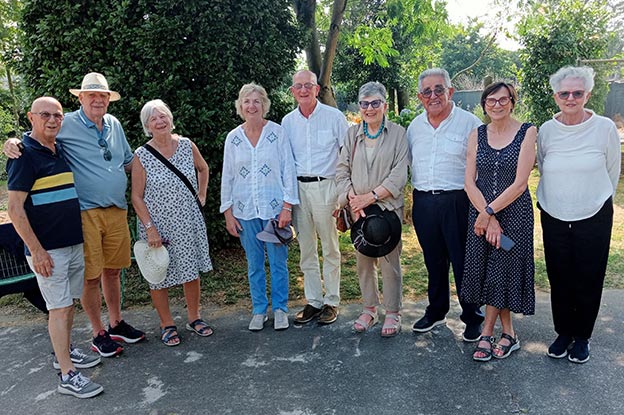
After meeting Gunner McCurdy’s daughters Rona Crane and Jeannie Hendra at Servigliano in September 2023, and after mentioning to them that I often collaborated with Prof. Zucca in researching the escapers in Lomellina, Rona and Jeannie and their respective husbands decided that it was time for a ‘boots on the ground’ investigation, so I Enzo and I accompanied them to meet Prof. Zucca in June this year.

As well as organising a visit to the Corciarino garage in Novara, where Gunner McCurdy and one of his fellow escapers had been kept hidden for two days by the Bacciagaluppi organisation, Prof. Zucca had managed to arrange a meeting with some inhabitants of the village of Morsella, whose forebears had been cited by Gunner McCurdy in his Escape Report as having helped him.


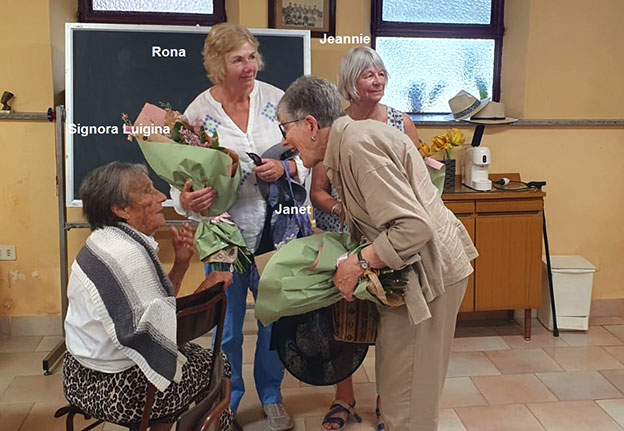
We received a cordial welcome in the community centre, with soft drinks for all and flowers for Rona, Jeannie, and me. Prof. Zucca gave a presentation describing our joint interest in prisoners of war, and I explained that we were looking for Luigi Moscara. At this a chorus of voices exclaimed in unison that a certain well-known character, Luigi Massara, more commonly known by the nickname ‘Mosca’, was likely to be the person we were interested in. He had been living at Casoni de’ Peri during the war.

Without knowing this beforehand, but making use of a contact he had made while researching Private Guiver, Prof. Zucca had already arranged for us to visit a small farmhouse in Casoni de’ Peri which belonged to a female member of the Manzini family—thinking that even if it wasn’t the actual house in which Gunner McCurdy had been given hospitality it would at least give the sisters some idea of what the property and its outbuildings (in which their father had been hidden under some old rags during a search by the Germans) might have looked like.
Back at home after the visit Prof. Zucca immediately requested a copy of Massara’s compensation claim and, unbelievably, it not only confirmed that he had indeed helped Gunner McCurdy but that Private Guiver was also one of the four escaped prisoners to whom he had given assistance!
One of the four was another soldier from the 2/5 Essex Regiment, Private Gordon Poulter, possibly a friend of Private Guiver’s. Private Poulter was almost certainly the companion with whom Gunner McCurdy had passed the two uncomfortable days above the Corciarino garage in Novara. A week after the recapture on 12 November of Private Guiver and Gunner Clarence Harold Baker, the fourth member of the ‘Mosca’ contingent, Private Poulter and Gunner McCurdy left Casoni de’ Peri for the station at Vigevano on bicycles provided by the Bacciagaluppi organisation.
Local agents working for the organisation had arranged their transfer by rail from Vigevano via Novara to Domodossola, where a group of twelve men eager to make the journey to Switzerland was constituted. On 24 November they were once more escorted by rail to the mountain village of Re, where they were given overnight accommodation in a Pilgrims’ Hostel run by nine nuns belonging to the order of the Suore di Maria Ausiliatrice. Rona and Jeannie managed to pay a visit to the erstwhile hostel, now an imposing-looking hotel. Their father had mentioned the nuns to his family, but it was only through Driver Albert Palmer’s escape report that the convent was traced to Re.
On the following day, the 25th of November, each man in the group was given a numbered form (formulario) by the Bacciagaluppi agent responsible. The ex-prisoner had to insert his name and military details on the formulario and hand it back to the agent before he set off for the Swiss border. The escapers continued on foot in twos without a guide.
(Note—the formulari can be consulted in the INSMLI Archive, Milan, Fondo Bacciagaluppi, Busta 2, Fascicolo 13, Final Report on the Activity of the CLNAI on behalf of Allied POWs.)
Gunner McCurdy and his partner (not identified, but possibly Private Poulter or Lance/Bombardier John Johnstone Livingstone), crossed into Switzerland on the 26th, arriving at Camedo, as did all the others in the group with the exception of Driver Palmer and South African Signalman Christian Aspeling, whose crossing was registered a day later. Of the twelve escapers, seven were known to have been held in either PG 146/19 Vigevano or PG146/18 Sforzesca (TNA WO 208 Escape Reports Switzerland), four were South Africans (three from PG 146/6 Ottobiano/San Giorgio Lomellina), and the twelfth was Driver Alfred George Deakin, for whom no Escape Report has been found but whose presence in Switzerland was registered in WO 32/9895. (See the list at the end of this article.)
Rona and Jeannie’s visit had been well worthwhile, but one thing remained to be discovered, possibly the most important as far as ex-prisoners sent from Servigliano to Lomellina are concerned. Whereabouts exactly was PG 146/19? After his examination of hundreds of escape reports, the late Brian Sims had identified the existence of two camps at Vigevano, 146/19 and 146/33. Detailed results of his research can be found on the Pegasus Archive. However, from my perusal of Escape Report summaries (WO 208) available online in the Discovery catalogue of The National Archives*, I found only one prisoner, Gunner Ralph Eric Byne, who had mentioned being held in PG 146/33 without giving it a name. Annoyingly, one ex-prisoner, Guardsman Alexander Gibson, 2 Scots Guards, gave the camp name as Calva, Vigevano, but omitted to give it a number. Fortunately, forty-nine ex-prisoners indicated PG 146/19 as their camp and named it Vigevano. Camp PG 146/19 was clearly the more important of the two.
*331.23 Records of the Allied Screening Commission (Italy) and its successor, the Prisoner-Of-War Claims Commission.
Initially Prof. Zucca had believed that PG 146/33, not PG 146/19, had been set up at La Calva, a large farm on the outskirts of Morsella. Indeed, when we visited the village, he said that he had never managed to find the precise location of PG146/19 and had excluded going to this farm. I looked again in my collection of escape report summaries and decided to request the report of Bombardier Alma Flamson Goodwin. Its online summary mentions La Calva, Vigevano without a number, and it is only in the report itself that we read that he had been held in PG 146/19 at Calva, Vigevano. The problem of the whereabouts of PG 146/19 has been resolved, though that of PG 146/33 remains a mystery.
The camp at La Calva had been mentioned on our visit to Morsella by a 94-year-old resident named Luigina, who recounted that some prisoners she knew who used to pass her chocolates through the wire had escaped from there after the armistice and had gone into hiding near Casoni de’ Peri.
Unfortunately, I only sent for Bombardier Goodwin’s Escape Report after Gunner McCurdy’s daughters had left Lomellina to follow their father’s route to Camedo. Whilst waiting for a response from The National Archives I consulted the online collect of Liberation reports now available on Ancestry. By inserting the research term ‘Agedabia’ and the date of capture ‘28 December 1941’ I turned up some references to Morsella. For example, the Liberation report of Driver Alan David Moon, RASC, states clearly that he was interned in camp PG 146/19 at Morsella, Vigevano. In addition, he names Gunner McCurdy as being one of the eight with whom he escaped into the woods following the September armistice.


Fortunately, Google Maps and Google Earth allow Rona and Jeannie to see La Calva, the precise location of which was indicated to Prof. Zucca by Germano, who had arranged our visit to Morsella.
If this online visualisation doesn’t entirely satisfy Rona and Jeannie, a further visit to Lomellina might be on the cards!
Escapers in the Group with Gunner McCurdy
British
Sub camp not known
T/191370 Driver Alfred George DEAKIN, Royal Army Service Corps
PG 146/18 Sforzesca
1102234 Gunner George Spencer WILDER, 74 Field Regiment, Royal Artillery – Formulario B1259
7630295 Private Frederick Arthur SIRETT, Royal Army Ordnance Corps – Formulario B1261
7880202 Trooper Leonard F. WILLIAMS, 4 Royal Tank Regiment, Royal Armoured Corps – Formulario B1262
PG 146/19 La Calva, Vigevano
951052 Driver Albert PALMER, 102 Royal Horse Artillery – Formulario B1260
6016256 Private Gordon POULTER, 2/5 Essex Regiment – Formulario B1263
1477901 L/Bombardier John J. LIVINGSTONE, Royal Artillery – Formulario B1265
1170062 Gunner Ronald Edmund McCURDY,122 Light Anti-Aircraft Regiment, Royal Artillery – Formulario B1266
South Africans
146/6 San Giorgio in Lomellina
105551 Signalman Christian ASPELING, South African Corps of Signals – Formulario B1264
1884 Private Arthur Ernest ARDERNE, Royal Durban Light Infantry – Formulario B1256
89687 L/Bombardier Malcolm Eric WOODLEY, South African Artillery – Formulario B1257
Sub camp wrongly specified
2752 Sapper Arthur BULLOUGH, South African Engineer Corps – Formulario B1258
 Camp 59 Survivors