Monthly Archives: August 2014

Swingler and Antognozzi Families United

Ham-and-High-14-Aug_r72

This news article from the London area Ham&High newspaper is provided by Anne Copley. It’s the touching story of a contact made between the family of POW Sydney Swingler, known to the Italians as “Antonio,” and his Italians protectors, the Antognozzi family.

Family trace Italians who sheltered their father from fascists
Brave peasants risked their lives to help soldier Sydney

By Tom Marshall
Ham&High, London, UK
hamhigh.co.uk

Thursday, August 14, 2014

The familes of a Second World War soldier from Kentish Town and the Italian peasants who risked their lives to save him have been united after 70 years.

The children of Sydney Swingler have made contact with the Antognozzi family, who protected their father for several months during the war, after an amateur historian and the Ham&High helped bring them together.

Sydney was among the thousands of fighters who fled prisoner-of-war camps after Italy signed an armistice with the Allies in September 1943, then took refuge with Italian peasants as the countryside remained in turmoil.

Delighted

He was sheltered by the Antognozzi family in the Italian village of Montelparo, where they still live, before eventually making it back across Allied lines and returning to his Kentish Town home.

Sydney’s son Colin Swingler, 64, one of four siblings born at the former family home in Highgate Road after the war, said he was delighted to make contact with the Antognozzi family, who had risked their lives to look after his father.

He said: “If the Germans or Italian fascists had found dad, they could have been killed along with him.
Continue reading

An Execution at Comunanza

cemetery-comunanza-1_r72

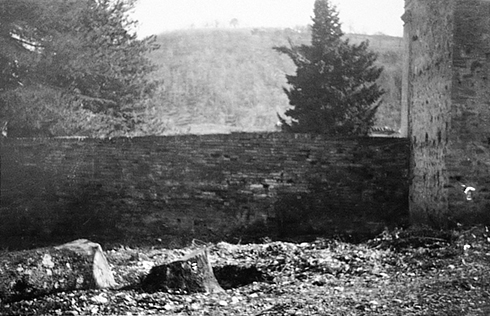
Exhibit G.4 in a report of the British military’s Special Investigation Branch inquiry into the execution of six servicemen at Comunanza, Italy, is captioned, “Photograph at Comunanza showing alleged scene of crime.”

cemetery-comunanza-2_r72

Exhibit G.2 is captioned, “Photograph showing position of Communal Grave where six deceased were originally buried.”

This post contains a draft report of the British Special Investigation Branch (SIB) into the deaths of six Allied servicemen (four English and two American) in Comunanza on May 2, 1944.

The creation of the draft followed an extensive investigation by the SIB. It traces a likely scenario of events that preceded the killings, and speculates on who the soldiers were.

After the draft report is an October 1944 special report of the Graves Registration Unit (GRU). The six bodies were removed by the GRU from the vault where they had been buried and carefully examined in an attempt at identification.

More information on the Comunanza incident and the activities of the Brandenburg Division will follow on this site. Once again I am grateful to researcher Brian Sims for drawing my attention to these and other important documents from the British National Archives.

See also “The Brandenburgers—War Crimes Investigations.”

The Draft Report

SECRET. DRAFT.

H.Q., ‘A’ Group, 60 Section.
Special Investigation Branch,
c/o A.P.M’s Office, 61 Area,
Central Mediterranean Forces.

SUBJECT:- Alleged War Crime against six allied escaped prisoners of war at COMUNANZA on 2 May, 1944.

Two of the deceased believed to be:
(a) No.2935269, Pte. GORDON, Charles.
(b) No.T/3052152, Dvr. DIDCOCK, James.

Continue reading

A Warning to German Officers and Men

The following letter from General H. R. Alexander to commanders and men of the German army is from the British National Archives.

Unfortunately, it is undated. However, as the last of the atrocities listed in it allegedly occurred on October 2, 1944, it is apparent the letter was written sometime after that date and before the end of the war in Europe.

My access to the document is courtesy of British researcher Brian Sims.

Here is the full text of the letter:

WARNING to German officers and men

By General Sir H. R. Alexander, Commander-in-Chief, Allied Armies in Italy.

1. Reports of atrocities – killings of hostages, mass reprisals against innocent civilians, torturings and the like – committed by German troops in Northern Italy are becoming daily more frequent.

2. I therefore call the attention to all German officers and men in Northern Italy, who otherwise might give or carry out orders to commit such atrocities, to the following:

3. The fact that in, for example, a certain village Italian patriots – whether or not wearing uniforms, arm-bands or other recognizable insignia – may have attacked German soldiers is not, according to the Jus Gentium or any other Legal or moral code, a justification for collective reprisals upon the population of the village, nor for the killing or persons without due legal trial and conviction.

Continue reading

Memorial to Rome Escape Line’s Sam Derry

derry-article-1

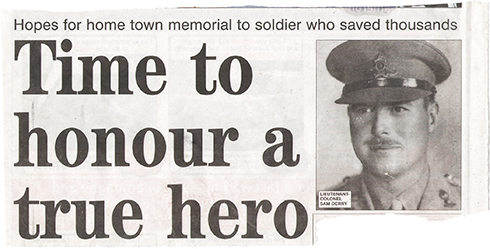
Recently my friend Brian Sims sent me an article that was published last year in the Newark Advertiser, which serves the UK’s Newark-on-Trent area.

The article describes a local interest in the establishment of a lasting memorial to Newark-born Lieutenant-Colonel Sam Derry, who, with Irish priest Hugh O’Flaherty, ran the escaped-POW rescue effort known as the Rome Escape Line out of the Vatican.

The Rome Escape Line rescue efforts were run independently of the I.S.9 rescue efforts, which were mainly conducted along the Adriatic coastline of Italy and east of the Apeninnine Mountains.

The following paragraph from the official I.S.9 history (see “I.S.9 History—Operations in Italy, Part 3“) in the British National Archives, confirms the minimal contact that existed between these two organizations:

“By far the most interesting outcome of our entry into ROME was gaining contact with the Escape Organization which had existed during the German occupation under the direction of Major S.I. DERRY (now Lt-Col. S.I. DERRY, DSO, MC, GS01, G-2 (P/W), AFHQ). This particular organization was easily the largest non-I.S.9 unit engaged in the care and maintenance and possible escape of E & Es. Although we were well aware of the existence of this organization, and had made successful attempts to gain contact during the German occupation, it was unfortunate that we were unable to encourage a closer connection in the early days. We sent an Italian officer courier into ROME and he returned with a reasonably accurate description of the situation, and had personally contacted Father O’FLAHERTY of the Vatican. We sent him back almost immediately, in an attempt to connect ourselves more closely with Major DERRY. Unfortunately, our courier was unable to obtain an interview with Major DERRY and was very naturally treated with suspicion. It was not until the final entry into the city and our contact with Major DERRY that we both realised the pity in that real contact was not established between I.S.9 and the Rome Escape Organization during the German occupation.”

Although the Newark Advertiser article mentions various possibilities for the memorial, Brian more recently told me the actual memorial will be a large painted portrait of Sam Derry, to be hung in the Newark Town Hall.

A dedication ceremony is being planned for this fall.

Continue reading