Monthly Archives: July 2013

Escapee Edmund Petrelli—An Obituary

Petrelli_r72

Several years ago, Mario Vacca attempted to discover what happened to the four men with whom his father, Felice “Phil” Vacca, escaped from Camp 59.

He sent one inquiry to New Haven, Connecticut.

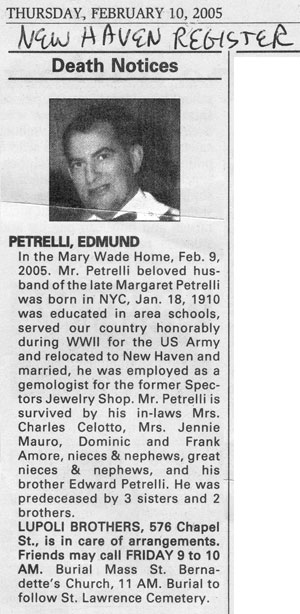
Mario explained, “A kind doctor from New Haven, Dr. E. Anthony Petrelli sent me a letter with Edmund’s obituary and it had a photo. It was only by coincidence that he had just received my letter and saw the obituary.”

New Haven Register
Thursday, Febuary 10, 2005

Death Notices

Petrelli, Edmund

In the Mary Wade Home, Feb. 9, 2005. Mr. Petrelli beloved husband of the late Margaret Petrelli was born in NYC, Jan. 18, 1910 was educated in area schools, served our country honorably during WWII for the US Army and relocated to New Haven and married, he was employed as a gemologist for the former Spectors Jewelry Shop. Mr. Petrelli is survived by his in-laws Mrs. Charles Celotto, Mrs. Jennie Mauro, Dominic and Frank Amore, nieces & nephews, great nieces & nephews and his brother Edward Petrelli. He was predeceased by 3 sisters and 2 brothers.
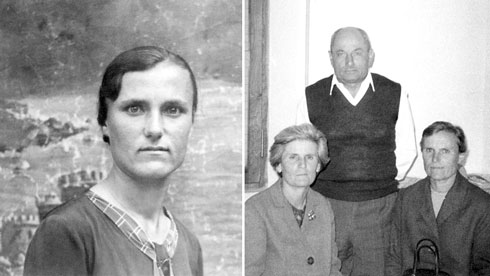
Continue reading

Post-war Letters from the Virgili Family

lelena_virgili-siblings_c72

Above left, Adele Virgili—also known as Lelena, or Lena
Above right, Virgili siblings Luigia (also called Gigetta) Sergio, and Adele (Lelena)

After his return from captivity in Italy, Felice “Phil” Vacca exchanged letters with several members of the Virgili family—the Italians who protected him after his escape from Camp 59. (See Felice “Phil” Vacca, Part 2—Camp 59 and Escape.)

These letters continued at least into the 1950s and 1960s.

In the first of two letters below, Virgili family matriarch Maria asks Phil about Giuseppe Montesi and Antonio Petrelli. Phil’s son Mario and I assume that Maria is in fact inquiring about Joe (whom the Italian family would have called Giuseppe) Mandese and Edmond Petrelli. Peter Calvagno, Edmond Petrelli, Joe Mandese, and Tony Spicola were the four prisoners with whom Phil escaped from Camp 59.

Continue reading

J. Keith Killby’s Memoir in Print

keith_killby_r72

J. Keith Killby, in his London flat, holds a copy of his memoir on the day the books arrived from the printer

The initial plan for publication of In Combat, Unarmed: The Memoir of a World War II Soldier and Prisoner of War goes back several years, when Keith’s nephew, Malcolm Angus, approached him about recording his story.

Malcolm lives in New South Wales, Australia. In the epilogue of the memoir, he writes of the challenging process of writing the book when he and Keith were separated by great distance:

“It is June 2011, two weeks before Keith’s ninety-fifth birthday.

“I am writing this epilogue under my uncle’s close direction in his London flat, where we have been hard at work revising and editing his memoir. I started work on his story some years ago, attempting to do so by Royal Mail from my home in Australia. This proved rather difficult, and so I decided to complete the memoir by his side. Knowing that I was planning the visit, he telephoned me and said, ‘You better hurry up!'”

Continue reading

Vacca Brothers—Tracing Their Father’s Trail

church_01_r72

Felice “Phil” Vacca attended services at this church with the Virgilis, even while the area was controlled by the Germans.

The church was the landmark that Tony used to find the Virgili family in 1968. He knew that it was just down the hill and across the river from the Virgili home, where his father had found shelter after his escape from Camp 59.

Continue reading

Felice “Phil” Vacca, Part 3—War’s End

This post is the third and final installment of the story of Camp 59 survivor Felice “Phil Vacca, which began with “Part 1—Off to War,” and “Part 2—Camp 59 and Escape.”

“We landed at Boston, Massachusetts, on August 2, 1944. From there we were shipped to Camp Upton, Long Island, New York. At that time we were given a thirty-day vacation. After 30 days, on August 31, 1944, I reported to Camp Butner, North Carolina, for duty.”

There was a rule in force at that time that forbade Ex-POWs from returning to the same theater of action once repatriated. The military had the choice of sending Phil to the Pacific theater or keeping him in the U.S. He became a guard at the White House.

wh_guard_r72

Phil standing guard in front of the Treasury Building, September 1945

“At that time I was picked out by Captain Minns, from the 250th Military Police (SP),” Phil explained, “[and we were] stationed at 17th and E behind the State Department in Washington, D.C. We had four machine guns—two that were located on the grounds in front of the White House near the Washington Monument, and one each on the East and West Wings.

Continue reading

Italians—Resist by Every Means!

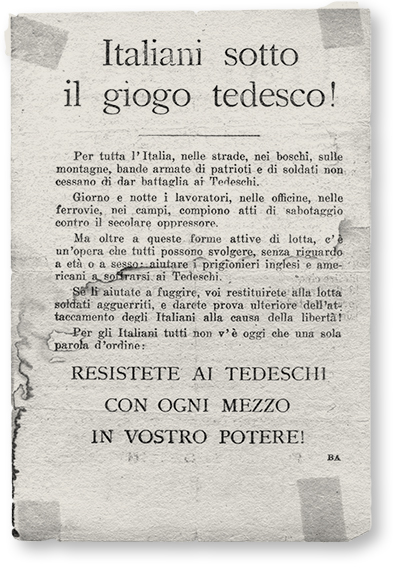
Mario Vacca shared the following leaflet with me.

His father, Felice “Phil” Vacca, an escapee from Camp 59, later described distribution of the leaflets over the Italian countryside:

“…American planes dropped [these] leaflets by the thousands in the area, offering 5,000 lire to any Italian who would help hide and care for the escapees. There were so many leaflets it looked as though it had snowed.”

Shown below are the leaflet’s front and back sides and translation into English.

leaflet_1_r72

ITALIANS UNDER THE GERMAN YOKE!

Throughout Italy’s roads, forests, and mountains partisan soldiers are in battle against the Germans.

Day and night from their shops, the railways, and fields, they continue to sabotage the oppressors.

Beyond their active struggle is work that everyone—regardless of age or gender—can do: help the English and American prisoners escape from the Germans.

Continue reading

Felice “Phil” Vacca, Part 1—Off to War

vacca_dress_unif_r72

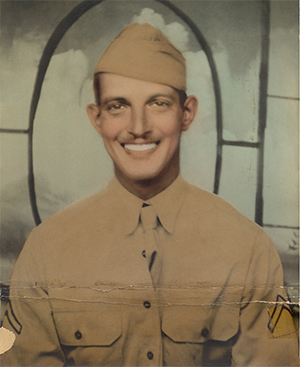
Private First Class Felice Vacca

I first heard about Felice “Phil” Vacca when his son Mario wrote to me last January:

“My father, Felice Vacca, escaped from PG 59 along with Peter Calvagno, Edmond Petrelli, Joe Mandese and Tony Spicola. I have visited the camp twice. I do have some history if you are interested.”

When I wrote back that of course I was very interested, Mario then sent me a long, detailed account of Phil’s experiences.

Mario had clearly invested a great deal of thought and effort into recording his father’s story. The format he chose was that of a scholarly research paper, complete with extensive footnotes, cross references to historical accounts of the war in North Africa (where Phil was captured), and links to web resources.

What I am posting here, with Mario’s permission, has been taken from that larger paper. Although I’ve removed the notes and references to external sources, the posts contain Phil’s full account of his experiences as well as additional details provided by Mario’s brother Jim.

Mario’s brother Tony was a resource for the paper, too. It was Tony who, when stationed in Italy during the 1960s, found the Virgili family—Phil’s protectors after his escape from Camp 59.

Continue reading

Felice “Phil” Vacca, Part 2—Camp 59 and Escape

5_escapes_r72

Phil Vacca escaped from Camp 59 with four other prisoners, shown in this photograph. At rear (left to right) are Peter Calvagno, Edmond Petrelli, and Joe Mandese. In front (left to right) are Tony Spicola, and Phil Vacca.

This post is the second installment of the story of Camp 59 survivor Felice “Phil Vacca, which began with “Part 1—Off to War.”

“In January of 1943, we were taken by passenger car to Rome, Camp P.G. 50. Approximately 20 of us American-Italians spent about a month there being interrogated. The questions they asked were the same as before (and they already had the answers to them). There was a German planted among us who spoke American English quite fluently. The interrogators were an Italian Calvary and Mountain Troops (The Alpine Post). While I was there, I saw Mussolini’s Arabian horse. It was a beautiful horse.

“Our group of American Italians remained together for the rest of our trip by passenger car to Camp P.G. 59.

“When we were captured, we had regular uniform on. We had our heavy coats, since the nights were cool, even in North Africa. After our arrival at our permanent camp, P.G. 59, we were given gray jackets with a red 4 x 4-inch patch on the right side of the back of the jacket. On the pants they had sewed on another 4 x 4-inch red patch between the knee and hip. They let us keep our uniform, except for the gray jacket, which was theirs.”

Camp P.G. 59 had wood frame buildings for barracks, with windows and two doors—one at each end of the building. The barracks were intact, but with no heat of any kind. The windows were open to the outside. Bugs and lice were plentiful.

“You’d go in for delousing and come out worse than when you went in.” Phil said. “We passed time with bed bugs and body lice.

Continue reading

More on Giovina Fioravanti

After I added the post on Giovina Fioravanti to the Camp 59 Survivors site this week, I heard from Joely Carter. Giovina is her husband’s grandmother. On her blog, iwishiwasalandgirl.wordpress.com, she has shared some personal reminiscences:

“My husband’s grandmother, Bella, has always been larger than life. A typical Italian matriarch, she is fiery and protective, and always wants to feed you! When I first met her around 7 years ago, I was struck by how beautiful and elegant she was, and couldn’t believe it when she told me she was 86! Bella is a term of endearment, her real name being Giovina Fioravanti. Originally, Bella aspired to be an actress however on the outbreak of World War II Bella volunteered her services to her country. Over the years, Bella has shared many stories with me, the most memorable being that during a boat crossing from Albania back to Italy, a Bulgarian man had taken a bullet for her using his body as a shield. When I first went to her house, I was proudly shown a certificate, which was hanging in the dining room. Bella explained that this was for bravery during the War, but never elaborated on what she had done to obtain this. It was always assumed that this was an award given to all Italians who played their part in the War.

Continue reading

A Heroine Recognized

giovina-2_r72

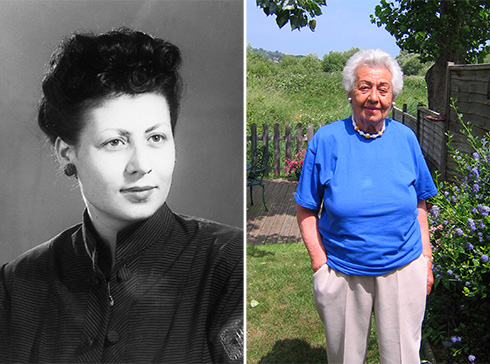
Giovina Fioravanti, circa 1940s, and a more recently photo on the Isle of Wight

I received an e-mail late last month from Isabelle Burberry on the Isle of Wight on the south coast of England.

She wrote, “I am in possession of the Certificate of Gratitude signed by Field-Marshall H.R. Alexander awarded to my Mother, Fioravanti Giovina. My Mother is extremely proud of said Certificate and would show it off to all and sundry even to this day. However, I was completely unaware of the story behind the Certificate until a search on the internet led me to your site.”

“I’m not really sure exactly what it was that my mother did, but presume it was to provide help. I know that she was with the Red Cross, and I seem to remember that she had been in Albania and was travelling back down from the North to the South of Italy to be reunited with her family.”

Giovina’s family lived about an hour south of Rome.

The certificates, signed by Field Marshal Harold Alexander, commander of Allied forces in Italy, were issued to a select group of Italians who had risked their lives to protect escaped British POWs and evaders (soldiers evading capture in enemy territory) during German occupation of their homeland.

Continue reading