Category Archives: Robert Dickinson

“Servigliano Calling” Camp Poem #2

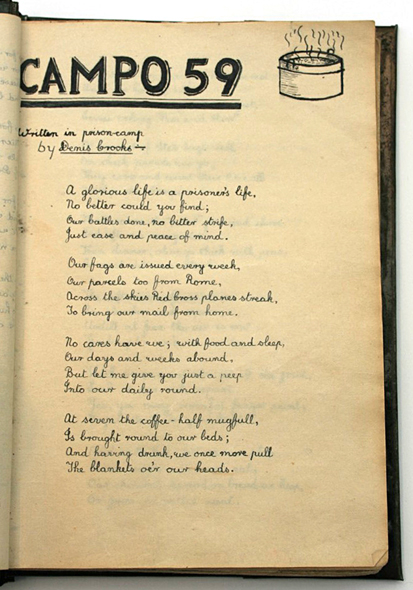
“Campo 59,” from Robert Dickinson’s diary, “Servigliano Calling,” is one of three poems by Robert’s friend Denis Crooks.

Campo 59

A glorious life is a prisoner’s life,
No better could you find.
Our battles done, no bitter strife,
Just ease and piece of mind

Our fags are issued every week,
Our parcels too from Rome.
Across the skies Red Cross planes streak,
To bring our mail from home.

No cares have we, with food and sleep
Our days and weeks abound.
But let me give you just a peep,
Into our daily round.

At seven the coffee, half mug full,
Is brought round to our beds.
And having drunk, we once more pull,
The blankets o’er our heads.

And there in peaceful bliss we rest,
Until the hour of nine.
When section sergeant as a jest,
Comes calling “rise and shine”.

At sound of Iti’s bugle call,
On check parade we go.
They come and count their P.G.’s all,
Within their Campio.

Continue reading

“Servigliano Calling” Camp Poem #1

Robert Dickinson’s amazing diary, “Servigliano Calling,” contains 34 poems written in camp by Robert’s fellow inmates during World War II. In the weeks ahead we will share all of these poems in individual posts.

This post contains one of the longer poems, “The Alphabet.”

The Alphabet

A is for “Aussi”, our “Comrades in Arms”
Who’ve left far behind them, their sheep and their farms.
Good fighters and jolly, the pick of fine men,
Who like their brave fathers are fighting again.

B that’s for British, now aren’t we all,
And to keep the flag flying soon answered the call.
We came in our millions to fight if we must,
For what we considered was true, right, and just.

C is for capture, a term that’s not nice,
But there’s always some who must pay the price,
We’ve all done our best and no ones to blame,
So don’t be downhearted, don’t think it a shame.

D reminds of Dunkirk, which all Germans say,
Was a farce, and that we ran away.
But twenty five Germans to each British three,
To my way of thinking, was our victory.

E is for eating, but sad to relate,
That term’s forgotten, we now masticate.
The meats is all gristly, the soups weak and thin,
And if we were at home, would go straight in the bin.

F is for freedom, so dear to our hearts,
But seems Oh! So distant in these foreign parts.
But freedom will come, have patience and smile,
Old Churchill himself said “its just for a while”.

Continue reading

“Servigliano Calling” Calendar of Events

Robert Dickinson kept a diary from November 23, 1941 to September 3, 1944—from the date of his capture by the Germans until six months before his death.

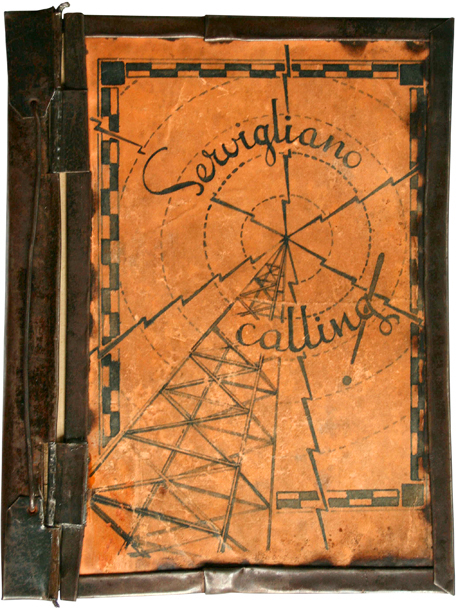
Robert titled his diary “Servigliano Calling.”

The diary chronicles Robert’s transfer from camp to camp, his escape, and his involvement with the Partisan resistance movement. In the diary, Robert details day to day activities and events at the Servigliano camp, including football matches, camp cooking recipes, mail and food parcels received, special holiday activities, and escape attempts. “Servigliano Calling” also includes drawings and poetry created by fellow prisoners.

Some time after the war, the diary was discovered during renovations to a farmhouse in Gassino, Italy—a house where the Partisans had hidden Robert—and it was returned to Robert’s family.

Parts of “Servigliano Calling” are shared here by Robert’s nephew, Steve Dickinson, who transcribed the calendar. The binding of the diary cover (shown above) is made from Cocoa tins. According to Steve, “Even to this day the diary has a slight aroma of Cocoa.”

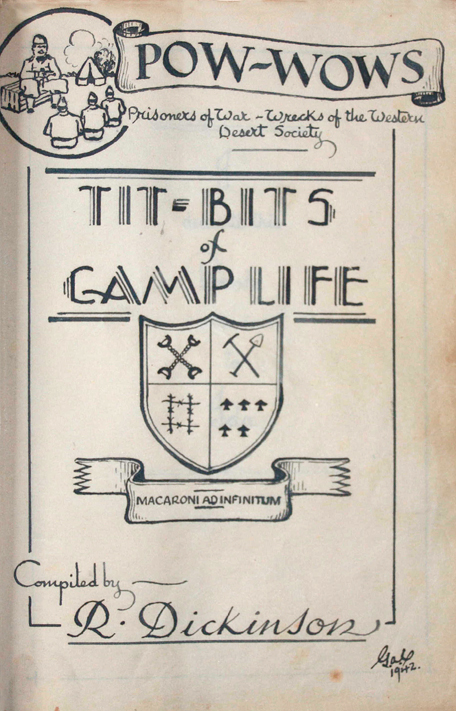
The page shown below is the diary’s title page.
This is a record of the main events which took place after my capture by the Germans near Gambut Aerodrome on Nov. 23rd 1941.

Nov 23rd
Captured by the Germans at 8:30 in the evening near Gambut Aerodrome about 12 miles south of Tobruk.

Nov 24th
Handed over to the Italians and joined up with approx 2,000 other prisoners, then transported to the ‘Pen’ a barbed wire enclosure about 50 miles from Tobruk, being bombed and shelled by our own forces on the way.

Nov 25th
Arrived Derna at 6 O’clock in the evening, still sleeping in the open without ground-sheet or blankets, rain and very cold.

Nov 26th
Arrived Benghazi prison camp at 5:30 in the evening feeling hellish hungry

Nov 27th
Letter card home and Red Cross

Nov 29th
Birthday, ½ mess tin of watery macaroni, ¼ tin of Bully (Iti) and 1½ rolls of bread

Nov 30th
Boarded a destroyer along with 100 officers and 150 men, split up from Pollard and most of the ‘Boys’, only 4 of us together now. Hellish night, believed to be chased by the ‘Navy’, everyone seasick.

Dec 3rd
Arrived Tripoli at 5 O’clock in the evening and taken in lorries to Tarhuna about 50 miles, arriving at midnight.

Dec 4th
Met 4 of the guys from the Battery and found they were captured 2 days before I.

Dec 5th
Hair cut right off!! and a shower bath, also blankets issued. Firsts nights sleep with any covering for a fortnight, but on a tiled floor no ground-sheet or mattress.

Dec 25th
Christmas Day, food just the same, bar for a lemon. Luckily I exchanged my cheap wallet for 20 cigs. Or else the boys and I would not have had a smoke.

Dec 26th
Forty of us taken to Castel Benito aerodrome and by plane at 2 O’clock in the afternoon and arrived at Trapani in Sicily at 5pm; from there taken to a new camp being erected; and found only one tent with 116 POW’s already in.

Dec 27th
Finished erecting the second tent and half of us move in, league of nations tent personel consists of Australians, New Zealanders, South Africans, 1 Indian (Sikh), 3 Polish, 2 Greeks, 2 Libyans and of course English; in all 72. Everyone talks in their own languages or dialects. What a row!!

Continue reading

News of Robert Dickinson’s Death

A letter was sent to the family of Robert Dickinson soon after Robert’s death in Italy by Varesio Vincenza. Her family had cared deeply for Robert, and this touching letter reflects that deep affection and their grief in losing him.

Following is a transcription of the letter:

17/6/45.

The scope of this letter is because of a sworn promise that I would send you news of your dear Robert. Unfortunately he is dead. He was killed by some ex fascists and Germans. He died on the 3rd March 1945. Dear Robert was seriously wounded in one of his legs but was able to draw himself as far as our village where his wounds were immediately attended to. He placed his machine gun and ammunition in a house from which he kept on firing right up to the last as a real warrior would do after which he took the smallest firearm and endeavoured to make his way to join his comrades, however, being wounded could no longer walk and because of firing against the Republic stayed near a small stream. All of a sudden he was surrounded by three ruffians who beat him to death. Poor Robert, whilst he could, he always called for his dear mother and family but no one could go to his help at that moment. When he died he was abandoned and he was eventually found by our partisans during the night when together with his friend, who was also killed, they were brought to a house and after a few days they were given a most honourable burial. His honour was very great. We cannot pray for him because we belong to a different religion, but this notwithstanding, I never miss to go to his grave every Sunday and place flowers on his grave.

The cemetery he is buried in is quite near to us. He has been placed in two coffins one of wood and one of zinc.

He always did his duty and always carefully listened to the advice of his officers, but destiny would be barbarously cruel to him. He told me a good many of his experiences. Now he is reposing and resting in peace. When his body was brought in I was able to wash him and clean him up. I have done so to a great many of the wounded. Robert did not seem to me he looked any different to when he was alive.

Do pray for him and always remember him because he was really good and a great warrior. To be able to write all about Robert it would take me a book. Many, many times he came to our house and have happy days but the Fascists would kill him. Now he rests in peace and do pray for him because he was such a good lad.

With kindest regards and with deepest sympathy

I am
VARESIO VINCENZA
PIEMONTE.

Robert Dickinson Killed in Action

After his escape from Camp 59, gunner Robert Dickinson of the Royal Artillery spent time with an Italian family in Gassino in northern Italy. He joined the Partisans in October 1944, and fought with them against the German army until March 3, 1945, when he was mortally wounded. This article from the August 25, 1945 Lincolnshire Chronicle provides details of his death.

Robert Dickinson Taken Captive

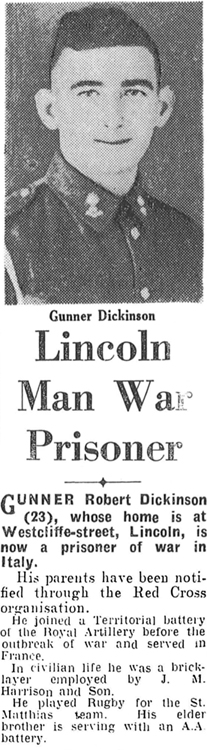
Robert Dickinson joined the Royal Artillery in 1938. Following the outbreak of the war, he saw action in France and the Middle East. He was taken captive in Libya in November 1941 and was sent to Camp 59 in January 1942.

A letter to Robert’s family from the “Officer in charge of Records” confirmed his POW status, and on February 20, 1942, an article in the Lincolnshire Echo provided the local community with news of Robert’s captivity.