Category Archives: Robert Dickinson

Robert Dickinson’s Last Letter

rbtdickinson_150

Robert Dickinson at home.

This letter from Robert to his brother Jim and Jim’s wife Olive must have been sent after September 1944, as the breakout from Camp 59 was on September 14, 1943, and Robert writes that he has not been a POW for over a year.

Jim must have been glad to receive the letter, as he had not been in contact with Robert since he left camp.

Eve, who is mentioned, is Olive’s sister. Known in the family as Auntie Eve, she turned 90 in 2008.

Ida was Robert’s girlfriend. It is to Ida that he dedicated his journal, “Servigliano Calling.” Had Robert returned home, he and Ida would likely have married.

Continue reading

Robert’s Calendars

dickinson_diary_angle_2001

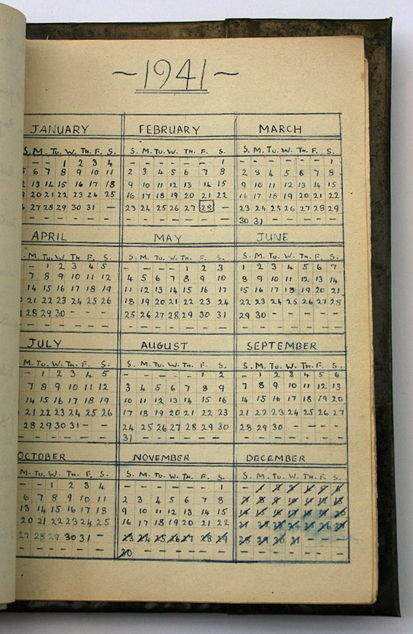
calend_1941_r150

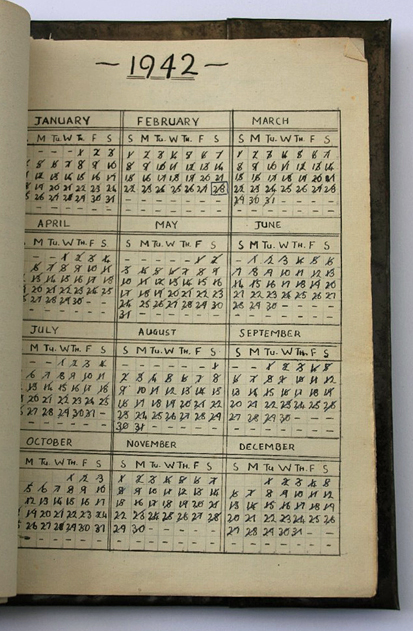
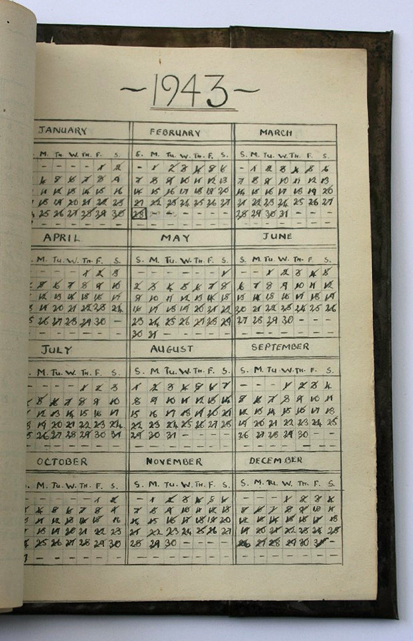
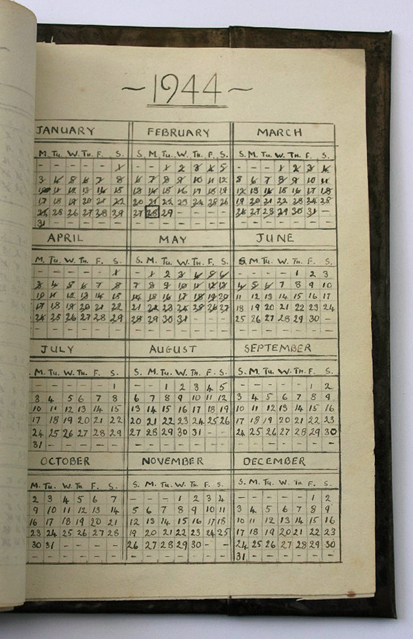
calend_1942_r150 calend_1943_r150 calend_1944_r150

The last few pages of Robert Dickinson’s journal, “Servigliano Calling,” contain calendars for the years 1941–44. Each of these calendars is meticulously drawn and accurate; the 1944 calendar includes February 29th, as it was a leap year.

On each of the four calendars one date has a heavy outline, February 28—Robert’s sweetheart Ida’s birthday. Robert’s journal entry for February 28, 1944 reads:

“Feb 28th—Ida’s Birthday; Oh for a letter.”

The strikes-throughs marking each passing day begin on Sunday, November 23rd, the day Robert was captured by the Germans. The last strike was through June 6, 1944. But, curiously, Robert continued to record daily events in his journal through September 3, 1944. Why did he decide to stop marking out the days?

His entry for the last struck-though date is:

“Jun 6th—The invasion is on; news of big landings in France!!”

“Servigliano Calling” Camp Poem #9

dickinson_diary_angle_2001

“To Mother and Dad” is one of three poems by Denis Crooks recorded in Robert Dickinson’s diary, “Servigliano Calling.”

mother-dad_r150

To Mother and Dad

All my thoughts are for you, dear Mother and Dad,
And I dream of you both day and night;
Our our little white home
And the old sitting room,
And the things that are now gone from sight.

Of a night spent at home by the old fireside
With the wireless, a book and you two,
Of all the good things
And all the kind love
That you’ve always given me too.

And I pray every night to the good God above
To comfort you, not make you sad;
That one day quite soon
He’ll send me back home
To old England, my Mother and Dad.

“Servigliano Calling” Camp Poem #8


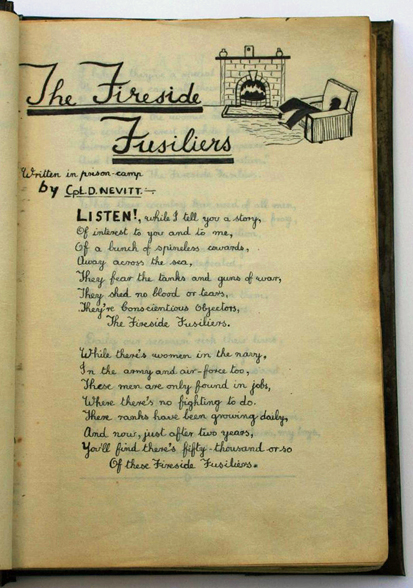
This poem is one of eight by Cpl. D. Nevitt recorded in Robert Dickinson’s diary, “Servigliano Calling.”

The Fireside Fusiliers

LISTEN!, while I tell you a story,
Of interest to you and to me,
Of a bunch of spineless cowards,
Away across the sea,
They fear the tanks and guns of war,
They shed no blood or tears,
They’re Conscientious Objectors,
The Fireside Fusiliers.

While there’s women in the navy,
In the army and air-force too,
These men are only found in jobs,
Where there’s no fighting to do
There ranks have been growing daily,
And now, just after two years,
You’ll find there’s fifty-thousand or so,
Of these Fireside Fusiliers.

I believe they’ve a special medal,
It’s one they can call their own,
Painted a bright gleaming yellow,
Designed by the women at home,
Its centre’s a crest of white feathers,
Surrounded by cold feet, it appears,
And their motto “Self-preservation,”
That’s the Fireside Fusiliers.

While their country has need of all men,
On “religious grounds”, keep from the fray,
And despite the serious position,
Enjoy home-comfort each day,
When Jerry has been defeated,
They’ll flourish their souvenirs,
Then tell you how they won them,
These Fireside Fusiliers.

Daily our seamen risk their lives,
To bring their rations through,
For remember there’s fifty-thousand,
Not just one or two,
But when this war is over,
You can regard these men with sneers,
For you’ve done your bit, and theirs, my boys,
The Fireside Fusiliers

“Servigliano Calling” Camp Poem #7


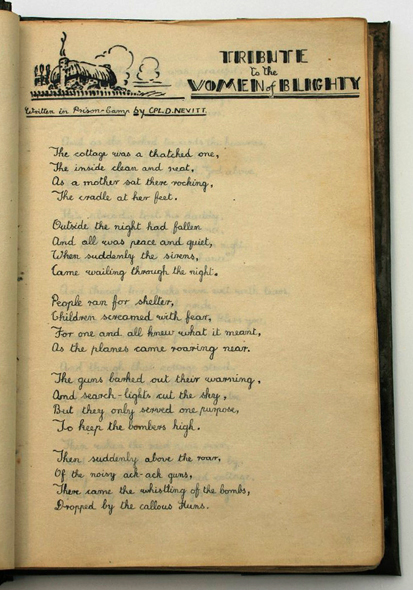
This touching poem by Cpl. D. Nevitt reflects on the bravery and sacrifice of the women of Blighty (England) through the story of one widow’s loving protection of her baby. The poem is from Robert Dickinson’s diary, “Servigliano Calling.”

Tribute to the Women of Blighty

The cottage was a thatched one,
The inside clean and neat,
As a mother sat there rocking,
The cradle at her feet.

Outside the night had fallen
And all was peace and quit,
When suddenly the sirens,
Came wailing through the night.

People ran for shelter,
Children screamed with fear,
For one and all knew what it meant,
As the planes came roaring near.

The guns barked out their warning,
And search-lights cut the sky,
But they only served one purpose,
To keep the bombers high.

Then suddenly above the roar,
Of the noisy ack-ack guns,
There came the whistling of the bombs,
Dropped by the callous Huns.

In the cottage all was peaceful,
And at the bottom of the stairs,
Knelt that mother with her baby,
As she softly said her prayers.

And as she looked towards the heavens,
Her eyes shone full of faith,
As she softly murmured, “God above,
Please keep my baby safe.

He’s already lost his daddy,
For he gave his life in France,
So if I should get killed this night,
Please give my child a chance.”

And though her cheeks were wet with tears,
Her voice was full of pride,
As she whispered may God Bless you,
And the bombs still fell outside.

And though that cottage stood,
Outside the town, alone,
A bomb crashed through the centre,
Of that peaceful little home.

Then when the raid was over,
And the bombers had passed by,
They searched that ruined cottage,
And they heard a baby’s cry.

They found her ’neath the ruins,
That poor young soldiers wife,
For her dead and battered body,
Had saved her baby’s life.

So when you go in action,
And you feel somewhat afraid,
Just think of what the women stand,
In any big air-raid.

“Servigliano Calling” Camp Poem #6


This clever poem, an ode to the Camp 59 dog, is one of six by C.A. Hollis recorded in Robert Dickinson’s diary, “Servigliano Calling.”

The Neutral

He’s not of any army, he has no need to kill,
His is the freedom of the prison, he comes and goes at will,
No cheering at advances, no worries of retreats;
It matters not, if he’s a coward, or performs heroic feats.

He’s the friend of captor and captive, of both he has no fear,
He just walks disdainfully, if either clip his ear.
No rations is he issued, his meals are bits and scraps,
And when he’s feeling tired, most anywhere, he knaps.

And when this war is over, his life will be the same,
He cares not who’s the victor, or who deserves the blame.
He’s a neutral in this conflict—this world engulfing bog,
He’s one of man’s greatest friends, just a homely dog.

This poem was inspired by Old Bob the camp dog.

The Christmas Ship

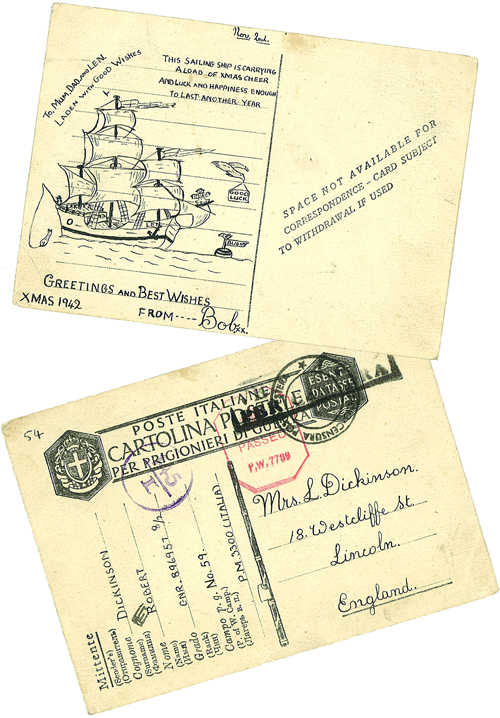
This Christmas postcard, sent from Camp 59 by Robert Dickinson to his parents and young brother Len, reads:

Nov. 2nd.

“To Mum, Dad, and Len.
Laden with Good Wishes

“This sailing ship is carrying
A load of Xmas cheer
And luck and happiness enough
To last another year

“Greetings and Best Wishes
From—Bob.xx.

“Xmas 1942”

Robert’s ocean scene is full of happy detail. Wind fills the sails of the ship, named Len, and sends it on it’s merry way toward “Blighty” (a nickname for Britain). A gull carries a sign that reads “Good Luck” as it sails on a breeze overhead. One sailer, playing an accordion, balances on the bowsprit. Another, with broad-brimmed hat, lands a fish at the back of the ship.

Continue reading

“Servigliano Calling” Camp Poem #5

On August 4, 1942 Robert Dickinson wrote in his diary:

“A new invention in the camp ‘a Blower’. Denis has got cracking and has made lots of improvements and now we have a blower. Affair of wheels and belts and a fan. Turn the wheel slow and get about 1000 revs a minute, guaranteed to burn charcoal (other peoples embers), socks and even sawdust.”

In the drawing above this poem, an ode to the evening “brew,” by Cpl. D. Nevitt, a camp cookstove, or ‘blower,’ is shown in remarkable detail.

The Brew,
it must go through

I have passed some weary times,
Trying hard to make up rhymes,
But now I think I’ve found one that will do;
It’s about a thing we say
Every evening, every day,
That’s our motto: “The Brew, it must go through.”

Every night there can be seen,
’Tween the wall and hut thirteen,
Scores of men all kneeling down, and what a crew,
There they waft and there they blow,
Private, sergeant, W.O.
Never mind the rank, the brew it must go through.

If H.Q. could only see
Those sergeant-majors on one knee,
They would cry “what is our army coming to”?
If they had one scoop per day,
I’m sure that they would say,
“Most decidedly, the brew it must go through.”

There are patent fire cans,
Ovens, stoves and frying pans,
And they’ve even got a new invention too;
It’s a belt-propelled affair,
Wails and whines, and blows out air,
And all because the brew it must go through.

But the fuel’s very poor,
Old socks, cardboard, even straw,
But we do get wood sometimes, it’s true;
But if we use much more;
We’ll be sleeping on the floor,
But even then the brew it must go through.

Men have suffered many times
For this noblest of all crimes
And they’ve had to pay a lot of lire too,
So raise your brews and drink
To those martyrs in the clink,
And the toast is to the brew that must go through.

“Servigliano Calling” Poem #4

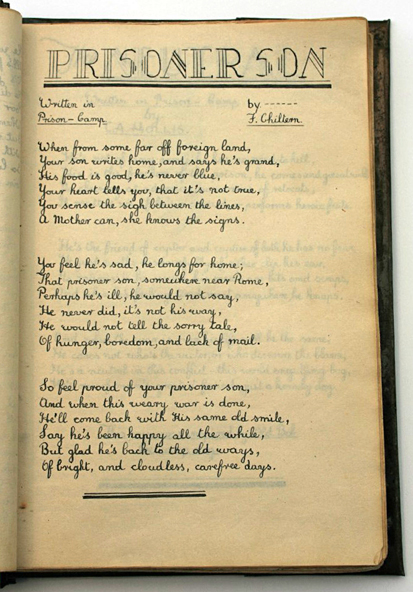
F. Chiltern is represented by this single poem in Robert Dickinson’s diary, “Servigliano Calling.”

Prisoner Son

When from some far off foreign land,
Your son writes home, and says he’s grand,
His food is good, he’s never blue,
Your heart tells you, that it’s not true,
You sense the sigh between the lines,
A mother can, she knows the signs.

You feel he’s sad, he longs for home;
That prisoner son, somewhere near Rome,
Perhaps he’s ill, he would not say,
He never did, it’s not his way,
He would not tell the sorry tale,
Of hunger, boredom, and lack of mail.

So feel proud of your prisoner son,
And when this weary war is done,
He’ll come back with his same old smile,
Say he’s been happy all the while,
But glad he’s back to the old ways,
Of bright, and cloudless, carefree days.

“Servigliano Calling” Camp Poem #3

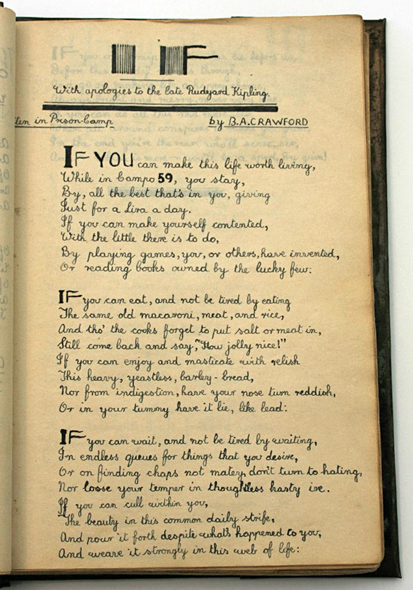
“If” is one of two poems by G. A. Crawford that are recorded in Robert Dickinson’s journal, “Servigliano Calling.”

IF

(With apologies to the late Rudyard Kipling)

IF YOU can make this life worth living,
While in Campo 59, you stay.
By, all the best that’s in you, giving,
Just for a Lira a day.
If you can make yourself contented,
With the little there is to do.
By playing games, you, or others have invented,
Or reading books owned by the lucky few.

IF you can eat, and not get tired by eating,
The same old macaroni, meat and rice.
And tho’ the cooks forget to put salt or meat in,
Still come back and say “How jolly nice”.
If you can enjoy and masticate with relish,
This heavy, yeastless, barley-bread.
Nor from indigestion, have your nose turn reddish,
Or in your tummy have it lie, like lead.

IF you can wait, and not be tired by waiting,
In endless queues for things that you desire.
Or on finding chaps not matey, don’t turn to hating,
Nor loose your temper in thoughtless hasty ire.
If you can cull within you,
The beauty in the common daily strife.
And pour it forth despite what’s happened to you
And weave it strongly in this web of life.

IF you can grasp what vistas lie before us,
Before the “ruddy” war is through.
And go on making life a happy chorus,
Always bright and merry, never very blue.
If you can do all this and more, sir,
When all around conspires to make you glum.
In the end you’re the man who’ll score, sir
And—which is more—you’ll be a sport, By gum!