Category Archives: Prisoners—Camp 59

“Servigliano Calling” Camp Poem #5

On August 4, 1942 Robert Dickinson wrote in his diary:

“A new invention in the camp ‘a Blower’. Denis has got cracking and has made lots of improvements and now we have a blower. Affair of wheels and belts and a fan. Turn the wheel slow and get about 1000 revs a minute, guaranteed to burn charcoal (other peoples embers), socks and even sawdust.”

In the drawing above this poem, an ode to the evening “brew,” by Cpl. D. Nevitt, a camp cookstove, or ‘blower,’ is shown in remarkable detail.

The Brew,
it must go through

I have passed some weary times,
Trying hard to make up rhymes,
But now I think I’ve found one that will do;
It’s about a thing we say
Every evening, every day,
That’s our motto: “The Brew, it must go through.”

Every night there can be seen,
’Tween the wall and hut thirteen,
Scores of men all kneeling down, and what a crew,
There they waft and there they blow,
Private, sergeant, W.O.
Never mind the rank, the brew it must go through.

If H.Q. could only see
Those sergeant-majors on one knee,
They would cry “what is our army coming to”?
If they had one scoop per day,
I’m sure that they would say,
“Most decidedly, the brew it must go through.”

There are patent fire cans,
Ovens, stoves and frying pans,
And they’ve even got a new invention too;
It’s a belt-propelled affair,
Wails and whines, and blows out air,
And all because the brew it must go through.

But the fuel’s very poor,
Old socks, cardboard, even straw,
But we do get wood sometimes, it’s true;
But if we use much more;
We’ll be sleeping on the floor,
But even then the brew it must go through.

Men have suffered many times
For this noblest of all crimes
And they’ve had to pay a lot of lire too,
So raise your brews and drink
To those martyrs in the clink,
And the toast is to the brew that must go through.
The POW Cook Stove

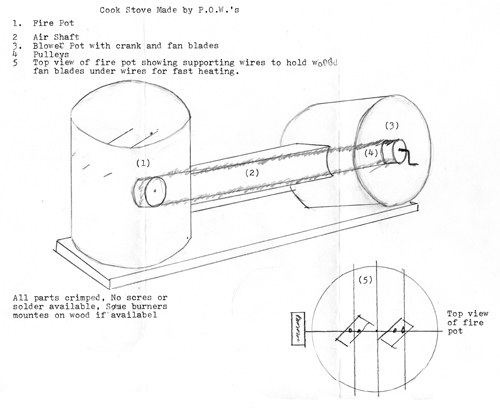
In March of this year, ex-POW Neil Torssell sent me this diagram of a handmade Camp 59 cook stove. He labeled the parts of the stove: 1) fire pot, 2) air shaft, 3) blower pot with crank and fan blades, and 4) pulleys. Sketch 5 is a top view of the fire pot, showing supporting wires to hold the wood and fan blades under the wires for fast heating.

All parts were crimped together, he explained, as screws and solder were not available. Some of these burners were mounted on wood—when wood was available.

Continue reading

An Interview with Neil Torssell

I interviewed Neil Torssell over the phone on May 13, 2008. He had agreed in advance to my taping him. At first, I suggested we might do a series of shorter conversations. However, once we got started he was sharp and eager to talk and in one hour and 45 minutes he covered the whole of his service experience—from enlistment to discharge!

I’m pleased to post this fascinating interview here. My questions for Neil and comments are shown in italic.

Enlistment and Training

Tell me what unit you joined, how you trained, and how you came to go overseas.

“I wasn’t drafted—I enlisted in September 1940, before the draft started.

“I went into the service to learn more about photography. The recruiters knew that the draft was coming up and they didn’t care where they sent you. So they sent me to 322nd Signal Aviation Company, which is communications. I didn’t find that out until I got up to Selfridge Field, Michigan.

“After I took basic training, I transferred over to the 3rd Air Base Group at Selfridge Field—to the photo section there. That was the time when I got up in grades from private to private first class, then corporal, and then sergeant.

“Things were going pretty good. I’ll probably skip a lot of details here because they’re not significant. After the war was declared in 1941, my group got transferred down to South Carolina—Florence, South Carolina to be exact. I was with the 3rd Air Base Group still. We were there for a few months and then we were moved up to Wilmington, North Carolina.

“From there I flew in a couple of missions—submarine control in B-25s—as a photographer. At that time the Army Air Force wasn’t well-equipped. On the B-25s I was back where the camera was and the guns were two wooden sticks.

Continue reading

Roland Rakow’s Story

This narrative is by Staff Sgt. Roland V. Rakow, a crewmember of the 83rd Squadron, 12th Bomb Group of the United States Army Air Force. It describes the mission on September 1, 1942 when his plane was shot down.

The narrative also covers the events that followed—his capture, POW experience, escape from camp, and finally his return home.

In compiling this account, Sgt. Rakow drew on his personal experiences, as well as information from Capt. Croteau, as relayed in correspondence by the captain’s wife to Sgt. Rakow’s mother.

83rd Squadron, 12th Bomb Group (M), 9th United States Army Air Force
Attached to the British 8th Army—based at Ismailia, Egypt—El Alamein

The Crew

Pilot
Capt. Hubert P. Croteau—Prisoner of War in Germany
Army Serial No. 0-404012

Co-Pilot
2nd Lt. Irving Biers—Prisoner of War in Germany
Army Serial No. 0-659064

Navigator
2nd Lt. Robert J. McPartlin—Killed in Action—El Alamein
Army Serial No. 0-659067

Bombardier–Nose Gunner
2nd Lt. Thomas F. Archer—Killed in Action—El Alamein
Army Serial No. 0-850959

Top Turret Gunner
Staff Sgt. Leonard George Andersen—Killed in Action—El Alamein
Army Serial No. 57030832

Radio Operator–Lower Turret Gunner
Staff Sgt. Roland V. Rakow—Prisoner of War in Italy
Army Serial No. 16004997

The Mission

“On September 1, 1942, as our B-25 was returning from its second completed mission—dropping its bomb load on tanks, trucks and troops on the front line at El Alamein—it was struck by a German anti-aircraft 88 mm shell on the left side of the aircraft, adjacent to the top turret gun position. The shell made a gaping hole, which caused the aircraft to break open and go into a 30-or 40-degree dive.

[See further details of the crash on a later post, Roland Rakow’s Story—An Update.]

“After the aircraft was hit, I looked for a way of escape and found the gaping hole where the shell had hit. After some effort, since the aircraft was in a dive, I bailed out at the hole. Before exiting, I looked for Sergeant Andersen. He should have been adjacent to the hole, as this was the location of the top turret gun. I could only conjecture that he had been blown out of the aircraft when the shell hit.

“I bailed out and waited a few seconds, then felt for the ripcord—but I couldn’t find it. Frantically, I tried to locate it and finally found it, almost completely behind my back.

“With my last energy, I pulled the cord. The parachute opened with a jerk. My left arm became so entangled in the parachute’s lines I sustained a compound fracture of the left clavicle. I had no control of the chute before hitting the ground, my face down. There was a strong wind as I landed. The parachute ballooned and dragged me approximately 300 feet, until German soldiers came and stopped me from being dragged farther.

“Lt. Archer and Lt. McPartlin were unable to leave the aircraft and died in the crash. Capt. Croteau, Lt. Biers, and I parachuted to the ground. We landed in separate locations. Each of us sustained wounds and injuries.

Continue reading

Christmas Card of the 12th Bomb Group

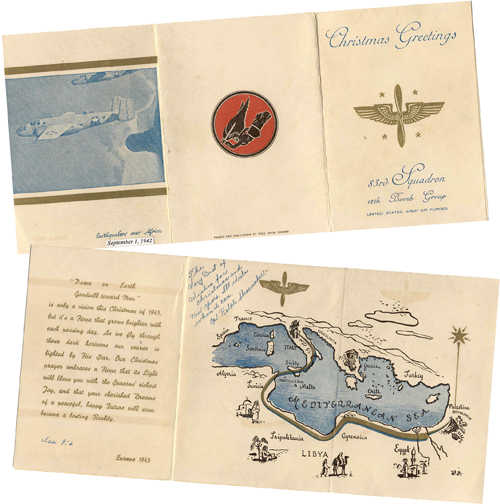
Roland Rakow received this Christmas card from his comrade Cpl. Ralph Shoemaker at Christmastime 1943. It had been a little over a year since Roland’s return to the States after his escape from captivity.

Cpl. Shoemaker, a member of the maintenance crew of the 83rd (Roland’s squadron), served with that unit until the end of the war. Roland kept in touch with him since the war, until Shoemaker passed away last year.

The front of the card reads: “Christmas Greetings, 83rd Squadron, 12th Bomb Group, United States Army Air Force”; in the center is a propeller with wings and four stars in gold.

The British Eighth Army, with essential support from the USAAF 12th Bombardment Group (known as the “Earthquakers”), had pushed Gen. Erwin Rommel’s Afrika Korps from North Africa and pursued them northward into Europe.

Continue reading

Roland Rakow Returns

The following 1942 news item was clipped from the Chicago Tribune.

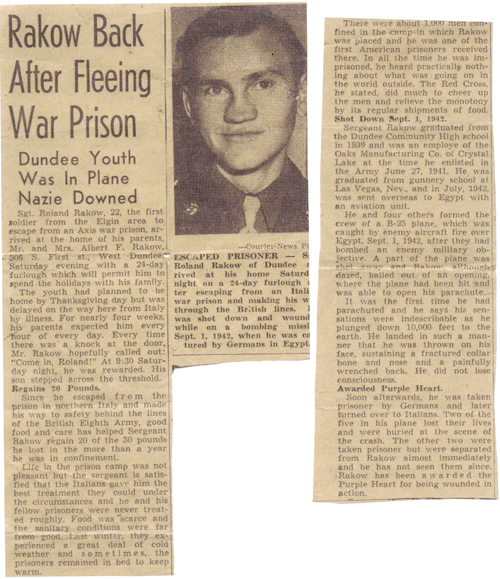
Rakow Back After Fleeing War Prison

Dundee Youth Was In Plane Nazie Downed

Sgt. Roland Rakow, 22, the first soldier from the Elgin area to escape from an Axis war prison, arrived at the home of his parents, Mr. and Mrs. Albert F. Rakow, 506 S. First st., West Dundee, Saturday evening with a 24-day furlough which will permit him to spend the holidays with his family.

The youth had planned to be home by Thanksgiving day but was delayed on the way here from Italy by illness. For nearly four weeks, his parents expected him every hour of every day. Every time there was a knock at the door, Mr. Rakow hopefully called out: “Come in, Roland!” At 9:30 Saturday night, he was rewarded. His son stepped across the threshold.

Regains 20 Pounds.

Since he escaped from the prison in northern Italy and made his way to safety behind the lines of the British Eighth Army, good food and care has helped Sergeant Rakow regain 20 of the 30 pounds he lost in the more than a year he was in confinement.

Continue reading

Roland Rakow, MIA

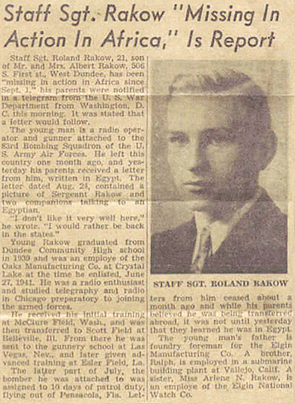
The following news clipping is likely from the Elgin Courier News, published in Elgin, Illinois, near Roland Rakow’s boyhood home of West Dundee.

The article would have appeared in the paper in September 1942.

Staff Sgt. Rakow “Missing In Action In Africa”
Is Report

Staff Sgt. Roland Rakow, 21, son of Mr. and Mrs. Albert Rakow, 506 S. First st., West Dundee, has been “missing in action in Africa since Sept. 1.” his parents were notified in a telegram from the U.S. War Department from Washington, D.C. this morning. It was stated that a letter would follow.

The young man is a radio operator and gunner attached to the 83rd Bombing Squadron of the U.S. Army Air Forces. He left this country one month ago, and yesterday his parents received a letter from him, written in Egypt. The letter dated Aug. 24, contained a picture of Sergeant Rakow and two companions talking to an Egyptian.

I don’t like it very well here,” he wrote. “I would rather be back in the states.”

Young Rakow graduated from Dundee Community High school in 1939 and was an employee of the Oaks Manufacturing Co. at Crystal Lake at the time he enlisted, June 27, 1941. He was a radio enthusiast and studied telegraphy and radio in Chicago preparatory to joining the armed forces.

He received his initial training at McClure Field, Wash., and was then transferred to Scott Field at Belleville, Ill. From there he was sent to the gunnery school at Las Vegas, Nev., and later given advanced training at Esler Field, La.

The latter part of July, the bomber he was attached to was assigned to 10 days of patrol duty, flying out of Pensacola, Fla. Letters from him ceased about a month ago and while his parents believed he was being transferred abroad, it was not until yesterday that they learned he was in Egypt.

The young man’s father is foundry foreman for the Elgin Manufacturing Co. A brother, Ralph, is employed in a submarine building plant at Vallejo, Calif. A sister, Miss Arlene N. Rakow, is an employe of the Elgin National Watch Co.

“Servigliano Calling” Poem #4

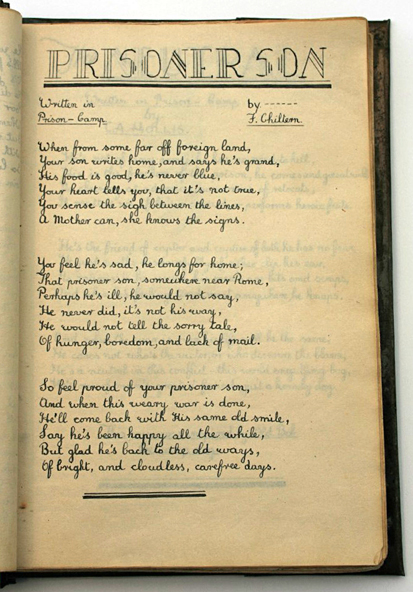
F. Chiltern is represented by this single poem in Robert Dickinson’s diary, “Servigliano Calling.”

Prisoner Son

When from some far off foreign land,
Your son writes home, and says he’s grand,
His food is good, he’s never blue,
Your heart tells you, that it’s not true,
You sense the sigh between the lines,
A mother can, she knows the signs.

You feel he’s sad, he longs for home;
That prisoner son, somewhere near Rome,
Perhaps he’s ill, he would not say,
He never did, it’s not his way,
He would not tell the sorry tale,
Of hunger, boredom, and lack of mail.

So feel proud of your prisoner son,
And when this weary war is done,
He’ll come back with his same old smile,
Say he’s been happy all the while,
But glad he’s back to the old ways,
Of bright, and cloudless, carefree days.

“Servigliano Calling” Camp Poem #3

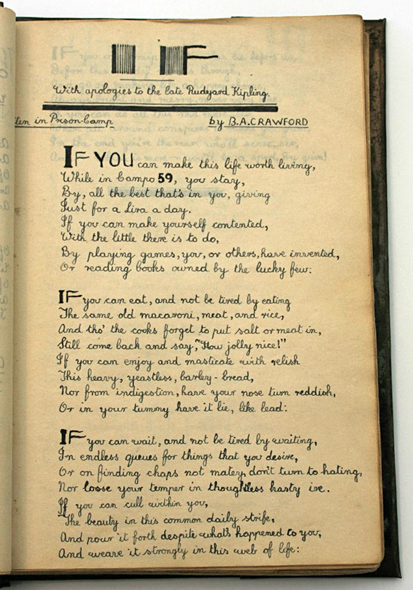
“If” is one of two poems by G. A. Crawford that are recorded in Robert Dickinson’s journal, “Servigliano Calling.”

IF

(With apologies to the late Rudyard Kipling)

IF YOU can make this life worth living,
While in Campo 59, you stay.
By, all the best that’s in you, giving,
Just for a Lira a day.
If you can make yourself contented,
With the little there is to do.
By playing games, you, or others have invented,
Or reading books owned by the lucky few.

IF you can eat, and not get tired by eating,
The same old macaroni, meat and rice.
And tho’ the cooks forget to put salt or meat in,
Still come back and say “How jolly nice”.
If you can enjoy and masticate with relish,
This heavy, yeastless, barley-bread.
Nor from indigestion, have your nose turn reddish,
Or in your tummy have it lie, like lead.

IF you can wait, and not be tired by waiting,
In endless queues for things that you desire.
Or on finding chaps not matey, don’t turn to hating,
Nor loose your temper in thoughtless hasty ire.
If you can cull within you,
The beauty in the common daily strife.
And pour it forth despite what’s happened to you
And weave it strongly in this web of life.

IF you can grasp what vistas lie before us,
Before the “ruddy” war is through.
And go on making life a happy chorus,
Always bright and merry, never very blue.
If you can do all this and more, sir,
When all around conspires to make you glum.
In the end you’re the man who’ll score, sir
And—which is more—you’ll be a sport, By gum!

“Servigliano Calling” Camp Poem #2

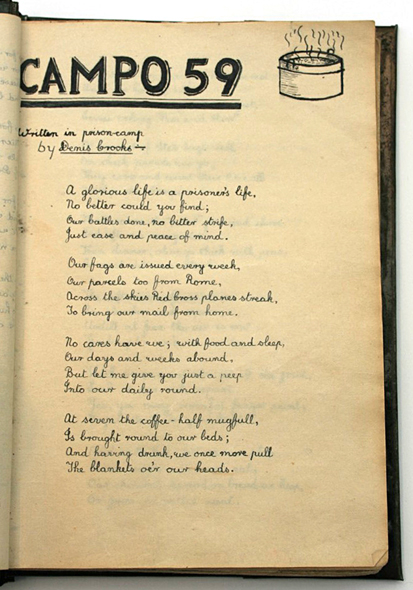
“Campo 59,” from Robert Dickinson’s diary, “Servigliano Calling,” is one of three poems by Robert’s friend Denis Crooks.

Campo 59

A glorious life is a prisoner’s life,
No better could you find.
Our battles done, no bitter strife,
Just ease and piece of mind

Our fags are issued every week,
Our parcels too from Rome.
Across the skies Red Cross planes streak,
To bring our mail from home.

No cares have we, with food and sleep
Our days and weeks abound.
But let me give you just a peep,
Into our daily round.

At seven the coffee, half mug full,
Is brought round to our beds.
And having drunk, we once more pull,
The blankets o’er our heads.

And there in peaceful bliss we rest,
Until the hour of nine.
When section sergeant as a jest,
Comes calling “rise and shine”.

At sound of Iti’s bugle call,
On check parade we go.
They come and count their P.G.’s all,
Within their Campio.

Continue reading