Category Archives: Prisoners—Camp 59

Camp 59 Poets

Bernard Petrulis’s story in the previous post ends with the poem “Prisoner Son,” which is one of the poems recorded in Robert Dickinson’s journal and presented on this site as “Servigliano Calling” Poem #4.

In Robert’s journal, F. Chiltern is credited for the poem.

The poem is also recorded in Edward Smith’s book of poems, and there, too, it is credited to F. Chiltern.

Alan Petrulis wrote that the poem “came from a small notebook full of poems in my father’s hand. I had thought he may have written them in camp but I was very apprehensive about ever attributing them to him.

“My father’s book contained nine poems: Unholy Conflict, Prayer of a Soldier, Wishful Thinking, Doubtful Future, Prisoner Son, In a Desert Outpost, Far Away Dream, Tribute to Women in an Air Raid, and The Gunner.”

Some of these poems are in Robert’s journal.

Of the nine poems, “In a Desert Outpost” is in G. Norman Davison’s notebook. And although “Prisoner Son” is recorded in Norman’s notebook—yet a fourth appearance of the poem—there the title of the poem is “Diplomacy” and the author is F. Chilton (not Chiltern).

Norman recorded an address for F. Chilton in his notebook:

F. Chilton
8, Alfred Road
Sheffield

This is Norman’s mate Fred Chilton. The two were sent to North Africa on the same boat, were captured together in Libya in April 1940, and were transferred from camp to camp together, eventually ending up in Camp 59. After their time in Servigliano, the men were sent to separate camps and, after escape from their respective camps, both made their way north to freedom in Switzerland. They were later reunited in their hometown of Sheffield. The story of the friendship is recounted in Norman’s memoirs, In the Prison of His Days.

There are more poems in Norman’s book: “A Point We All Agree,” “Ten Little Foreign Lands,” “A Little Toast to Love,” “Reflections of A P.O.W.,” and “A Tribute to The Women of Blighty.”

Of these, “Reflections of a P.O.W.” is the same poem as “Reflections” in Robert’s journal (though the poem is a slight variation).

“A Tribute to the Women of Blighty” is also in Robert’s journal. Again, some of the wording is different.

These poems convey so freshly and intimately the prisoner-poets’ longing for home and loved ones, pride in country, and feelings about war and the experience of captivity that it is a moving experience to read them again so many years after the war.

The Story of Bernard Petrulis

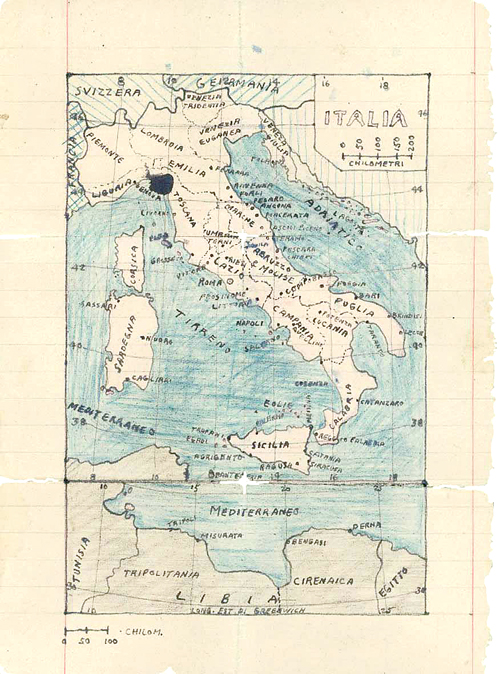
This map was drawn by Camp 59 prisoner Bernard Petrulis. According to his son Alan, “The scale would seem to make it impracticable but it was bundled with the poems and letters my father took with him when he escaped.”

The fascinating story of Pfc. Bernard Petrulis is available on the Metropolitan Postcard Club of New York City blog, maintained by Alan Petrulis.

As you arrive at the site, scroll down to the entry entitled “The Long Trail Through Bari.”

Many thanks to Anne Copley for having discovered this site.

“Servigliano Calling” Poem #21

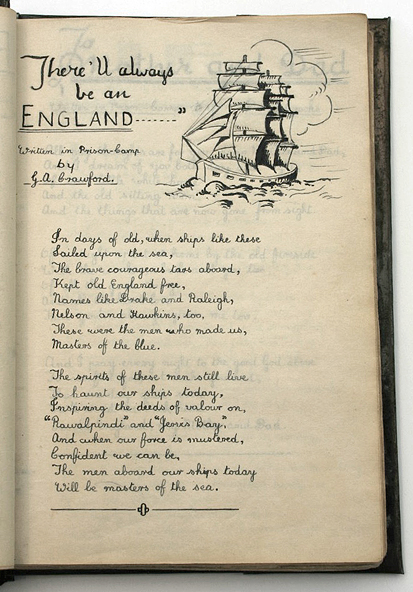
“There’ll always be an England….” by G.A. Crawford is one of two works by this soldier-poet in Robert Dickinson’s journal, “Servigliano Calling.”

We know G.A. Crawford to be George A. Crawford of London, as Robert recorded his address in the book.

There’ll always be an England….

In days of old, when ships like these
Sailed upon the sea,
The brave courageous tars aboard,
Kept old England free,
Names like Drake and Raleigh,
Nelson and Hawkins, too,
These were the men who made us,
Masters of the blue.

The spirits of these men still live
To haunt our ships today,
Inspiring the deeds of valour on,
“Rawalpindi” and Jeori’s Bay”,
And when our force is mustered,
Confident we can be,
The men aboard our ships today
Will be masters of the sea.

Arnold Chessell in Africa

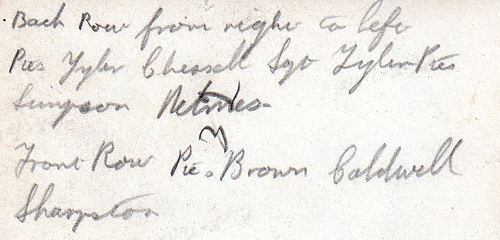
This photo from Roger Chessell is of his dad and fellow members of the British Royal Army Medical Corps.

As noted on the back of the photo, the fellows are:

Back Row from right to left
Ptes [Privates] Tyler Chessell Sgt Tyler Ptes Simpson Nelmes
Front Row Ptes Brown Caldwell Sharpston

Arnold Chessell’s Portrait from Camp 59

This photo of Arnold Chessell was sent to me by his son Roger Chessell of Lincoln, UK. Writing on the back suggests that it was taken in Camp 59 and sent home to England, perhaps as proof of his captive status:

FROM:
CHESSELL
ARNOLD
PRE No 7264690. HUT 8.
CAMPO P.G. NO. 59. PM 3300
(ITALIA)

Arnold Chessell served in the Royal Army Medical Corps (R.A.M.C.) of the British Army.

Roger wrote of his father that “Like most men of that period he didn’t give us much detail about his war experiences, but he did say that he was captured in Tobruck [Libya] and ended up in a P.O.W. camp.” That camp was, of course, Italian P.G. 59.

Roger continued, “He told us a story that he was one of many that had walked out of the camp during the 24 hour period between the Italians leaving and the Germans arriving.”

Arnold’s medical records indicate that he had been bayoneted at some point in time.

His army records indicate that he was missing and believed a P.O.W. on December 12, 1941, identified by the International Red Cross as a P.O.W. on February 2, 1942, and repatriated to 15 F.H.S. (Field Hygiene Section), which was based in Alexandria, Egypt, in June 1943.

This last date of June 1943 seems an error, as the mass escape from Camp 59 occurred three months later, in September 1943. However, Arnold’s story of walking out of camp before the German’s arrived to take control fits the Camp 59 escape episode.

Edward Smith of the Buffs

Rodney Smith’s grandfather E. G. Smith, served in the British Buffs regiment during WW II. He was captured in North Africa and thereafter was transferred from prison camp to prison camp for a period of over two years.

He was in Camp 59 from December 30, 1942 until he was transferred the following February to Camp 53 (Sforzacosta).

At Servigliano he was housed in Hut 10—Bed 1158.

Here is a timeline of his internment in various camps:

Capua—from January 2, 1941
Behgasi—from December 17, 1941
Tripoli—from December 23, 1941
Camp 59, Servigliano—from December 30, 1942
Camp 53, Sforzacosta—from February 24, 1943
Camp 82, Laterina—from April 8, 1943
Camp 72—from April 19, 1943

He was repatriated from Italy on June 6, 1943.

Rod owns a book of poems and drawings that his grandfather compiled while in Camp 59.

Interestingly, the poems Rod typed out and sent to me are ones that also appear in Robert Dickinson’s journal, “Servigliano Calling.”

The poems and authors are:

“Army Slang”
By C. G. Hooper Rogers and A. Forman

“ENGLAND”
By D. Crooks

“A Prisoner Son”
By F. Chiltern

“Escarpment Escapade”
by Cpl. D. Nevitt

Jack Davies’ First Aid Book

Jack Davies is another of the 20 men whose addresses are recorded in Robert Dickinson’s “Servigliano Calling” journal:

Jack Davies
11. Clent Avenue. Maghull.
Off Dods Lane. Liverpool.

I heard from Lorraine McLoughlin in October of last year. She wrote:

“I am just writing, with much excitement I must say, to find that I have information about POW Jack Davies of Camp 59.

“My mother was Jack’s daughter-in-law.

“Jack’s son, Rick Davies, was my mum’s (Ivy Davies nee Hindley) first husband.

“My mum is now 94 years of age but still remembers nursing her father-in-law, Jack, at 11 Clent Avenue, Maghull, before he died.”

A second note from Lorraine, two months later, informed me that her mother had passed away in early December.

Lorraine kindly shared scans of the covers of Jack’s St. John’s Ambulance First Aid Book. She wrote that it “was obviously with Jack during his time at the camp—as it has the camp address in the back cover.”

The inscription reads:

Davies
John
Pte 7597368
Campo P.G. No 59 3 Secttro 3 A/34
PM 3300. ITALIA

Jack was in the RAOC (Royal Army Ordnance Corps), a corps of the British Army that dealt exclusively with supply and maintenance of weaponry, munitions and other military equipment.

Memories of Fred Druce


Fred looking very dapper on his motorbike in the desert, presumably before his capture and imprisonment in Italy.

Fred Druce was one of 20 POWs whose addresses are listed in Robert Dickenson’s prison camp journal, “Servigliano Calling”:

Frederick Druce
Sunny Side. New Road. Tyler’s Green.
High Wycombe. Bucks.

Many thanks to Anne Copley of Oxford, UK, for having found information on Fred Druce for me.

Anne’s inquiry to the Penn and Tylers Green blog, a site dedicated to news about Fred’s home village, yielded two photos of Fred and some amusing stories about Fred in his youth.

For some unknown reason his nickname was “Wedger.”

Here are the comments:

“Knowing his personality as a teenager when he was a ‘bit of a lad’, I can understand why he was a successful evader.”

“You are right about Wedger being a character, I can remember him and a friend, standing up in the swing boats at Penn Fair and working them way past the horizontal position. Also, I believe, he took on one of the professional boxers who used to challenge all comers at the fair.”

“I’m afraid I can’t add much to the facts about Fred Druce but oh what memories it brings back of such a character. As a kid delivering vegetables for my Uncle Bob Long in the 1950’s from his market garden up near Penn Church I used to stand listening to Wedger who was a gardener nearby. My young eyes popped out of my head as I learnt swear-words that I’d never heard before and was told endless unbelievable tales. Thank you writers for reminding me of happy days long before political correctness was invented.”


In later years—Fred Druce and his wife Betty at a wedding dinner.

Frederick Solberg 2009 Video Interview

Frederick Solberg, World War II veteran and a POW of Camp 59 and Stalag 17B, was filmed by the nonprofit Stoneham Theatre (Stoneham, Massachusetts) in 2009.

The short film was one of a series of interviews with “Greatest Generation” veterans from the Boston area shown in conjunction with the theatre company’s production of Studs Terkel’s The Good War: A Musical Collage of WWII.

While on a bombing mission during the war, Frederick’s plane was shot down. He and his companions were captured by the Italian forces. They were interrogated and then imprisoned in Camp 59.

After three months in camp, Frederick and two comrades “went over the fence.”

They roamed Italy for three months, assisted by sympathetic Italians. In winter the men were recaptured by Germans and sent to Stalag 17B (Krems, Austria). Near war’s end, the POWs were liberated by American forces.

Link to this excellent Interview with Frederick Solberg on YouTube.

Sadly, Frederick passed away earlier this month. I’m pleased to honor and remember him on our site with this video.

Luther Shields Recognized for Service

Sometimes recognition for meritorious service is quick, and sometimes it comes unexpectedly after a long passage of time.

For Luther Shields, much delayed honor came last October at in a Vista Grande Inn ceremony in Cortez, Colorado. He was presented with a half-dozen medals earned during World War II.

Read the story, WWII vet finally awarded medals 60 years after serving country, in the Cortez Journal online.

Also, several posts on Luther’s fascinating escape story are available on this site.