Category Archives: Prisoners—Camp 59

“Servigliano Calling” Poem #33


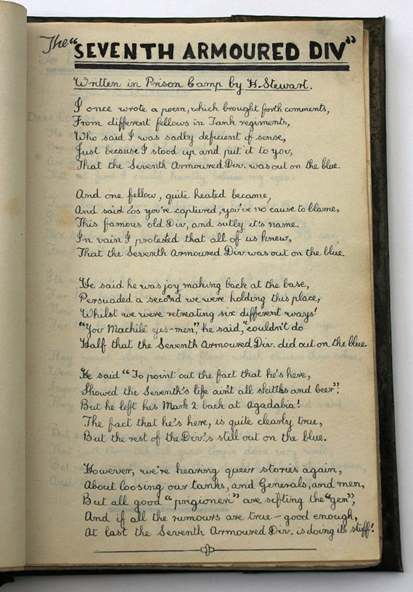
This poem by H. Stewart is a rousing defense of the reputation of the British Army’s Seventh Armoured Division. The division was known as the “Desert Rats” and its mascot—a red jerboa—is displayed on its insignia.

“The ‘Seventh Armoured Div’” is one of three poems by Harry Stewart in Robert Dickinson’s journal, “Servigliano Calling.”

The “Seventh Armoured Div”

I once wrote a poem, which brought forth comments,
From different fellows in tank regiments,
Who said I was sadly deficient of sense,
Just because I stood up and put it to you,
That the Seventh Armoured Div. was out on the blue.

And one fellow, quite heated became,
And said ’cos you’re captured, you’ve no cause to blame,
This famous old Div., and subtly its name,
In vain I protested that all of us knew,
That the Seventh Armoured Div. was out of on the blue.

He said he was joy-making back at the base,
Persuaded a second we were holding this place,
Whilst we were retreating six different ways!
“You Machilé yes-men”, he said, “couldn’t do
Half that the Seventh Armoured Div. did out on the blue.”

He said “To point out the fact that he’s here,
Showed the Seventh’s life ain’t all skittles and beer”;
But he left his Mark 2 back at Agadabia!
The fact that he’s here is quite clearly true,
But the rest of the Div.’s still out on the blue.

However, we’re hearing queer stories again,
About loosing our tanks, and generals, and men,
But all good “prigioniere” are sifting the “gen”,
And if all the rumours are true—good enough,
At last the Seventh Armoured Div. is doing its stuff!

Note: The phase “all good ‘prigioniere’ are sifting the ‘gen'” seems to mean that the attentive prisoners are weighing incoming information about the war.
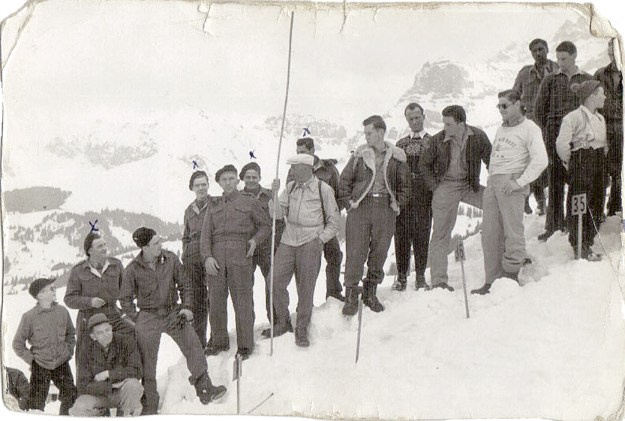
British Rifleman Robert Smith

Carole Procter—who lives in Berkshire, England—provided this information about her uncle Bob.

On the back of this photo are date and place: April 5, 1944. Adelboden. Gilback Ski-jump, Switzerland. Also recorded are the names Sera, Ginger, and Bill. Carole says her uncle Bob is the second one from the left with a cross over his head. Presumably Sera, Ginger, and Bill are (left to right) beneath the other three crosses. According to Carole, “‘Ginger’ was probably a nickname—people with red hair get called that over here!”

“My uncle, Rifleman 6142045 Robert Smith, was a prisoner in this camp. I have 10 postcards written by him, the first six being from Campo 59 written to his sisters, one of whom was my mother who died in 2005.

“Robert was always know as Bob.

“The first date on the postcards is August 5, 1942 and the last is December 23, 1942. The next postcard is dated July 31, 1943 and the address is Lavoro Base No. 133/xvii. PM3100. He is still there on July 4, 1943, but a card dated August 15, 1943 he says he is in a new camp–No.133/iii.

“I know that my uncle escaped from a camp and managed to get to Switzerland where he was in Adelboden—certainly in July and August 1944—and I have photos of him there with other soldiers. It was discovered that he had TB and was transferred to Laysin. I have photos of him there dated March 18, 1945.

“He eventually came home and sadly died in 1950 of TB. He was 30 years old. I was three when he died and have only very vague memories of him—he was also my godfather.

“Bob was born in South Shields, County Durham, in 1919 and his family moved to Surrey in the south of England in the early 1930s. I think he enlisted at the beginning of the war. I have photos of him in Egypt in 1940, but I don’t know where or when he was captured. He was in the King’s Royal Rifle Corps. He was the ‘baby’ of the family and very close to my mother, which is why she kept his letters and photos I think.

“I have also found a letter to my grandmother from a George William Beer dated July 23, 1943 saying he was with Bob in Campo 59 for two years but has now been moved and wants Bob to know he is OK. He is in a working camp getting double rations and Sundays off!”

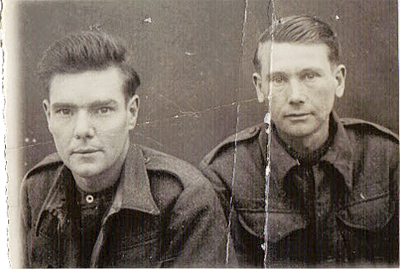
Of this photo, Carole says, “On the back is my grandmother’s name and address and then Robert Smith. Rifleman 6142045. Campo PG No 59. PM 3300 Italia—all hand written in capital letters. I don’t know if this photo was taken in the camp or before he was captured, but it certainly looks as if it was sent from there.” Robert is on the left. We don’t know the identity of the other fellow.

Safe in Switzerland

Information for this post was provided by Carole Procter of Berkshire, England.
Bob Smith was her uncle.

Interned in Switzerland

The Herald (A paper serving the borough of Epsom and Ewell in Surrey, England)
January 25, 1944

“Mrs. M. Smith, Tonstall-road. Epsom, has received letters from her son Robert, who was one of the British prisoners who escaped from an Italian prisoner of war camp a few weeks ago.

“Robert Smith, aged 24, managed to reach Switzerland, where he has been interned. In a letter to his mother he wrote last December: ‘I can only say it is the best Christmas I have had in the Army. The Swiss people of this village made donations for the food, and the officers fixed everything else up. We had turkey, ham and everything that goes with it, including beer and fags. Don’t forget my bob on the Derby next year, and I am betting I will be there to see and collect it. I am treating myself to a rolled gold watch while I am here, and it is a pretty good one, too. We go to the pictures every week here, and there is also a wireless in the billet. The weather here is not too bad. We have been having snow.’

Continue reading

“Servigliano Calling” Poem #32

This is another of Cpl. D. Nevitt’s eight poems in Robert Dickinson’s journal.

Like several of the corporal’s other poems, “Escarpment Escapade” is a ballad of an event during the war.

Escarpment Escape:
An account of the June encounter

The dawn broke clear and crimson,
With a halo of golden rays,
As the Tommies woke up early,
For this was a day of days.
Today the “Wops” and “Jerries”,
Were to get a big surprise,
And not a pleasant one at all
By the look in those soldiers’ eyes.

At zero hour the trucks moved off,
Arcoss the yellow sand,
The sight they made, dispersed for miles,
Was nothing short of grand.
The men all joked as usual,
And sang any old refrain,
Although they knew that some of them
Would ne’er see dawn again.

They stopped, at last, to let the tanks
Wake Jerry from his bed,
He didn’t get hot coffee that morn,
But hot lead instead.
For above the roar of artillery.
Came the Besa’s deadly rattle,
And the men slide on their bayonets,
Then charged into the battle.

Continue reading

“Servigliano Calling” Poem #31


This humorous poem gives a revealing peek into daily prison camp life—and behavior!

It is one of three poems by H. Stewart in Robert Dickinson’s journal, “Servigliano Calling.”

It wouldn’t quite do for the Ritz!

I’ve noticed since being “prigioneri” here,
That manners have gone by the board,
One often sees things done, quite coolly, that which
As a civvy one would have abhorred.
And really, we ought to remember these things,
Or one day our folk will have fits,
It hardly would do for the Berkeley, old boy,
It wouldn’t quite do for the Ritz!

To sit down to dinner without any shirt,
Is a habit of ours, I’m afraid,
And cleaning our teeth in a dixie of stew
And shouting rude words on parade.
You should say to the man eating lemons next door,
As pips in your coffee he spits,
It hardly would do for the Berkeley, old boy,
It wouldn’t quite do for the Ritz!

Continue reading

“Servigliano Calling” Poem #30


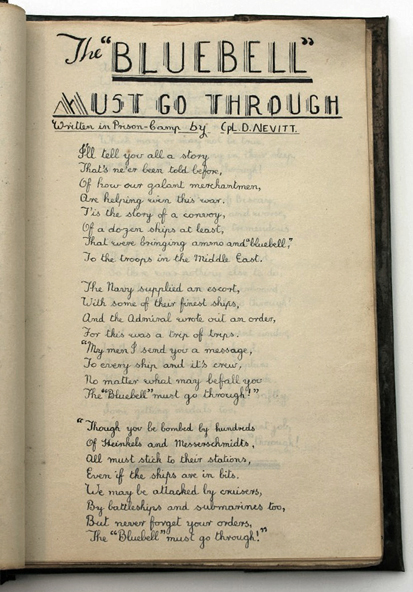
“The ‘Bluebell’ Must Go Though” is one of eight poems by Cpl. D. Nevitt recorded in Robert Dickinson’s prison camp journal.

The “Bluebell” Must Go Through

I’ll tell you all a story
That’s ne’er been told before,
Of how our gallant merchantmen,
Are helping win this war.
T’is the story of a convoy,
Of a dozen ships at least,
That were bringing ammo and the “bluebell”,
To troops in the Middle East.

The Navy supplied an escort,
With some of their finest ships,
And the Admiral wrote out an order,
For this was a trip of trips.
“My men I send you a message,
To every ship and its crew,
No matter what may befall you
The ‘Bluebell’ must go through!”

“Though you be bombed by hundreds
Of Heinkels and Messerschmidts,
All must stick to their stations,
Even if the ships are in bits.
We may be attacked by cruisers,
By battleships and submarines too,
But never forget your orders,
The “Bluebell” must go though!”

Continue reading

“Servigliano Calling” Poem #29


This gem of a poem is one of four by A. Forman (including one he co-authored with C. G. Hooper-Rogers) in Robert Dickinson’s “Servigliano Calling.”

The title of this poem plays on the popular idiom “If wishes were horses, beggars would ride,” meaning that wishing for or wanting a thing is not the same as getting it.

If Wishes were Horses

The Red Cross came to our prison camp,
To hear complaints and such.
Two thousand voices spoke at one,
Resulting in “plain Dutch.”

But with the help of interpreters;
Pro-Iti’s not the word,
He made some sense of all our din,
And this is what he heard.

Our first complaint was breakfast,
We miss our ham and eggs,
And by the time our lunch is up
We’re knock-kneed round the legs.

And then ten-thirty seems the time
For team fruit-cakes, and buns,
The tea we’ve got, so send the rest
Big, fat, and well baked ones.

Continue reading

“Servigliano Calling” Poem #28


“‘Gonna’ Win,” is one of six poems by C. A. Hollis recorded in Robert Dickinson’s “Servigliano Calling” journal.

“Gonna” Win

When you’re feeling blue,
And you don’t know what to do,
And prison life to you seems such a bore.
When you’re feeling out of sorts—
Making hasty, bad retorts,
Just remember, that we’re gonna win this war!

Though you’ve lost your place in battle,
And you’re penned in just like cattle,
And your pride has been battered pretty raw.
Though you haven’t got your guns,
You’re still old Britain’s Sons,
And remember, that we’re gonna win this war.

You have done your little bit,
Though you didn’t make a hit,
Your pals are sure to add it to their score.
So lay a double bet,
It’s victory they will get,
For aren’t we going to win this bloomin’ war?

And someday you will find,
When you’ve left this life behind,
And the “Wops” have shown you where’s the door.
That you’ll say to your sons,
The new Brittanic ones,
Old England always wins a blinkin’ war!

“Servigliano Calling” Poem #27

This short work is the only poem by J. R. Cromley in Robert Dickinson’s “Servigliano Calling” diary.

It’s a simply stated—but heartfelt—observation.

It’s Principle Makes the Man

A man without principle
Is as a tree with no leaves,
A rose with no perfume,
Torrid day without breeze.

For principle is the spirit
Of the man that’s within,
Should he lack this fair jewel,
He makes life a sin.

Let it burn like a beacon,
Through his daily life;
He can make it a signpost
Midst trouble and strife.

“Now what is this principle?”
Fools often shout.
It’s the inner-man
Guiding the outer, about.