Category Archives: Prisoners—Camp 59

Swimmers in Arosa

I received this intriguing photo today from Dean Cahill who said be believes it to have been taken in Switzerland, “during the time between the escape and the repatriation. My grandfather, Pat, is seated second from right in the picture. Maybe someone will be able to shed light on his fellow swimmers.”

Click on the image above to see a full-sized scan of the photograph.

Inscribed in the lower right corner are the words “Photo Brandt AROSA.”

Arosa is a municipality in the canton of Graubünden in Switzerland. As a resort, Arosa is popular in both winter and summer.

The photographer is evidently British photographer Bill Brandt. Vintage photographs that he took of horse races in Arosa during 1946—“Race Journalist” and “Snowy Spectators” are available though Getty images.

Pat Cahill and two other British soldiers who escaped from Camp 59 made their way to Switzerland, where they lived for six months until their repatriation.

Read more about Patrick Cahill in the May 16, 2010 post “Patrick Cahill—Capture and Liberation.”

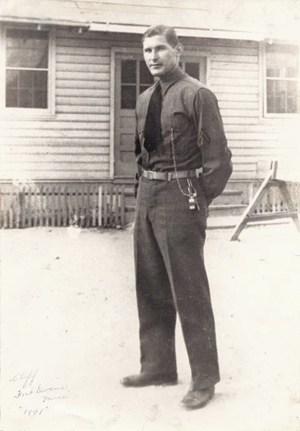
Clifford Houben—A Prisoner for 28 Months

Cliff Houben at Fort Devens, Massachusetts, 1941.

I heard earlier this month from Wayne Houben, who had this information to share concerning his father, who was a former POW at Camp 59.

“Clifford Houben was my father. He died in 1971 and was buried at the Glen Haven veteran’s memorial cemetery in Winter Park Florida.

“He wouldn’t talk about the time he was in the war, but he did leave some records. One was a war log that he wrote while in the prison camps. Unfortunately a part of the book was missing, taken by the Germans I assume.

“My dad went from England to Tunisia in North Africa. He was a scout and saw some terrible fighting. In his log he writes about a friend, Ralph Wilson, who was shot and died in my dad’s arms. He wrote several stories in his log, but it’s short on dates and places. Perhaps those were some of the things that were taken out.

Continue reading

Captain Millar—Valor in the Hour of Crisis

It’s clear from existing accounts of POWs who escaped from Camp 59 on the night of September 14, 1943, that few fully understood how they were able to escape from the camp in relative safety.

Captain J. H. Derek Millar—who was both the camp’s chief medical officer and highest-ranking British officer—acted quietly to ensure that safe passage.

Italian Giuseppe Millozzi, whose family helped to protect escaped POWs, studied historical records related to the night’s events decades later while in London as a student. In his dissertation, Allied Prisoners of War in the Region of the Marche and Prison Camp at Servigliano, he reconstructs the unfolding events of the night—as he tells the story of Captain Millar’s heroic fight with the Italian camp commandant for control of the camp, and ultimately his acceptance of full personal responsibility for allowing the men to evacuate.

Captain Millar’s move was in defiance of the “Stay Put Order” issued from London which declared all Allied POWs were to stay in the prison camps until repatriated by the Allied forces. He knew that the Germans would reach the camps sooner than the Allies, and staying would only ensure transfer of the men to camps in the north.

in 2008, in honor of his role in the liberation of the camp, the Associazione Casa della Memoria—the Camp 59 “House of Memory” association—published Captain Millar’s memoirs. In the book, Dr. Millar’s story is presented in both English and Italian.

Within the book, Edward Chaplin, British Ambassador to Italy, wrote:

“[Dr. Millar’s] ‘disobedience’ allowed around two thousand prisoners to escape and seek safety, unlike the prisoners detained in other camps nearby who remained where they were and were deported to Germany. He was decorated for his action at the end of the war. …[His] enormously generous efforts to save others in a time of great peril, will be kept alive in the minds and hearts of future generations.”

J. H. Derek Millar and the Escape
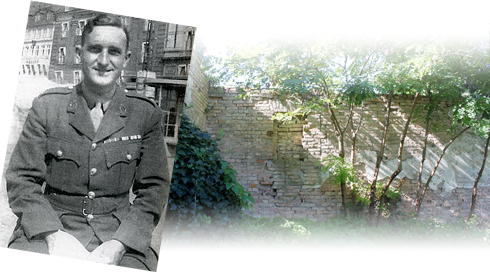
I am extremely grateful to Giuseppe Millozzi for kindly allowing me to share the following account of the escape in this post.

The Armistice in the Marche prison camps

To summarise a complex event like the Armistice, it entails necessarily some imagination and omissions. It has been attempted to unite information found in documents, books and manuscripts written by ex POWs after the war. Regarding Servigliano’s events, it has been possible—after 60 years—to interview living witnesses who played an important part—Capt. Millar—class 1914—was one of these witnesses. Also Keith Killby—class 1916, one of the SAS captured in Sardinia—who pointed out through various interviews unpublished details on the camp escape.

Bit by bit, it has been possible to have a sufficiently clear vision of the “puzzle” and to make a coherent interpretation of events.

The Armistice in the camp at Servigliano

In the evening of 8 September all the villagers of Servigliano were celebrating the announcement of the Armistice, but even though in the camp—only 1 km. away—POWs could hear an uproar, but they did not know why.

The next day, 9 September, started as any other day but during the morning a similar sound attracted POWs towards the main gate of the camp.

Continue reading

A Family in Service

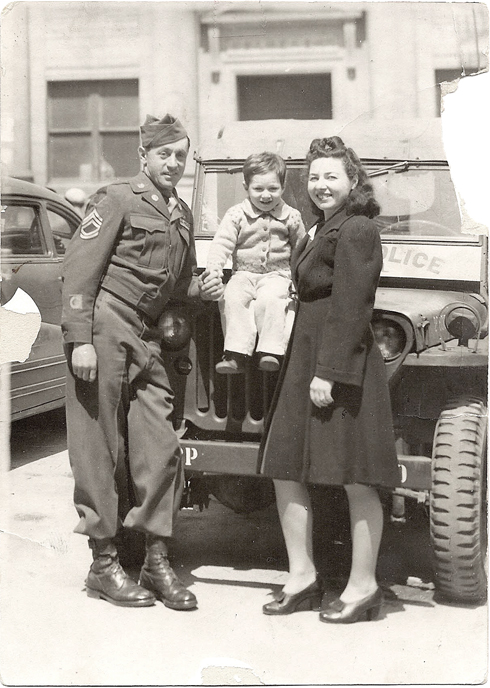
I’ve given this post the title “A Family in Service” in recognition of the way the war affected both American serviceman Albert Rosenblum and his family as a whole.

Like many families during World War II, Al’s parents had more than one son serving in the military.

Al was married when he went overseas in 1942. A close network of relatives provided support for his wife Rose and for his parents while he was at war and a prisoner.

After the war’s end, Al stayed in the service, and Rose and their son Alan lived with him when he was stationed in occupied Japan. Al also served in the Korean War. He enlisted in 1929 and served to 1938. He then rejoined his old unit in 1939 and served until 1953.

Staff Sergeant Albert Rosenblum with son Alan and wife Rose in Japan, 1947.

Here is Alan’s story of his dad’s service:

My father, Staff Sergeant Albert Rosenblum, joined the U.S. Army during the Great Depression of the 1930’s. He served at Fort Hamilton, New York, Schofield Barracks in the Territory of Hawaii, and Fort Douglas, Utah. During that period he twice encountered President Franklin Delano Roosevelt. Once when F.D.R. made an inspection tour of Hawaii military bases and later at the dedication of The Hoover (Boulder) Dam, where my father was a member of the Honor Guard.

Photos Al took of Franklin Delano Roosevelt when the president was on Hawaiian inspection tour, 1934.

Continue reading

Conversations with Vaughan Laurence Carter

In 2006, Ray Worthington had two conversations with Vaughan Laurence Carter, a former Australian POW at Camp 59.

The two conversations were on June 23rd and June 30th. I am grateful to Ray for sharing his notes from those conversations with me for this site.

Vaughan had responded to a request for information on Ray’s father, Leslie Worthington WX4449, posted by Ray in Tobruk to Borneo, a quarterly journal of the Australian 2nd/28th Battalion and 24th Anti-Tank Company Association.

At the time of these conversations, Vaughan was 85 years old and was being treated for pancreatic cancer, but was still very alert and demonstrated an excellent memory. He served as WX11634 in the 2nd/28th Battalion and was one of the 490 taken prisoner at Ruin Ridge on 27 July 1942. [Miteirya Ridge, near El Alamein, Egypt, was known to the Australians as “Ruin Ridge.”]

Although he had not met Les earlier (Vaughan was in D Company; while Les was 8 Section, 12 Platoon, B Company), he remembers Les because they were in the same POW camp. Vaughan’s memory of Les is as a “good bloke.” He also remembers Les as fairly old—Les turned 39 in 1942, while Vaughan only turned 22 while they were in the camp at Servigliano.

Continue reading

A Timeline of Les Worthington’s Service

The following dates are from Les Worthington’s service record (WX4449) at the National Archives of Australia.

1940

June 1—medically examined and accepted in Wiluna

July 6—ceased work at The Wiluna Gold Mines Limited

July 13—enlisted at Northam Army Camp as WX4449

September 5—transferred to the 2nd/28th Battalion, 24th Brigade, 9th Division, A.I.F.; became a member of 8 Section, 12 Platoon, B Company

1941

January 5—the 2nd/28th departed for the Middle East on the Aquitania

November 12—appointed lance corporal

Continue reading

Les Worthington—an Australian’s Adventure

Australian Lance Corporal Leslie Worthington’s service record from the National Archives of Australia is presented in this post, along with a few comments and photos provided by his son, Ray Worthington.

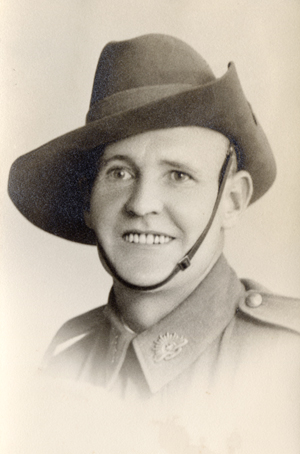
This portrait of Les Worthington was taken sometime in the latter part of 1940. His army battalion departed from Australia on 3 January 1941.

Written on back: “Taken at Kilo 89. Winner of donkey race.” Les’s battalion—the 2nd/28th—moved from Tobruk to Alexandria on 23 September 1941, and then to the camp at Kilo 89, so this photo was probably taken around then. If you look closely you can see the ears of the donkey Les is seated on.

Service Record

National Archives transcription from the service record of Leslie Worthington WX4449, pages 13 and 14

Minor edits have been made for readability. Where a name appears to be incorrect or there is a variation, a likely alternative is shown in brackets.

WESTERN AUSTRALIAN SEARCHER’S REPORT ON AN ESCAPED P.O.W.

WITNESS STATES:

“I was taken prisoner of war at El Alamein the night of 27 July 1942.

“After being captured, I was taken to the German HQ [headquarters] and questioned, and after that to the Italian HQ at a place called Appaloni [Apollonia or Susah, Libya] for the same purpose. I was then taken to Derna [Darnah, Libya], Tocra [Tukrah, Libya], and finally to the main prison camp at Benghazi [Banghazi, Libya]. This camp was not the best when we arrived here as it was really a staging camp and overcrowded. We slept in the open most of the time, and there was very little water and food was scarce.

[This would have been The Palms Prison Camp also known as Palm Tree Camp, or The Palm Grove.]

Continue reading

News of Ira Powers’ Captivity and Escape

Carolyn Abell of Tifton, Georgia, in conducting research for a book she is writing about war veterans from her county who died in wars (World War I to the present), came across two articles from archived issues of her local newspaper, the Tifton Gazette, about Camp 59 POW Ira Powers.

I am grateful to her for sharing this information for this site.

Ira Powers Is Safe After Being Prisoner

Tifton Gazette, July 5, 1944

“Ira Powers of Tifton, technician fourth grade, who had been reported as a prisoner of war since December 12, 1942, has been reported by the War Department as returned to duty since June 21, 1944.

“The communication from Adjutant General Ulio of the War Department was received July 3 by Sam Powers, of Tifton, brother of Ira Powers. It was the first news of him in several months. The communication stated that Powers would undoubtedly communicate with his brother at an early date concerning his welfare and whereabouts.

Continue reading

A Son’s Memories of Tom Cronin

These comments about Clarence T. (Tom) Cronin are from his son, Ed Cronin.

“My father, like many of the survivors of WW II and prisoners of war, never talked much about his experience. What I can tell you about his is that he had full-blown PTSD but in those days it just was not recognized. He was a man with a good heart underneath it all but he had an explosive temper through most of his life. He was typical in that he would jump out of bed in the middle of the night and get under his bed to cover himself from “attack.”

“He was street kid from Brooklyn, New York, who literally grew up on the streets. He worked in the Brooklyn Navy yard for a while before his service in the military. He actually had two stints in the army—one in the ’30s, and then again during WWII. He was a really good boxer when he was in the military.

“I recently made contact with a guy who was in his outfit when they landed at Oran in Algeria. This gentleman tells me that he and my father were in the third regiment (1st Infantry Division, Big Red One) and were actually in the same company but different platoons. He told me that when the troops landed in Oran they landed on three different beaches, and he and my father landed on Arzew beach.

“You asked about my father’s experience when he got out. I can give you bits and pieces of what he told me. Again, I was young and it is hard to grab context but this is my best memory.

“He was captured in North Africa and as I remember he may have been taken to Sicily first. He told me that he was in more than one prison camp and that he had made several escape attempts during his period of confinement.

Continue reading

Robert A. Newton—Further Details

Robert A. Newton of Hillsboro, Oregon, Corporal Robert A. Newton’s nephew (he was named for his uncle when Corporal Newton did not return from the war) had these additional comments concerning his uncle and the interview with Cesare Viozzi (see the previous post):

“The father of the house was Pietro Viozzi.

“My uncle taught himself Italian in the camp. I understand that they held such classes for each other. He wrote home and said that he was learning both Italian and German.

Continue reading