
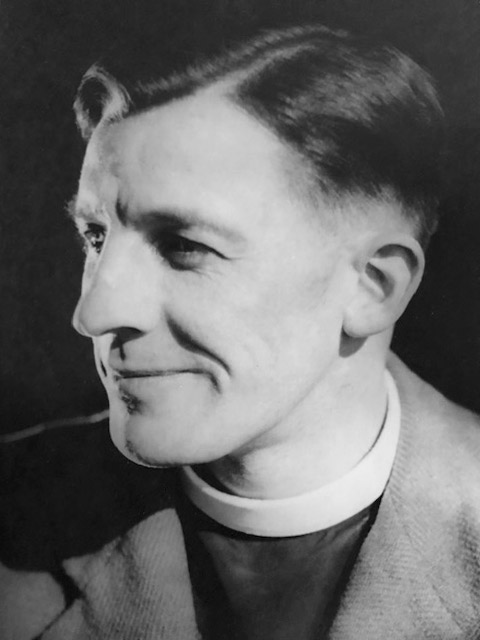
Chaplain Niel Nye, Royal Air Force
Today is Easter Sunday, and I can’t think of a better day to add a post on Niel Nye, who was a chaplain in Camp 59, to this site.
On a deep, personal level, Niel felt Easter represented hope and renewal. As a Royal Air Force chaplain, it was that spirit that he sought to impart year-around to soldiers fighting in France and North Africa, and to the interned POWs of P.G. 59.
I’ve mentioned him on this site before.
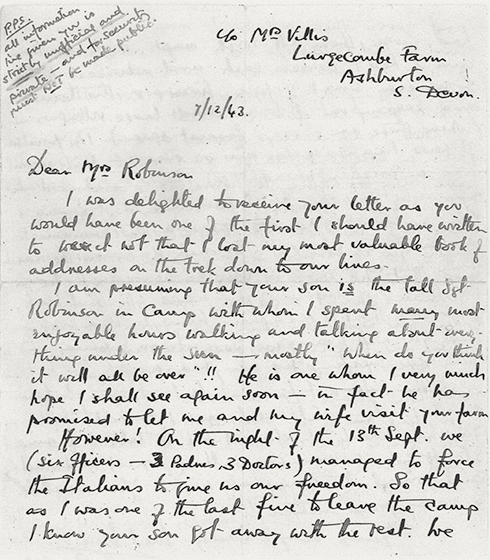
A few weeks ago, I received an email from David Osborn, who wrote, “I was researching family history for a friend of mine (Christopher Nye) when I came across this page which amazingly contains a letter, handwritten by his father Niel Nye:
“Letter from P.G. 59 Chaplain ‘Niel’ Nye”
When David contacted me he had already shared the page with Chris, and he told me Chris “was absolutely delighted to read the letter, and he recognised his father’s handwriting instantly. He is extremely grateful to Ms. Stewart that she shared the letter with you—it is a priceless piece of his family history that he would otherwise never have known existed.”
David put me in touch with Chris, and Chris and I exchanged a number of emails:
“My dad was a remarkable man who had a remarkable war.” Chris wrote. “After he escaped from P.G. 59, he had an exciting four months travelling south to meet the American forces as they drove north. He had several near misses and I recall him telling me of his adventures when I was about six, sitting in a bath that became colder and colder (but I didn’t notice, as I was so wrapped up with his story!!). When he got back to the UK, his adventures continued: he was appointed chaplain to Bomber Command, then went across to Europe a few days after D-Day. He was one of the first British officers to relieve Belsen concentration camp and, after the German surrender, set up a leadership training college in Hamburg to help with the German reconstruction. When he finally returned to England, he was appointed as vicar in three different parishes (Clapham, Morden, and Maidstone), and then joined the Archbishop of Canterbury’s staff as diocesan missionary. He was finally appointed as Archdeacon of Maidstone. He retired in the 1980s and died in 2003. His obituary in the London Times covered half a page!
“I will look out his biography which is hand typed (so I can’t easily send it electronically) and will post you a paper copy, if you like. It’s not brilliantly written (to quote your docs, he was never that academic!!) but it covers the basics of an interesting life.”
I was thrilled to receive the manuscript in the mail about a week later. It’s a fascinating, candid, frequently intimate account of his experiences—spiced throughout with rich humor. From his first memories of childhood in Bromley (in Greater London, England) to a very active retirement after leaving his position as Archdeacon of Maidstone, I was captivated by the tale!
Today I’m sharing the several chapters that cover Niel’s wartime years.

 Camp 59 Survivors