Author Archives: Dennis Hill

“Servigliano Calling” Camp Poem #8


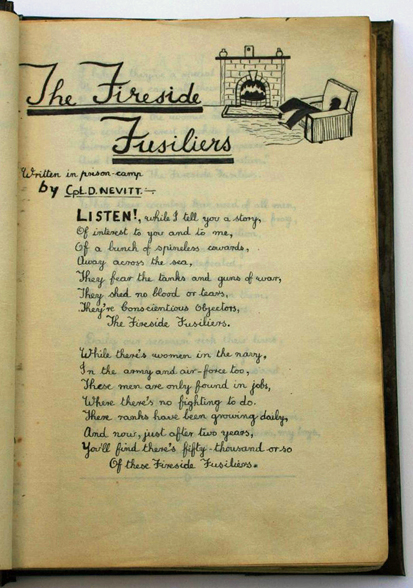
This poem is one of eight by Cpl. D. Nevitt recorded in Robert Dickinson’s diary, “Servigliano Calling.”

The Fireside Fusiliers

LISTEN!, while I tell you a story,
Of interest to you and to me,
Of a bunch of spineless cowards,
Away across the sea,
They fear the tanks and guns of war,
They shed no blood or tears,
They’re Conscientious Objectors,
The Fireside Fusiliers.

While there’s women in the navy,
In the army and air-force too,
These men are only found in jobs,
Where there’s no fighting to do
There ranks have been growing daily,
And now, just after two years,
You’ll find there’s fifty-thousand or so,
Of these Fireside Fusiliers.

I believe they’ve a special medal,
It’s one they can call their own,
Painted a bright gleaming yellow,
Designed by the women at home,
Its centre’s a crest of white feathers,
Surrounded by cold feet, it appears,
And their motto “Self-preservation,”
That’s the Fireside Fusiliers.

While their country has need of all men,
On “religious grounds”, keep from the fray,
And despite the serious position,
Enjoy home-comfort each day,
When Jerry has been defeated,
They’ll flourish their souvenirs,
Then tell you how they won them,
These Fireside Fusiliers.

Daily our seamen risk their lives,
To bring their rations through,
For remember there’s fifty-thousand,
Not just one or two,
But when this war is over,
You can regard these men with sneers,
For you’ve done your bit, and theirs, my boys,
The Fireside Fusiliers
“Servigliano Calling” Camp Poem #7


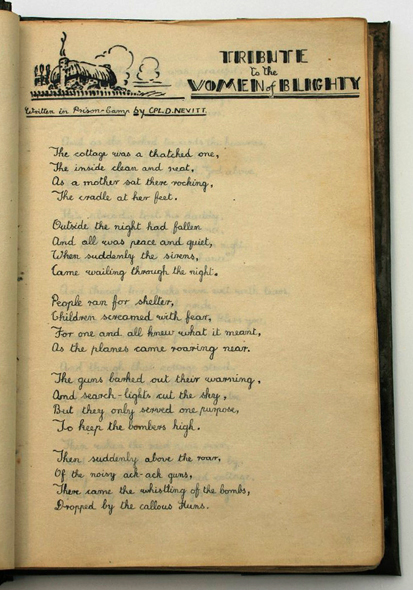
This touching poem by Cpl. D. Nevitt reflects on the bravery and sacrifice of the women of Blighty (England) through the story of one widow’s loving protection of her baby. The poem is from Robert Dickinson’s diary, “Servigliano Calling.”

Tribute to the Women of Blighty

The cottage was a thatched one,
The inside clean and neat,
As a mother sat there rocking,
The cradle at her feet.

Outside the night had fallen
And all was peace and quit,
When suddenly the sirens,
Came wailing through the night.

People ran for shelter,
Children screamed with fear,
For one and all knew what it meant,
As the planes came roaring near.

The guns barked out their warning,
And search-lights cut the sky,
But they only served one purpose,
To keep the bombers high.

Then suddenly above the roar,
Of the noisy ack-ack guns,
There came the whistling of the bombs,
Dropped by the callous Huns.

In the cottage all was peaceful,
And at the bottom of the stairs,
Knelt that mother with her baby,
As she softly said her prayers.

And as she looked towards the heavens,
Her eyes shone full of faith,
As she softly murmured, “God above,
Please keep my baby safe.

He’s already lost his daddy,
For he gave his life in France,
So if I should get killed this night,
Please give my child a chance.”

And though her cheeks were wet with tears,
Her voice was full of pride,
As she whispered may God Bless you,
And the bombs still fell outside.

And though that cottage stood,
Outside the town, alone,
A bomb crashed through the centre,
Of that peaceful little home.

Then when the raid was over,
And the bombers had passed by,
They searched that ruined cottage,
And they heard a baby’s cry.

They found her ’neath the ruins,
That poor young soldiers wife,
For her dead and battered body,
Had saved her baby’s life.

So when you go in action,
And you feel somewhat afraid,
Just think of what the women stand,
In any big air-raid.

“Servigliano Calling” Camp Poem #6


This clever poem, an ode to the Camp 59 dog, is one of six by C.A. Hollis recorded in Robert Dickinson’s diary, “Servigliano Calling.”

The Neutral

He’s not of any army, he has no need to kill,
His is the freedom of the prison, he comes and goes at will,
No cheering at advances, no worries of retreats;
It matters not, if he’s a coward, or performs heroic feats.

He’s the friend of captor and captive, of both he has no fear,
He just walks disdainfully, if either clip his ear.
No rations is he issued, his meals are bits and scraps,
And when he’s feeling tired, most anywhere, he knaps.

And when this war is over, his life will be the same,
He cares not who’s the victor, or who deserves the blame.
He’s a neutral in this conflict—this world engulfing bog,
He’s one of man’s greatest friends, just a homely dog.

This poem was inspired by Old Bob the camp dog.

The Christmas Ship

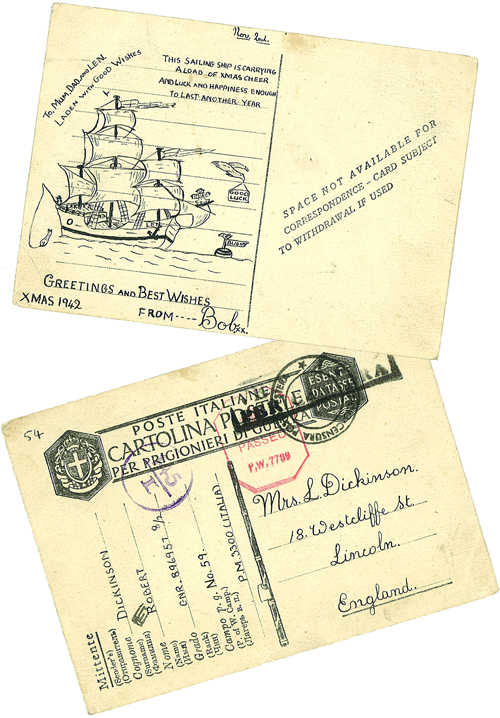
This Christmas postcard, sent from Camp 59 by Robert Dickinson to his parents and young brother Len, reads:

Nov. 2nd.

“To Mum, Dad, and Len.
Laden with Good Wishes

“This sailing ship is carrying
A load of Xmas cheer
And luck and happiness enough
To last another year

“Greetings and Best Wishes
From—Bob.xx.

“Xmas 1942”

Robert’s ocean scene is full of happy detail. Wind fills the sails of the ship, named Len, and sends it on it’s merry way toward “Blighty” (a nickname for Britain). A gull carries a sign that reads “Good Luck” as it sails on a breeze overhead. One sailer, playing an accordion, balances on the bowsprit. Another, with broad-brimmed hat, lands a fish at the back of the ship.

Continue reading

Combat and Capture—Armie’s 1976 Story

This account is from the first of two interviews with Armie regarding his experience during World War II. Armie’s son Dennis Hill taped this conversation on February 21, 1976 in Phelps, Wisconsin.

Dennis edited the transcript; Armie also made a few additions and corrections to the story.

This portrait of Armie was created by an artist in North Africa.

En Route to Invasion

“On August 31, 1942 the troops in my company left the States. Our first stop was Antrim County, Ireland. We were in Ireland for a few weeks. Then they sent us to England—to Liverpool. In England we had an idea that we would be sent someplace, but we didn’t know where we would be sent. We had been given extra training. We had spent time getting all our equipment ready. Everything had to be covered with oil and grease so that it would be waterproof, and then we covered it with canvas.

“One day we were told to be ready to load on the ships. They took us in barges out to the ships. And the ship that I was loaded on—I was a sergeant and a squad-leader at the time—wasn’t a passenger ship but an old, Russian ship that had been used to carry freight. It really wasn’t sea-worthy. All around ships were being loaded. It took us several days to load and assemble the convoy. Finally, we set off from Liverpool.

“We were given orders to stay below deck. When we were allowed on deck, we weren’t supposed to throw anything in the water that would give a clue as to the trail of the ships. When we did throw anything overboard—garbage or anything—it was always at night.

Continue reading

Combat and Capture—Armie’s 1987 Story

This account of Armie Hill’s early service experience, from induction and training through combat and capture, is based on the second of two tape-recorded interviews Armie made with his son Dennis.

This conversation was recorded on August 24–26, 1987 in Phelps, Wisconsin. Dennis edited the transcript and made a few additions and corrections that Armie requested.

Armie Hill at Fort Ord, California, 1941

First Year in Service

“I’ll start my story from the beginning, when I was first inducted into the service. I received my draft notice 1940 and signed up for selective service. Word came that December that I would be called, and I was inducted into the service in January 1941.

“This was the first draft and I was one of the first men drafted from Vilas County. There were about seven of us who were drafted from Vilas County, and I was the first one from the town of Phelps. We went to the courthouse in Eagle River and we were driven by bus—I think it was to the train station—and then we took a train to Chicago, and then from Chicago to Fort Sheridan, Illinois.

“At Fort Sheridan we were selected to go to Fort Ord in California. We went by train and it took us several days to get there.

“At that time, Fort Ord had been a tent camp—everyone had been living in tents. Before we arrived, new barracks had just been hastily put up and everything at the fort was still a mess. A lot of the work was still undone. The streets were sand. It was raining. We hadn’t had basic training, so we got all of our training there at Fort Ord.

“All was confusion there. I thought to myself, ‘If they’d just let me out, I’d walk home.’

Continue reading

An Unpaid Bill for Onions

This note reads:

“SEC. No 11. received from Canteen 30 KILOS of onions at 3 LIRE per kilo TOTAL LIRE = 90 Lire To be payed on the 16/9/43.

“8/IX/1943 [signed] Armie Hill Sec. Sergt.”

This scrap of paper, which was both a receipt for onions received and an I.O.U. for payment owed, was in Armie Hill’s pocket when he escaped from Camp 59 on September 14, 1943.

Armie was the Section 11 “section sergeant,” the serviceman who was put in charge of the 35 American servicemen who lived with him in Hut 4—Section 11.

The date of the receipt is written 8/IX/1943, seemingly a combination of Arabic and Roman numerals. If this is the case, then the transaction date was September 8, 1943—the day the Italian Armistice was signed.

And the due date for payment was September 16, 1943—two days after breakout from the camp.

It’s interesting to learn the price on onions from this slip (paid for in special Camp 59 POW money, of course), and to know that at least on one occasion purchase of food on credit was allowed.

“Servigliano Calling” Camp Poem #5

On August 4, 1942 Robert Dickinson wrote in his diary:

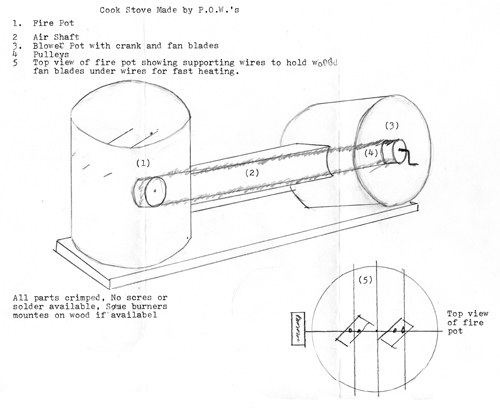
“A new invention in the camp ‘a Blower’. Denis has got cracking and has made lots of improvements and now we have a blower. Affair of wheels and belts and a fan. Turn the wheel slow and get about 1000 revs a minute, guaranteed to burn charcoal (other peoples embers), socks and even sawdust.”

In the drawing above this poem, an ode to the evening “brew,” by Cpl. D. Nevitt, a camp cookstove, or ‘blower,’ is shown in remarkable detail.

The Brew,
it must go through

I have passed some weary times,
Trying hard to make up rhymes,
But now I think I’ve found one that will do;
It’s about a thing we say
Every evening, every day,
That’s our motto: “The Brew, it must go through.”

Every night there can be seen,
’Tween the wall and hut thirteen,
Scores of men all kneeling down, and what a crew,
There they waft and there they blow,
Private, sergeant, W.O.
Never mind the rank, the brew it must go through.

If H.Q. could only see
Those sergeant-majors on one knee,
They would cry “what is our army coming to”?
If they had one scoop per day,
I’m sure that they would say,
“Most decidedly, the brew it must go through.”

There are patent fire cans,
Ovens, stoves and frying pans,
And they’ve even got a new invention too;
It’s a belt-propelled affair,
Wails and whines, and blows out air,
And all because the brew it must go through.

But the fuel’s very poor,
Old socks, cardboard, even straw,
But we do get wood sometimes, it’s true;
But if we use much more;
We’ll be sleeping on the floor,
But even then the brew it must go through.

Men have suffered many times
For this noblest of all crimes
And they’ve had to pay a lot of lire too,
So raise your brews and drink
To those martyrs in the clink,
And the toast is to the brew that must go through.

The POW Cook Stove

In March of this year, ex-POW Neil Torssell sent me this diagram of a handmade Camp 59 cook stove. He labeled the parts of the stove: 1) fire pot, 2) air shaft, 3) blower pot with crank and fan blades, and 4) pulleys. Sketch 5 is a top view of the fire pot, showing supporting wires to hold the wood and fan blades under the wires for fast heating.

All parts were crimped together, he explained, as screws and solder were not available. Some of these burners were mounted on wood—when wood was available.

Continue reading

An Interview with Neil Torssell

I interviewed Neil Torssell over the phone on May 13, 2008. He had agreed in advance to my taping him. At first, I suggested we might do a series of shorter conversations. However, once we got started he was sharp and eager to talk and in one hour and 45 minutes he covered the whole of his service experience—from enlistment to discharge!

I’m pleased to post this fascinating interview here. My questions for Neil and comments are shown in italic.

Enlistment and Training

Tell me what unit you joined, how you trained, and how you came to go overseas.

“I wasn’t drafted—I enlisted in September 1940, before the draft started.

“I went into the service to learn more about photography. The recruiters knew that the draft was coming up and they didn’t care where they sent you. So they sent me to 322nd Signal Aviation Company, which is communications. I didn’t find that out until I got up to Selfridge Field, Michigan.

“After I took basic training, I transferred over to the 3rd Air Base Group at Selfridge Field—to the photo section there. That was the time when I got up in grades from private to private first class, then corporal, and then sergeant.

“Things were going pretty good. I’ll probably skip a lot of details here because they’re not significant. After the war was declared in 1941, my group got transferred down to South Carolina—Florence, South Carolina to be exact. I was with the 3rd Air Base Group still. We were there for a few months and then we were moved up to Wilmington, North Carolina.

“From there I flew in a couple of missions—submarine control in B-25s—as a photographer. At that time the Army Air Force wasn’t well-equipped. On the B-25s I was back where the camera was and the guns were two wooden sticks.

Continue reading