Author Archives: Dennis Hill

“A Mother’s Intuition Rewarded”

For this Memorial Day, here is a glad report of one captured American soldier’s return home. The solder is Sergeant John F. Kirkpatrick Jr. of Johnstown, Pennsylvania.

The news article is one of several items about Jack Kirkpatrick saved by his daughter, Colleen Nisewonger. She had been to this site a number of months ago looking for information about her father and found that his address was one of 55 addresses of servicemen recorded on Luther Shield’s deck of American Red Cross Aviator playing cards. The post is “Dual Purpose Deck of Cards.”

Colleen wrote that in the deck of cards, “much to my surprise, was my fathers name and old address, in his own handwriting. He was Jack Kirkpatrick on the 7 of hearts.”

Here is the article:
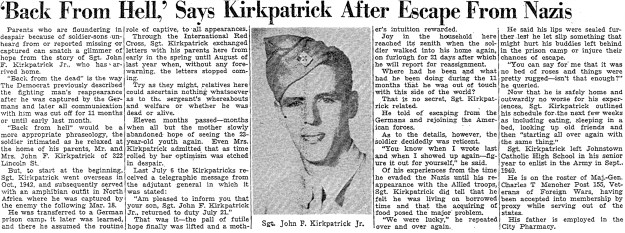
‘Back from Hell,’ Says Kirkpatrick After Escape from Nazis

The Democrat (Johnstown, Pennsylvania), July 1944

Parents who are floundering in despair because of soldier-sons unheard from or reported missing or captured can snatch a glimmer of’ hope from the story of Sgt. John F. Kirkpatrick Jr., who has arrived home.

“Back from the dead” is the way The Democrat previously described the fighting man’s reappearance after he was captured by the Germans and later all communication with him was cut off for 11 months or until early last month.

“Back from hell” would be a more appropriate phraseology, the soldier intimated as he relaxed at the home of his parents, Mr. and Mrs. John F. Kirkpatrick of 322 Lincoln St.

Continue reading

Jack Kirkpatrick—Returned to Duty

Sgt. Kirkpatrick, Captured in 1943, Returns to Duty

Johnstown, Pennsylvania, June 1944

Sgt. John F. Kirkpatrick Jr., reported captured on Mar. 28, 1943, in the North African area, has returned to active duty with the American troops overseas, according to a War Department message received last night by his parents, Mr. and Mrs. John F. Kirkpatrick of 322 Lincoln St.

“Am pleased to inform you that your son, Sgt. John F. Kirkpatrick Jr., returned to duty June 21 [1944],” the telegram stated. “Undoubtedly he will communicate with you at an early date concerning his welfare and whereabouts.”

The family had been informed in May, 1943, that he was missing and a short time later that he was a prisoner. The solder left Catholic High School in his senior year to enlist in the Army in September, 1940, and was sent overseas in October, 1942.

L’informatore on the Davison Rescue

Since publishing his father’s memoirs last year, John Davison has continued to search for information about the people in northern Italy who protected Norman Davison and arranged for his safe passage to Switzerland.

This spring, Anne Copley told John that she had discovered a Web site dedicated to the resistance history of Vigevano—La Resistenza a Vigevano—and John’s subsequent contacts with this historical group led to a Vigevano newspaper’s research and publication of a two-page story on Norman’s rescue and the brave Italians who risked their lives to protect him.

L’informatore‘s report, translated into English, is below.

Courage and gratitude

L’informatore (The Informer), April 22, 2010
Commentary (“Coraggio e gratitudine”)
by Margherita Natale

We want to tell you a beautiful story, of those who, in the midst of so much misery and penury, keep true human values in their hearts. In a society which rewards highest the scramble for worthless honours and tin medals, here’s this book, written by an Englishman—Norman Davison—dedicated to a group of citizens of Vigevano who, in October 1943, saved him and his friends from raids by the Germans in the woods of Ticino, and arranged for their safe passage to Switzerland.

This was an episode we had not heard of, as it had been kept private by relatives of those who had taken part in the adventure. Their reserve and modesty is a sign of their honor.

Continue reading

William Redman—Captivity, 1941–45

William Redman was one of 20 men recorded in Robert Dickinson’s Address List in his journal, “Servigliano Calling.”

To date we have learned more about three of these fellows: Fred Druce, Jack Davies, and now William Redman.

In February, Jo Millard of Littlehampton (Sussex, England) wrote, “I have been researching my family tree, and I always knew my Mother’s brother was a prisoner of war in Italy but never knew where, as he very rarely talked about those days.

“Just by chance I stumbled onto your site and saw his name and address. So I now have a little bit more of the puzzle that is my family.”

Two months later, Jo sent her uncle’s story, which she found archived at the local government records office.

William’s POW Story

In due course, I joined up and very soon found myself in the Middle East, where I met up with Sef [William’s younger brother] in Cairo. After a short spell in the Artillery base, which was at Heliopolis—the biblical “City of the Sun”—I got posted to a unit somewhere up the desert. I was miles away from anywhere and after a while our captain warned us to be ready to move “up to the wire,” as the sappers would be cutting the wire for us to go into Libya.

The wire was a monstrous affair, quite eight feet high, four feet at the base, and tapered up until it finished at two feet at the top. It was one mass of barbed wire. I met up with a chap who had been with the Long Range Desert Group. He came with us to the quarry in Germany [the quarry—described later—was a work camp in Grimma, Germany]. He told me that they ranged all over Libya and as far as he knew the fence was all around the country.

We went through the cutting and turned south. There, in the vast uninhabited interior, we spent our time on maneuvers, getting ready for “the big one.” We had several skirmishes with the Germans and Italians whilst we prowled around there. Not too bad. I cannot remember if we lost any men. Then one day we were ordered to pack and go north to take up our positions for attacking the Germans, who were dug in around Tobruck. It was in November 1941. We opened up at about 10,000 yards according to our No.1, who timed another gun’s shell explosion. It was the commencement of the Battle of Sidi Rezegh. The 6th Tanks came through our guns, and their commanders, with their heads out of the turrets, waved gaily to us as they rolled on towards the enemy.

Continue reading

Patrick Cahill’s First Flight

Fast forward from the war to August 1975 for this interesting event in Patrick Cahill’s later years.

According to Dean Cahill, Patrick’s grandson:

“Pat was working in Coventry, which he had made his home, at Lucus Aerospace when he won the top prize on a company raffle.

“As Lucus made aircraft parts for the BOAC Company, the prize was to sit in as a passenger on one of the Concorde’s proving flights. The aircraft was piloted by chief test pilot (also the Queen’s and George VI’s favorite pilot) Brian Trubshaw.

“It was my granddad’s first flight. I find it interesting that after all the traveling during the war, the first time he flew he went supersonic!”

Patrick Cahill—Capture and Liberation

Patrick Cahill with fellow servicemen. Patrick is the fellow leaning against the chair just left of center.

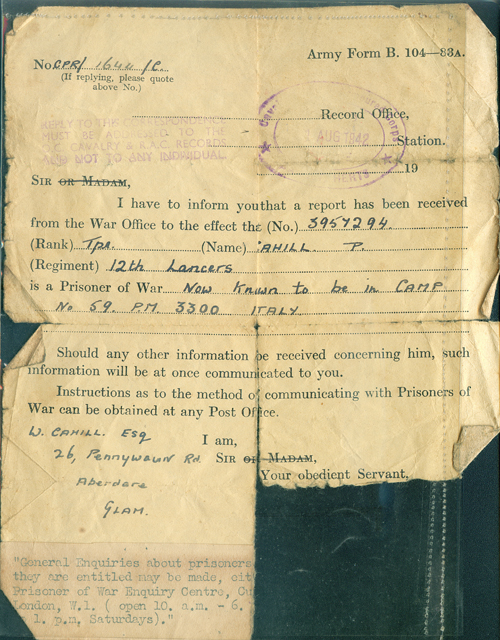
Notification of Pat’s capture and imprisonment at Camp 59, sent to his parents in August 1942.

Dean Cahill of Leicestershire, England, has provided some information for this site about his grandfather, Pvt. Patrick Cahill of the 12th Lancers. Pat was captured at Tobruk in North Africa. Information about Patrick’s war experience is sketchy because, as Dean put it, “He was the type that wanted to forget!”

Dean’s father, Ralph Cahill, said that the civilians in this picture somehow helped Pat with his escape. Pat Cahill is seated at far right, holding the dog.

According to Dean:

“Pat had escaped before and been re-captured. I’m not sure if this was from Camp 59. After the mass escape though the hole in the wall, Pat made his way, along with two other Brits to Switzerland, living for six months with a kind mountain farming family. He then passed though France and managed to reach Britain undetected.

G. Norman Davison recounts an early tunneling breakout from Hut 4 of Camp 59 in his published memoirs, In the Prison of His Days. All of the men were recaptured. Perhaps Pat took part in that breakout.

Camp 59 Poets

Bernard Petrulis’s story in the previous post ends with the poem “Prisoner Son,” which is one of the poems recorded in Robert Dickinson’s journal and presented on this site as “Servigliano Calling” Poem #4.

In Robert’s journal, F. Chiltern is credited for the poem.

The poem is also recorded in Edward Smith’s book of poems, and there, too, it is credited to F. Chiltern.

Alan Petrulis wrote that the poem “came from a small notebook full of poems in my father’s hand. I had thought he may have written them in camp but I was very apprehensive about ever attributing them to him.

“My father’s book contained nine poems: Unholy Conflict, Prayer of a Soldier, Wishful Thinking, Doubtful Future, Prisoner Son, In a Desert Outpost, Far Away Dream, Tribute to Women in an Air Raid, and The Gunner.”

Some of these poems are in Robert’s journal.

Of the nine poems, “In a Desert Outpost” is in G. Norman Davison’s notebook. And although “Prisoner Son” is recorded in Norman’s notebook—yet a fourth appearance of the poem—there the title of the poem is “Diplomacy” and the author is F. Chilton (not Chiltern).

Norman recorded an address for F. Chilton in his notebook:

F. Chilton
8, Alfred Road
Sheffield

This is Norman’s mate Fred Chilton. The two were sent to North Africa on the same boat, were captured together in Libya in April 1940, and were transferred from camp to camp together, eventually ending up in Camp 59. After their time in Servigliano, the men were sent to separate camps and, after escape from their respective camps, both made their way north to freedom in Switzerland. They were later reunited in their hometown of Sheffield. The story of the friendship is recounted in Norman’s memoirs, In the Prison of His Days.

There are more poems in Norman’s book: “A Point We All Agree,” “Ten Little Foreign Lands,” “A Little Toast to Love,” “Reflections of A P.O.W.,” and “A Tribute to The Women of Blighty.”

Of these, “Reflections of a P.O.W.” is the same poem as “Reflections” in Robert’s journal (though the poem is a slight variation).

“A Tribute to the Women of Blighty” is also in Robert’s journal. Again, some of the wording is different.

These poems convey so freshly and intimately the prisoner-poets’ longing for home and loved ones, pride in country, and feelings about war and the experience of captivity that it is a moving experience to read them again so many years after the war.

The Story of Bernard Petrulis

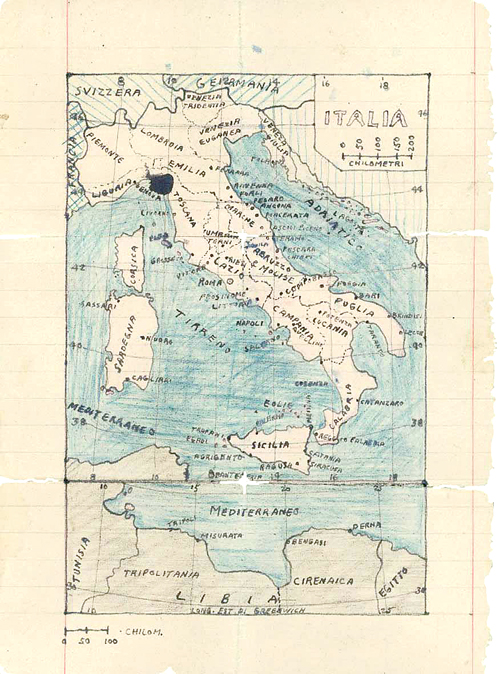
This map was drawn by Camp 59 prisoner Bernard Petrulis. According to his son Alan, “The scale would seem to make it impracticable but it was bundled with the poems and letters my father took with him when he escaped.”

The fascinating story of Pfc. Bernard Petrulis is available on the Metropolitan Postcard Club of New York City blog, maintained by Alan Petrulis.

As you arrive at the site, scroll down to the entry entitled “The Long Trail Through Bari.”

Many thanks to Anne Copley for having discovered this site.

“Servigliano Calling” Poem #21

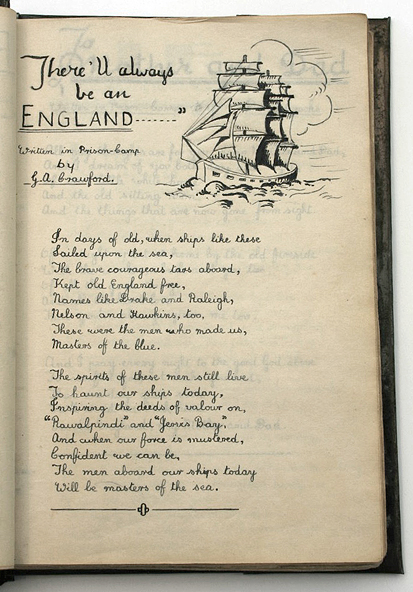
“There’ll always be an England….” by G.A. Crawford is one of two works by this soldier-poet in Robert Dickinson’s journal, “Servigliano Calling.”

We know G.A. Crawford to be George A. Crawford of London, as Robert recorded his address in the book.

There’ll always be an England….

In days of old, when ships like these
Sailed upon the sea,
The brave courageous tars aboard,
Kept old England free,
Names like Drake and Raleigh,
Nelson and Hawkins, too,
These were the men who made us,
Masters of the blue.

The spirits of these men still live
To haunt our ships today,
Inspiring the deeds of valour on,
“Rawalpindi” and Jeori’s Bay”,
And when our force is mustered,
Confident we can be,
The men aboard our ships today
Will be masters of the sea.

Arnold Chessell in Africa

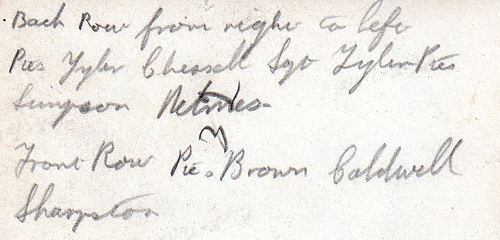
This photo from Roger Chessell is of his dad and fellow members of the British Royal Army Medical Corps.

As noted on the back of the photo, the fellows are:

Back Row from right to left
Ptes [Privates] Tyler Chessell Sgt Tyler Ptes Simpson Nelmes
Front Row Ptes Brown Caldwell Sharpston