Author Archives: Dennis Hill

“Servigliano Calling” Poem #30


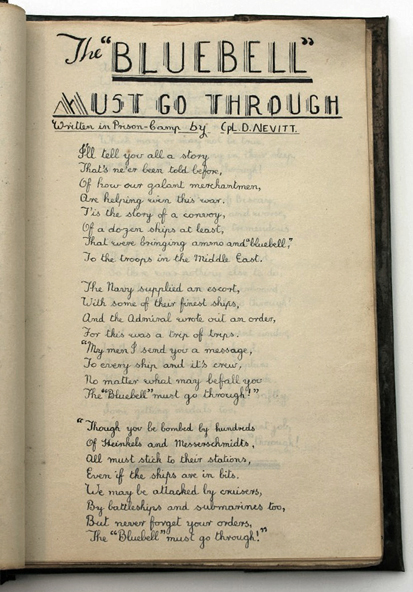
“The ‘Bluebell’ Must Go Though” is one of eight poems by Cpl. D. Nevitt recorded in Robert Dickinson’s prison camp journal.

The “Bluebell” Must Go Through

I’ll tell you all a story
That’s ne’er been told before,
Of how our gallant merchantmen,
Are helping win this war.
T’is the story of a convoy,
Of a dozen ships at least,
That were bringing ammo and the “bluebell”,
To troops in the Middle East.

The Navy supplied an escort,
With some of their finest ships,
And the Admiral wrote out an order,
For this was a trip of trips.
“My men I send you a message,
To every ship and its crew,
No matter what may befall you
The ‘Bluebell’ must go through!”

“Though you be bombed by hundreds
Of Heinkels and Messerschmidts,
All must stick to their stations,
Even if the ships are in bits.
We may be attacked by cruisers,
By battleships and submarines too,
But never forget your orders,
The “Bluebell” must go though!”

Continue reading

“Servigliano Calling” Poem #29


This gem of a poem is one of four by A. Forman (including one he co-authored with C. G. Hooper-Rogers) in Robert Dickinson’s “Servigliano Calling.”

The title of this poem plays on the popular idiom “If wishes were horses, beggars would ride,” meaning that wishing for or wanting a thing is not the same as getting it.

If Wishes were Horses

The Red Cross came to our prison camp,
To hear complaints and such.
Two thousand voices spoke at one,
Resulting in “plain Dutch.”

But with the help of interpreters;
Pro-Iti’s not the word,
He made some sense of all our din,
And this is what he heard.

Our first complaint was breakfast,
We miss our ham and eggs,
And by the time our lunch is up
We’re knock-kneed round the legs.

And then ten-thirty seems the time
For team fruit-cakes, and buns,
The tea we’ve got, so send the rest
Big, fat, and well baked ones.

Continue reading

“Servigliano Calling” Poem #28


“‘Gonna’ Win,” is one of six poems by C. A. Hollis recorded in Robert Dickinson’s “Servigliano Calling” journal.

“Gonna” Win

When you’re feeling blue,
And you don’t know what to do,
And prison life to you seems such a bore.
When you’re feeling out of sorts—
Making hasty, bad retorts,
Just remember, that we’re gonna win this war!

Though you’ve lost your place in battle,
And you’re penned in just like cattle,
And your pride has been battered pretty raw.
Though you haven’t got your guns,
You’re still old Britain’s Sons,
And remember, that we’re gonna win this war.

You have done your little bit,
Though you didn’t make a hit,
Your pals are sure to add it to their score.
So lay a double bet,
It’s victory they will get,
For aren’t we going to win this bloomin’ war?

And someday you will find,
When you’ve left this life behind,
And the “Wops” have shown you where’s the door.
That you’ll say to your sons,
The new Brittanic ones,
Old England always wins a blinkin’ war!

“Servigliano Calling” Poem #27

This short work is the only poem by J. R. Cromley in Robert Dickinson’s “Servigliano Calling” diary.

It’s a simply stated—but heartfelt—observation.

It’s Principle Makes the Man

A man without principle
Is as a tree with no leaves,
A rose with no perfume,
Torrid day without breeze.

For principle is the spirit
Of the man that’s within,
Should he lack this fair jewel,
He makes life a sin.

Let it burn like a beacon,
Through his daily life;
He can make it a signpost
Midst trouble and strife.

“Now what is this principle?”
Fools often shout.
It’s the inner-man
Guiding the outer, about.

“Servigliano Calling” Poem #26


Aside from the entertainment provided by C. A. Hollis’s “Our Prison Canteen,” this poem is interesting as a snapshot of one aspect of prison life—the long wait in line to be served at the canteen and the disappointment when supplies sell out!

Of interest, too, are the foods the poet lists as available at the canteen.

Historian Giuseppe Millozzi has this to say about the Camp 59 prison canteen:

“The camp shop was open at the following hours:

• Morning 8.00 – 10.00
• Afternoon 13.30 – 16.00

“As time went by, besides the usual items, the shop started to sell wine and more and more POWs called it canteen. Takings were used to cover part of the camp expenses.”

Our Prison Canteen

In our camp, there is a queue,
Of men eternally waiting.
And if you want ought, you’ll wait too,
Each hour, fresh hopes creating.

Polony, oranges, cheese, and jam,
Will there be enough
To serve these men, and also me.
Now “Tutti” do your stuff.

The system’s bad, and blooming slow,
Two Italians, only serving,
Hooray!, only a hundred more to go.
It really is unnerving.

Perhaps one day, I’ll reach the door,
Before they’ve sold right out,
Maybe tomorrow they’ll have some more,
Till then, right turn about!

Salami, oranges, cheese and jam,
I never get a “Smell”,
With all these men in front of me,
Oh! “Tutti” go to hell!

“Tutti” was the nickname given to a Rhodesian, who acted as interpreter at the Canteen.

Note: Tutti in Italian means “all” or “everyone.” Polony is another name for Bologna sausage.

“Servigliano Calling” Poem #25


“The Link” is one of six poems by C. A. Hollis recorded in Robert Dickinson’s journal.

The “capturing chains” that link letter writer to reading prisoner is an unusual way to acknowledge the humanity that allows mail between loved ones to flow even in the worst of situations.

Perhaps the grateful serviceman pictured is a self-portrait of Robert.

The Link

There’s a time when we are happy,
T’is the happiest hour of the day,
When our capturing chains link us
With our homeland far away.

This link brings words of comfort,
Of friendship, and good cheer,
It brings to us the fondest thoughts
Of all who hold us dear.

They come from Town and City,
Wherever freedom flows,
The message that keeps us smiling
The smile, once surrender, froze.

They help us to remember
Each English hill and dale,
And each night our hearts whisper
Thank God for our mail.

“Servigliano Calling” Poem #24

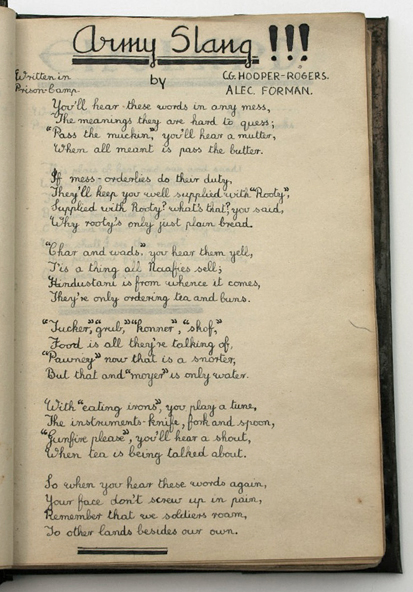
“Army Slang!!!” by C. G. Hooper-Rogers and Alec. Forman is the only poem in Robert Dickinson’s journal credited to two poets.

C. G. Hooper-Rogers authored two other poems that Robert recorded in “Servigliano Calling,” and Alec. Forman (or A. Forman) authored three other poems.

The colloquialisms in this poem might have been lost to time except for their having been defined here.

Army Slang!!!

You’ll hear these words in any mess,
The meanings they are hard to guess;
“Pass the muckin”, you’ll hear a mutter,
When all meant is pass the butter.

If mess-orderlies do they duty,
They’ll keep you supplied with “Rooty”,
Supplied with Rooty? what’s that? you said,
Why rooty’s only just plain bread.

“Char and wads”, you hear them yell,
T’is a thing all Naafies sell;
Hindustani is from whence it comes,
They’re only ordering tea and buns.

“Tucker”, “grub”, “konner”, “skof”,
Food is all they’re talking of,
“Pawney” now that is a snorter,
But that and “moyer” is only water.

With “eating irons”, you play a tune,
The instruments—knife, fork and spoon,
“Gunfire please”, you’ll hear a shout,
When tea is being talked about.

So when you hear these words again,
Your face doesn’t screw up in pain,
Remember that we soldiers roam,
To other lands besides our own.

Jack Kirkpatrick—A Returned War Hero

Sgt. John Kirkpatrick of Johnstown, Pennsylvania was considered a war hero on his return to the States. Here he is honored at a Red Cross fundraising event. Caven Point Marine Terminal is located in Jersey City, New Jersey.

ESCAPED PRISONER OF WAR WELCOMED AT JERSEY CITY WESTERN ELECTRIC RALLY FOR 1945 RED CROSS WAR FUND

Sergt. Jack Kirkpatrick of Caven Point Terminal, who was a prisoner of War in Italy for six months—then escaped and fought guerrilla warfare behind German lines for 10 months, being welcomed by Henry Jackson, superintendent of Western Electric Jersey City Plant. Left to right: Charles M. Wiest, labor-management war production Red Cross representative; Sergt. Kirkpatrick; Sterling P. Henry, Jr., Jersey City Red Cross speakers’ bureau, who delivered principal address; Superintendent Jackson, and Mike D’Allesando, elected representative of the Western Electric Employees Association, affiliate of N.F.T.W. [the National Federation of Telephone Workers union]

Sending Packages to Prisoners

This letter from Colleen Nisewonger, Jack Kirkpatrick’s daughter, contains an interesting bit of information—that families of imprisoned servicemen were allowed to send their loved one a single package of supplies and two packages containing cigarettes (or perhaps other tobacco products) every two months.

Unfortunately, I do not have the detailed instruction sheets and circular that were enclosed in this letter, but the letter itself is valuable evidence that each family was able to send supplies to their serviceman in captivity.

Here is the text of the letter:

WAR DEPARTMENT
ARMY SERVICE FORCES
OFFICE OF THE PROVOST MARSHAL GENERAL
WASHINGTON

16 July 1943

Re: Sgt. John F. Kirkpatrick, Jr.

Mrs. Ann Kirkpatrick,
322 Lincoln Street,
Johnstown, Pennsylvania.

Dear Mrs. Kirkpatrick:

The Provost Marshal General directs me to inform you that the above-named prisoner of war has been reported transferred to Concentration Camp 59, Military Post 3300, Italy.

You may communicate with him by following the enclosed mailing instructions.

One package label and two tobacco labels are issued every sixty-day period to the next of kin without application. These are enclosed with instructions for their use.

Further information will be forwarded as soon as it is received.

Sincerely yours,

Howard F. Bresee,
Colonel, C.M.P.,
Chief, Information Branch.

Incls:
Labels
Package Instructions
Tobacco Instructions
Mailing Circular