Author Archives: Dennis Hill

Swimmers in Arosa

I received this intriguing photo today from Dean Cahill who said be believes it to have been taken in Switzerland, “during the time between the escape and the repatriation. My grandfather, Pat, is seated second from right in the picture. Maybe someone will be able to shed light on his fellow swimmers.”

Click on the image above to see a full-sized scan of the photograph.

Inscribed in the lower right corner are the words “Photo Brandt AROSA.”

Arosa is a municipality in the canton of Graubünden in Switzerland. As a resort, Arosa is popular in both winter and summer.

The photographer is evidently British photographer Bill Brandt. Vintage photographs that he took of horse races in Arosa during 1946—“Race Journalist” and “Snowy Spectators” are available though Getty images.

Pat Cahill and two other British soldiers who escaped from Camp 59 made their way to Switzerland, where they lived for six months until their repatriation.

Read more about Patrick Cahill in the May 16, 2010 post “Patrick Cahill—Capture and Liberation.”

Clifford Houben—A Prisoner for 28 Months

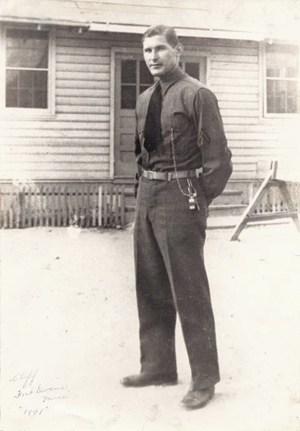
Cliff Houben at Fort Devens, Massachusetts, 1941.

I heard earlier this month from Wayne Houben, who had this information to share concerning his father, who was a former POW at Camp 59.

“Clifford Houben was my father. He died in 1971 and was buried at the Glen Haven veteran’s memorial cemetery in Winter Park Florida.

“He wouldn’t talk about the time he was in the war, but he did leave some records. One was a war log that he wrote while in the prison camps. Unfortunately a part of the book was missing, taken by the Germans I assume.

“My dad went from England to Tunisia in North Africa. He was a scout and saw some terrible fighting. In his log he writes about a friend, Ralph Wilson, who was shot and died in my dad’s arms. He wrote several stories in his log, but it’s short on dates and places. Perhaps those were some of the things that were taken out.

Continue reading

Captain Millar—Valor in the Hour of Crisis

It’s clear from existing accounts of POWs who escaped from Camp 59 on the night of September 14, 1943, that few fully understood how they were able to escape from the camp in relative safety.

Captain J. H. Derek Millar—who was both the camp’s chief medical officer and highest-ranking British officer—acted quietly to ensure that safe passage.

Italian Giuseppe Millozzi, whose family helped to protect escaped POWs, studied historical records related to the night’s events decades later while in London as a student. In his dissertation, Allied Prisoners of War in the Region of the Marche and Prison Camp at Servigliano, he reconstructs the unfolding events of the night—as he tells the story of Captain Millar’s heroic fight with the Italian camp commandant for control of the camp, and ultimately his acceptance of full personal responsibility for allowing the men to evacuate.

Captain Millar’s move was in defiance of the “Stay Put Order” issued from London which declared all Allied POWs were to stay in the prison camps until repatriated by the Allied forces. He knew that the Germans would reach the camps sooner than the Allies, and staying would only ensure transfer of the men to camps in the north.

in 2008, in honor of his role in the liberation of the camp, the Associazione Casa della Memoria—the Camp 59 “House of Memory” association—published Captain Millar’s memoirs. In the book, Dr. Millar’s story is presented in both English and Italian.

Within the book, Edward Chaplin, British Ambassador to Italy, wrote:

“[Dr. Millar’s] ‘disobedience’ allowed around two thousand prisoners to escape and seek safety, unlike the prisoners detained in other camps nearby who remained where they were and were deported to Germany. He was decorated for his action at the end of the war. …[His] enormously generous efforts to save others in a time of great peril, will be kept alive in the minds and hearts of future generations.”

J. H. Derek Millar and the Escape
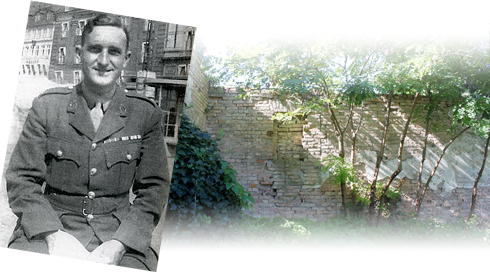
I am extremely grateful to Giuseppe Millozzi for kindly allowing me to share the following account of the escape in this post.

The Armistice in the Marche prison camps

To summarise a complex event like the Armistice, it entails necessarily some imagination and omissions. It has been attempted to unite information found in documents, books and manuscripts written by ex POWs after the war. Regarding Servigliano’s events, it has been possible—after 60 years—to interview living witnesses who played an important part—Capt. Millar—class 1914—was one of these witnesses. Also Keith Killby—class 1916, one of the SAS captured in Sardinia—who pointed out through various interviews unpublished details on the camp escape.

Bit by bit, it has been possible to have a sufficiently clear vision of the “puzzle” and to make a coherent interpretation of events.

The Armistice in the camp at Servigliano

In the evening of 8 September all the villagers of Servigliano were celebrating the announcement of the Armistice, but even though in the camp—only 1 km. away—POWs could hear an uproar, but they did not know why.

The next day, 9 September, started as any other day but during the morning a similar sound attracted POWs towards the main gate of the camp.

Continue reading

Giuseppe Millozzi on the “Stay Put Order”

In his excellent dissertation, Allied Prisoners of War in the Region of the Marche and Prison Camp at Servigliano, Italian historian Giuseppe Millozzi gives a clear account of what is known today as the “stay put order.”

This order from the War Office in London was intended for all of the POW camps in Italy after the signing of the Italian Armistice.

In Camp 59, however, that order was defied by Captain J. H. Derek Millar. This decisive action on the part of Captain Millar, chief medical officer of the camp and its highest-ranking British officer, enabled all of the camp’s estimated 2,000 POWs to escape.

Here is Giuseppe Millozzi’s account of the stay put order:

“The secret order not to leave prison camps, that is the ‘stay put order’, was initiated by the MI9, a section of the British Military Intelligence whose logistical head office was set at the War Office in London.

Continue reading

A Family in Service

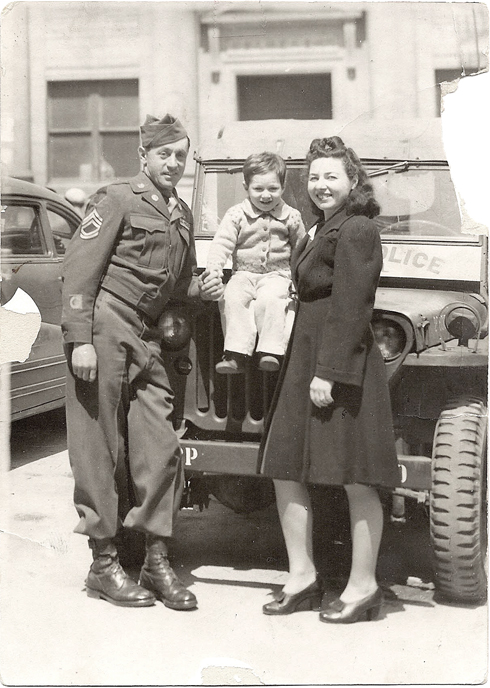
I’ve given this post the title “A Family in Service” in recognition of the way the war affected both American serviceman Albert Rosenblum and his family as a whole.

Like many families during World War II, Al’s parents had more than one son serving in the military.

Al was married when he went overseas in 1942. A close network of relatives provided support for his wife Rose and for his parents while he was at war and a prisoner.

After the war’s end, Al stayed in the service, and Rose and their son Alan lived with him when he was stationed in occupied Japan. Al also served in the Korean War. He enlisted in 1929 and served to 1938. He then rejoined his old unit in 1939 and served until 1953.

Staff Sergeant Albert Rosenblum with son Alan and wife Rose in Japan, 1947.

Here is Alan’s story of his dad’s service:

My father, Staff Sergeant Albert Rosenblum, joined the U.S. Army during the Great Depression of the 1930’s. He served at Fort Hamilton, New York, Schofield Barracks in the Territory of Hawaii, and Fort Douglas, Utah. During that period he twice encountered President Franklin Delano Roosevelt. Once when F.D.R. made an inspection tour of Hawaii military bases and later at the dedication of The Hoover (Boulder) Dam, where my father was a member of the Honor Guard.

Photos Al took of Franklin Delano Roosevelt when the president was on Hawaiian inspection tour, 1934.

Continue reading

Conversations with Vaughan Laurence Carter

In 2006, Ray Worthington had two conversations with Vaughan Laurence Carter, a former Australian POW at Camp 59.

The two conversations were on June 23rd and June 30th. I am grateful to Ray for sharing his notes from those conversations with me for this site.

Vaughan had responded to a request for information on Ray’s father, Leslie Worthington WX4449, posted by Ray in Tobruk to Borneo, a quarterly journal of the Australian 2nd/28th Battalion and 24th Anti-Tank Company Association.

At the time of these conversations, Vaughan was 85 years old and was being treated for pancreatic cancer, but was still very alert and demonstrated an excellent memory. He served as WX11634 in the 2nd/28th Battalion and was one of the 490 taken prisoner at Ruin Ridge on 27 July 1942. [Miteirya Ridge, near El Alamein, Egypt, was known to the Australians as “Ruin Ridge.”]

Although he had not met Les earlier (Vaughan was in D Company; while Les was 8 Section, 12 Platoon, B Company), he remembers Les because they were in the same POW camp. Vaughan’s memory of Les is as a “good bloke.” He also remembers Les as fairly old—Les turned 39 in 1942, while Vaughan only turned 22 while they were in the camp at Servigliano.

Continue reading

A Timeline of Les Worthington’s Service

The following dates are from Les Worthington’s service record (WX4449) at the National Archives of Australia.

1940

June 1—medically examined and accepted in Wiluna

July 6—ceased work at The Wiluna Gold Mines Limited

July 13—enlisted at Northam Army Camp as WX4449

September 5—transferred to the 2nd/28th Battalion, 24th Brigade, 9th Division, A.I.F.; became a member of 8 Section, 12 Platoon, B Company

1941

January 5—the 2nd/28th departed for the Middle East on the Aquitania

November 12—appointed lance corporal

Continue reading

Les Worthington—an Australian’s Adventure

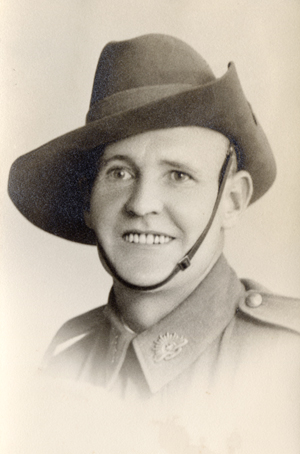
Australian Lance Corporal Leslie Worthington’s service record from the National Archives of Australia is presented in this post, along with a few comments and photos provided by his son, Ray Worthington.

This portrait of Les Worthington was taken sometime in the latter part of 1940. His army battalion departed from Australia on 3 January 1941.

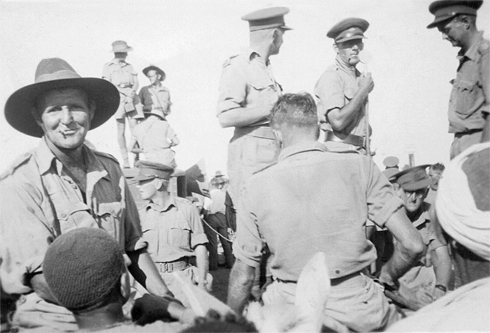
Written on back: “Taken at Kilo 89. Winner of donkey race.” Les’s battalion—the 2nd/28th—moved from Tobruk to Alexandria on 23 September 1941, and then to the camp at Kilo 89, so this photo was probably taken around then. If you look closely you can see the ears of the donkey Les is seated on.

Service Record

National Archives transcription from the service record of Leslie Worthington WX4449, pages 13 and 14

Minor edits have been made for readability. Where a name appears to be incorrect or there is a variation, a likely alternative is shown in brackets.

WESTERN AUSTRALIAN SEARCHER’S REPORT ON AN ESCAPED P.O.W.

WITNESS STATES:

“I was taken prisoner of war at El Alamein the night of 27 July 1942.

“After being captured, I was taken to the German HQ [headquarters] and questioned, and after that to the Italian HQ at a place called Appaloni [Apollonia or Susah, Libya] for the same purpose. I was then taken to Derna [Darnah, Libya], Tocra [Tukrah, Libya], and finally to the main prison camp at Benghazi [Banghazi, Libya]. This camp was not the best when we arrived here as it was really a staging camp and overcrowded. We slept in the open most of the time, and there was very little water and food was scarce.

[This would have been The Palms Prison Camp also known as Palm Tree Camp, or The Palm Grove.]

Continue reading

Official Reports on Camp Conditions

During the war, a British publication, The Prisoner of War journal, provided reports on conditions in POW camps to families of prisoners at home.

The journal was published by the Prisoners of War Department of the Red Cross and the St. John War Organization, St. James Palace, London.

Scans of the entire issue of this Prisoner of War publication—along with other issues of the journal from 1942–44—were contributed to the WWII Memories website by Jim Wicketts and his daughter Louise.

The following two items—from the April 1943 (Vol. 1, No. 12) issue of the journal—are reproduced here with permission of the WWII Memories site administrator.

The two on the right are old school pals who met again at Campo P.G. 59.

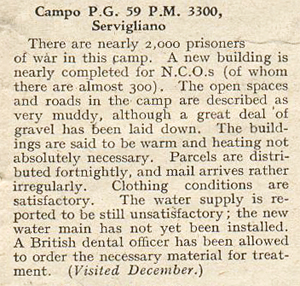
Campo P.G. 59 P.M. 3300, Servigliano

There are nearly 2,000 prisoners of war in this camp. A new building is nearly completed for N.C.O.s [non-commissioned officers] (of whom there are almost 300). The open spaces and roads in the camp are described as very muddy, although a great deal of gravel has been laid down. The buildings are said to be warm and heating not absolutely necessary. Parcels are distributed fortnightly, and mail arrives rather irregularly. Clothing conditions are satisfactory. The water supply is reported to be still unsatisfactory; the new water main has not yet been installed. A British dental officer has been allowed to order the necessary material for treatment. (Visited December.)

Australian and New Zealand “Free Men”

I have just added a link to the blogroll on this site, but lest anyone overlook it, I want to take a moment to recognize its excellence. Its impressive collection of information is the exhaustive work of Australian WW II POW Bill Rudd.

The site, ANZAC POW Freemen in Europe, is devoted to records and history of prisoners-of-war in Europe of ANZAC—the Australian and New Zealand Army Corps.

ANZAC is comprised of the New Zealand Australian Imperial Force (AIF) and the New Zealand Expeditionary Force (NZEF).

When I asked Bill Rudd about the use of his term “Free Men,” he explained:

“When I was asked by the Australian War Museum to extend my Swiss research to all other countries in which Anzac POW either escaped or evaded, but remained behind enemy lines, my first interest was the Anzac POW who had not been captured in Crete. Although technically they had been surrendered to the Germans in Crete, they had not been actually taken POW by them. Literally hundreds were recovered by SOE and MI9 operations and a considerable number came out under their own steam.

“When they eventually re-joined their units, they were never given the status of a POW.

“As a consequence, I had to change my working title to cover such cases and to accomodate the increasing number of airmen, who had crashed behind enemy lines and evaded among the civilian population of the area where that had occurred. Both the peasants of Crete and North Italy took enormous risks in succouring such Allied men. As did those brave patriots manning official escape lines developed throughout Europe.

“So I called all my evaders and escapers surviving behind enemy lines ‘Free Men.’ Many of course carried on their war with local partisan groups.

“My working research parameters was to cover all active escapers and evaders who were NOT sitting in a German prison Camp on VE Day. There were, of course, some exceptions of recaptured POW, but if they had been ‘on the loose’ for at least two months, I included them.”

Continue reading