Author Archives: Dennis Hill

Kind Strangers—Relays from Radio Rome

World War II Radio Heroes: Letters of Compassion, published in 2007 by psychologist Lisa Spahr and Austin Camacho, tells the story of shortwave radio listeners who collected and relayed information broadcast from enemy territory about newly-captured POWs to their families in the U.S.

An entry about Letters of Compassion on Wikipedia has this to say about the effort:

“During World War II, short messages from prisoners of war were often read by studio announcers at stations in Germany, Japan, and other Axis powers countries. A number of shortwave listeners copied the prisoner names and addresses and notified families by mail or telephone, and the practice became known as ‘Prisoner of War relay’ or ‘POW monitoring’. Although the Allied government provided similar services, the families usually heard from shortwave listeners first, sometimes as many as 100 at a time.

“Many wartime listeners were ordinary citizens who discovered they were able access the shortwave bands; a feature included on many premium consumer radios of the era. Times and radio frequencies of the news from Rome, Berlin and Tokyo were published daily on the radio page of The New York Times. Others were dedicated shortwave listeners or DXers who maintained an ongoing interest in long-distance radio listening as a hobby. Still others were licensed amateur radio operators who were, as a group, banned from transmitting due to wartime restrictions, but often kept their listening gear in operation.”

In May 1943, Sergeant Albert Rosenblum’s family received a host of these cards from shortwave listeners around the U.S. The writers reported they had heard Albert’s name and his home address broadcast from Rome.

In addition to the news conveyed, concern and encouragement these strangers expressed must have been a great comfort to the Rosenblums.

For Albert Rosenblum’s full story, read the following post:
A Family in Service.


Helen Barrett
317 Burnet Park Dr.
Syracuse, N.Y. [New York]

Mr. Horace Rosenblum
Route 1
Box 48
Swan Lake, N.Y.

May 8, 1943

Dear Mr. Rosenblum,

Last evening I was listening to my short-wave radio and tuned in on a news broadcast from a station in Italy. The news was in English, and among other information, were the names, addresses, etc. of American soldiers who are “Italian prisoners”. Your son’s name was among those given:

Albert Rosenblum
#6701591

Perhaps you already have this information, but as a fellow American with a young brother in the war I feel it is my duty, really, to send this news on to you.

Hoping you will be hearing good news of your son very soon, I remain—

Sincerely yours,
(Miss) Helen Barrett

Continue reading

William A. Hall—Home Again

William Hall is pictured here, second from the right, with service buddies. The photo was probably taken after his return from overseas (as he seems to be wearing corporal’s stripes). It have been taken at Ft. Benning, Georgia.

The following report on ex-POW William Hall’s camp experience is from a Canandaigua-area (New York) newspaper—probably The Democrat and Chronicle (Rochester, New York) as it is referred to in the article, circa August 1944.

Canandaiguan Visits Home After Nazi
Prison Escape

Canandaigua [New York]—“If it hadn’t been for the Red Cross food parcels none of us would have lived.”

Thus Pfc. William Hall sums up his nine months’ experience in Axis prison camps in almost the same words used by First Sgt. Earl W. Huddleston, Montgomery, W. Va., in the dramatic story of his escape from Camp 59, Italy, in the July and August issues of Cosmopolitan.

But while the West Virginian, apparently with the approval of public relations officers of the War Department details his capture, imprisonment and fight for freedom, the 28-year-old Canandaiguan, back home after two sensational escapes, had little to tell yesterday of his experiences.

Continue reading

William A. Hall Returned to Safety

William Albert Hall

American Private First Class William A. Hall was reported returned to safety after capture, imprisonment, and escape in the following Canandaigua-area (New York) newspaper article circa late-June 1944.

This and other articles and photos concerning William Hall were provided by his daughter Nancy Elizabeth Suyak (Hall) of Jack, Alabama.

Canandaiguan Escapes Second Time from Axis Captors, Rejoins Unit

One of the first Canandaiguans to be taken prisoner of war, who escaped from the Italians and was recaptured by the Germans, is again at liberty and has rejoined his unit in the European Theater of Operations, according to word received by his father, John W. Hall, of this city.

He is Pfc. William H. Hall [sic—William’s middle name is Albert], a member of Co. A 18th Infantry, who enlisted in the Army in December, 1940, and went overseas in August, 1942. He saw service in England, Scotland, and North Africa, where he is believed to have been captured by the Germans in the Allied drive on Tunisia in December, 1942.

Gets Letter Today

Since Saturday, three messages have been received by Mr. Hall, one in his son’s handwriting, which arrived today and two telegrams, one from Pvt. Hall and the other from the War Department.

Continue reading

New York Boys “Victims of War”

This news clipping is from a Canandaigua-area (New York) newspaper, circa late December 1942 or January 1943.

Ralph Hoag Prisoner of the Italians;
William Hall, Missing in Action

Two Canandaigua boys today are reported victims of war, one a prisoner, the other missing in action.

Ralph Hoag, Jr., son of Mr. and Mrs. Ralph Hoag, in a telegram received by Mr. Hoag, manager of Loblaw’s, was said to be a prisoner of war of the Italian government, but his whereabouts was not given and there were no details of when he was captured.

William Hall, 25, son of John Hall, South Main street, was also reported by telegram as being missing in action Dec. 24, but no details were received.

Hall, 25, who enlisted in the army about two years ago, had been serving in North Africa, according to letters received from him. He was in the same company with Hoag.

Hoag wrote his parents recently, giving an interesting account of his experiences in North Africa, together with details of his training and living conditions.

Another county resident, Capt. Martin J. Lawler, Jr., son of Mr. and Mrs. Martin J. Lawler, 24 Lyceum street, Geneva, was also reported to have been taken prisoner by the Italians. According to word received he was being detained “somewhere in Italy”. He was captured Nov. 29 by the Germans in Tunisia, according to the communication.

The photo of Ralph Hoag (left) was taken when he was interned at Stalag IVB, after escape from Camp 59 and recapture by the Germans. William Hall (right).

R. J. McMahon—Case for A Campaign Star

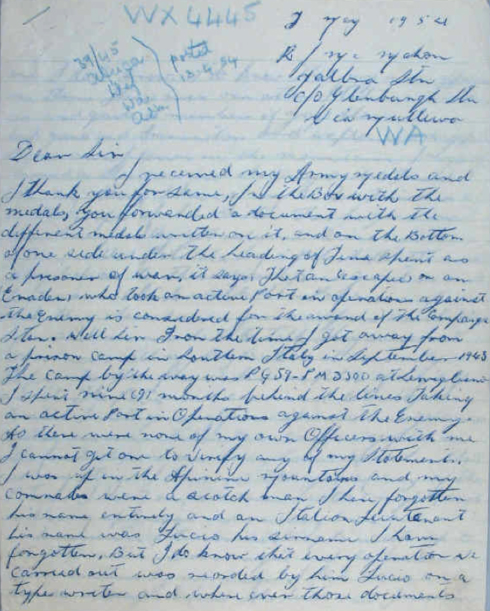
The three-page letter featured in this post was sent to me by R. J. McMahon’s daughter Linda Vaness. On receiving his WW II service medals, R. J. realized he qualified for one additional honor—an Italian Campaign Star.

This letter explains his justification for receiving the Star. As the text is written longhand in a single block, I’ve taken the liberty of dividing it into paragraphs for ease of reading.

I asked Linda if, in response to the letter, her father had received the campaign medal.

“Yes, Dad did get the Italian Star,” She replied. “We have had all of his medals set into a special jarrah (Western Australian hardwood) frame and his grandson has inherited them.”

7 May 1954
R J McMahon
Yalbra Stn
C/O Glenburgh
Via Mullewa
WA

Dear Sir,

I received my Army medals and I thank you for same. In the box with the medals you forwarded a document with the different medals written on it and on the bottom of one side under the heading of time spent as a prisoner of war, it says, that an escapee or evader who took part in operations against the enemy is considered for the award of the Campaign Star.

Well, sir, from the time I got away from a prison camp in southern Italy in September 1943—the camp, by the way, was PG 59–PM 3300 at Servigliano—I spent nine (9) months behind the lines taking an active part in operations against the enemy. As there were none of my own officers with me I cannot get one to verify any of my statements.

Continue reading

R. J. McMahon, Part 2—Escape and Beyond

What follows is the second installment of R. J. McMahon’s autobiography, 1939–44. This post covers his experience in prison at Servigliano, escape, his involvement with the Partisans, and his eventual return to Australia.

Inside the prison walls were about 14 huts and each hut contained 50 prisoners. These huts were the most unstable constructions around and would shake with the slightest movement. When we were in bed they would shake us to sleep. The beds were two-tier bunks made with wooden slats about 6” apart. The mattresses we were issued with were a good kapok style, which were fairly comfortable and [we were issued] plenty of blankets. Having sheets on the bed was a big surprise, as we never had sheets in our own army. The last sheets we had enjoyed were prior to leaving Australia. At the end of the first week we had them taken off us and sent away to be cleaned, and we were issued with another set. Our sheet issue ran out at the end of the second week, when we mustered at the collection point waiting for another lot. The Italian in charge informed us there would be no more sheets as they had found out that the Australians did not give their prisoners sheets so they wouldn’t give them to us.

Six mates and I stayed in this prison camp for 12 months before succeeding in finding a way to get out. We tried digging our way out, emptying the soil down the sewage system and flushing it away. It was only sand and you had to take a chance on whether it fell in or not. There were a few blokes who did escape through a tunnel, but they were caught shortly after and brought back.

Continue reading

R. J. McMahon, Part 1—Battle and Captivity

Earlier this year, I heard from Linda Veness of Perth, Western Australia.

She wrote, “My father was a POW in Camp 59. He and four other Australians escaped together. My father was R. J. (Jim) McMahon WX4445, AIF [Australian Imperial Force]. His companions were Private Tom Alman from Kalgoorlie, Jack Allen from Kalgoorlie, Lance Corporal Les Worthington of Wiluna, and J. Feehan of Geraldton—all from Western Australia. There is an account of their escape in one of our newspapers.

“Also escaping with them was a Scot. He was a man named Tom Kelly (written on the back of a photograph) who was nicknamed “Jock”—how odd for a Scotsman! I have tried to figure out who he was, where he hailed from, and what happened to him, but with no luck.

“My father wrote an autobiography when he was about 70 years old—15 years before he died in 1999.

“I had grown up with stories about my Dad’s war experiences: never the grim bits, just tales of where he had been and the mates he had made along the way. When we lived in Geraldton, Western Australia, he would catch up every couple of years with all the chaps from the 2/28 Battalion when they had their reunions. It was a regular weekend, I can’t remember which month, but the weather was always pleasant. They had get-togethers for the adults and there was always a BBQ or picnic which their children could attend. I loved those days. The men were some of the ‘best blokes’ you could ever hope to meet. It seemed to be a part of my teenage years, waiting for that weekend.

Continue reading

Ken Fenton on New Zealanders

Early this year I was in search of information about any New Zealand POWs interned in Camp 59. Bill Rudd, a former Australian WWII POW and creator of the excellent web resource ANZAC POW Freemen in Europe, referred me to New Zealand WWII veteran and historian Ken Fenton.

Ken wrote to me:

“I served in Italy during WW2 in the 2nd NZ Division, but was never captured, although there were occasions when I might have come close when on recce [reconnaissance].

“In the last six years I have become interested in the fortunes of NZ [New Zealand] and Aust [Australian] POWs, as I was asked to write a book about those who were detained at Campo 57.

“Most of the NZ and Aust POWs were sent to PG 57 soon after arrival in Italy, following brief stays in transit type camps, but a few drifted in over a period of time as they left Italian hospitals or for other reasons.

Continue reading

“The Earthquake” Returns to San Benedetto

This clipping from a local San Benedetto Del Tronto (Marche, Italy) newspaper, commemorated the return, after two decades, of a favorite son—Nicola Lagalla, known to locals as “the earthquake.”

Nicola returned to San Benedetto when the hometown soccer team, Samb, was having a spectacular season.

Nicola’s daughter, Marida Parkes, in sending me the clipping, explained:

“When Samb climbed up the soccer ladder—because of their win—the town went berserk… they celebrated for weeks (as you do when you are Italian). Dad and mum flew to Italy for the festivities.

“Dad is fanatical about his soccer and Aussie Rules football. To this day he does not miss a match and will get up at all hours to watch.”

Sanbenedettese, the name for a person who is born in San Benedetto Del Tronto, is also the name of the soccer team—or Samb for short. Red and Blue are the Samb team colors.

Translation of the article:

NICOLA LAGALLA (earthquake)

“Today amongst us, we have chosen an enthusiastic, fanatical pureblooded Sanbenedettese who, from such a distance, has maintained his love not only for his soccer team, Samb, but also that of his hometown.

“He immigrated to Australia 20 years ago. With such distance between them, he missed his family and he has also missed his beloved team—Samb. The only comfort, as the newspaper reported on Tuesday, was that the Red & Blue team was promoted on the football ladder. Upon hearing this, he could not ignore the call to return to his roots and returned to San Benedetto Del Tronto for the festivities.

“He [Nicola] will remain here with us until the beginning of the next season/championship.”

Continue reading

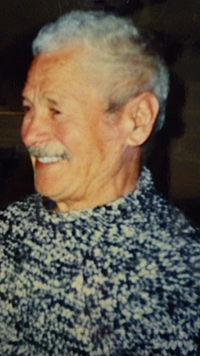
Nicola Lagalla—After the Rescue

Marida describes the photo above: “This is of dad and myself—yes, with a ‘boy coif.’ I was two years old and dad would then have been 29 years old. It was taken at San Benedetto, opposite the port.”

Below right: Nicola Lagalla in recent years.

I asked Mariada Parkes this week if her father, Nicola Lagalla, and his brother Liberato ever returned to San Benedetto del Tronto after their transport of the British POWs down the Adriatic coast. (See “Nicola and Liberato Lagalla—Rescue by Sea” for the full story.)

She replied, “Papà tells me that after he and his brother delivered the POWs to safety, their boats were tied up alongside an American ship in Termoli for approximately one month.

“The boats used to assist the POWs were the San Nicola—built by my nonno [grandfather] and named after my dad—and the Luigi Primo. My nonno purchased the second boat, which had already been named.

“Dad and uncle had no money and no diesel for the boats.

“After a while, the Americans supplied them with diesel so that they could take the boats out fishing. They fished off the shores of Termoli, Molfetta, and Barletta. They sold the fish at the fish markets in these towns and then returned to the ship in Termoli.

“There was a curfew at the time—and so, dad and uncle returned to Termoli every day no later than 5 p.m.

“A little twist—in Barletta, dad met a man who had previously been a POW in Tobruk for two years. This fellow was allowed to help dad as a deck hand.

Continue reading