When American soldiers from PG 59 turned up in Falciano just days after their escape from the camp in September 1943, they were welcomed warmly by the residents of the entire village. In the weeks to come help was provided by 17 families. The coordination of this effort was undertaken by Saturnino Brandimarte, a captain of Italy’s Royal Army, who was now serving as the village schoolteacher.
Although the individual families filed Allied Screening Commission claims requesting compensation for their assistance given to the POWs, Captain Brandimarte himself filed a highly detailed report with the ASC to bolster these claims.
Note that although there are frequent references to six prisoners, two others—Ira Powers and Jack Hayes—also received help in Falciano. Ira and Jack left sooner than the others and succeeded in crossing the Allied lines. The other six were recaptured.
Antonio Ferretti (seated, far right, with handlebar mustache) with a few of the villagers of Falciano. Falciano had a population of 110 residents in 1940. Today the village has 15 residents.
My good friend Gian Paolo Ferretti, who lives in Ascoli Piceno, was born in Falciano—a small village within the comune of Acquasanta Terme, Italy. His family moved from Falciano in 1975, when Paolo was very young.
Paolo’s great grandfather was one of many Falciano villagers who assisted a group of escaped POWs—including Keith Argraves—who turned up in their village in the fall of 1943.
“American soldiers who were escaped prisoners from Camp 59 were given refugee in my small village. Tales of them are becoming legend,” Paolo wrote. “A cave/stable where they slept is on the property of my family. The book Keith Argraves, Paratrooper has been the start of all my research.”
I asked Paolo about the spelling of the village name, because on today’s maps the village is spelled Falciano, but Keith Argraves refers to it as Falgiano. Paolo answered, “In the past the village name was Falgiano, now Falciano. These are changes in the language. Also, those with the name Brandimarte now spell it Brandimarti.” (As you will see, Captain Saturnino Brandimarte figures prominently in this village rescue saga.)
“The soldiers were in a wood of chestnuts. They slept in a cave or stable on the property of my family. During the day they came to the village and stayed with local people. The soldiers helped with farm work.
“One of those villagers was my great grandfather Antonio Ferretti. The prisoners usually talked with him, because Antonio once went to work in the U.S.—in Pittsburgh—during the 1908–1914 period.
I recently purchased through Amazon a book I have heard about for years, and that I have long wanted to own.
Keith Argraves, Paratrooper by George W. Chambers (published in 1946 by the Southern Publishing Association of Nashville, Tennessee) was among the first Allied POW narratives to be written and published after the war.
The memoir is Keith’s experience as told through George W. Chambers, an Arizona businessman, civic leader, and amateur historian.
The edition I purchased was printed by Kessinger Publishing as part of their Legacy Reprints series. I’m thrilled to finally own the book. Many such POW memoirs have long been out of print and are hard to find.
The original subtitle for Keith’s book suggests the full sweep of his impressive adventure: An Account of the Service of a Christian Medical Corpsman in the United States Army Paratroopers during World War II, with Thrilling Stories of Training, Battles, Imprisonment, Escapes, Guerrilla Warfare, Hunger, Torture, and Faithfulness to Man and God.
Regarding the last item in the subtitle, I should mention that Keith, as a Seventh-day Adventist, abstained from drinking or smoking, studied his Bible daily, prayed for guidance and strength, and lived his faith to the best of his ability.
Keith’s memoir was written as a faith testimony, as is made clear an introduction by church elder C. Lester Bond: “ … the hero of this narrative, is only one of approximately 12,000 Seventh-day Adventist youth of North America who gave loyal service to their country while at the same time maintaining their devotion to God and His cause. Their faithfulness under the stress and strain of war has been a great inspiration to their fellow youth and to the church as a whole.”
Keith acknowledged his fellow POWs in this dedication:
In APPRECIATION of the loyalty and fellowship of those who shared the dangers and sufferings of our lot as prisoners and fugitives, I dedicate this book to
Daniel and Francis Cole, Warren Decker, Mahlon Black, and Alfred Natassi [Nastasi].
My friend Robert A. Newton, author of Soldiers of the Strange Night, profiled Keith in a chapter entitled “Brave Men.” I asked Robert if he had been in contact with Keith while researching his book.
Robert replied, “Keith had passed before I started my search, but I did speak to Warren Decker, also a paratrooper, on the phone. He told me about Keith’s book and sent me a photocopy. I also spoke to Alfred Nastasi. Several of the other ex-POWs I contacted asked about Argraves. He was widely respected and made quite an impression on his fellow internees. Some remembered him as ‘Hargraves.’ The fact that he escaped the clutches of the Germans several times is amazing.”
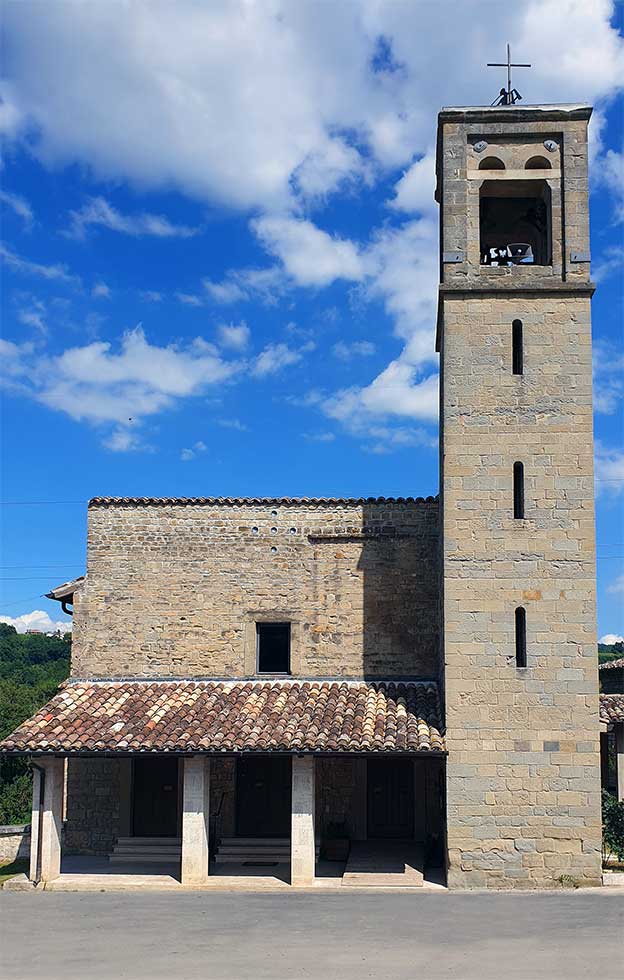
The Church of Santo Stefano Protomartire in Marsia, Roccafluvione. Image—Wikimedia Commons
An entry for 17–21 May 1938 from the “chronicon” of Don Giuseppe Ciabattoni offers insight into the turbulent political climate in Italy that presaged World War II. (The priest’s chronicon was a journal where activities of the parish were recorded.)
Then, in the latter two entries in this post, Don Peppe—as he was affectionately called by his parishioners—contrasts the oppression of war with the joy and spirit of thanksgiving felt by the parishioners after liberation from the Nazis.
Don Peppe used the phrase “in casa di Pietro” “(in Peter’s house”) in sharing the story of his own arrest and imprisonment by the fascists. This allusion is to the Biblical imprisonment and beating of Saint Peter.
I’ve recently posted another excerpt from Don Peppe’s chronicon on Camp 59 Survivors, an entry covering the period of Nazi-fascist oppression from 8 September 1943 to liberation on 17 June 1944. Read “Don Giuseppe Ciabattoni—A Hero of Faith.” That excerpt includes the Marsia parish’s escaped POW rescue work.
Chronicon excerpts are here translated into English; however, I’ve also included the original Italian transcription (in italics).
Once again I wish to thank Gian Paolo Ferretti for his ongoing support and for guiding me through the translation of the chronicon.
The Girl with a Peach: Courage and compassion in wartime Italy, a new work by Anne Copley, was published in June 2024 by London-based charity Monte San Martino Trust.
At 494 pages, this ambitious book is arranged chronologically—just as the POWs’ experiences flowed—from capture, transit, internment, and breakout from the camps, to the experiences of the POWs on the run, their being taken in by Italian families, and their ultimate reunion with the Allied forces.
Special emphasis is given to key aspects of the experience, such as relationships, dangers, and motivations.
The grave of Private B. F. Farley, 1923–1945, in the Farley Cemetery, Hatfield, Kentucky (USA). Apparently Ben Farley is buried beside his father, Bertran “Bert” Farley, and his maternal grandmother.
It’s Memorial Day in the United States, a national holiday set aside for the honoring of military personnel who died in service of their country.
I am remembering and honoring one soldier in particular: Private Benjamin F. Farley.
The name Ben Farley has been one I’ve known for nearly all my life. My father, Sergeant Armie Hill, a former PG 59 POW, used to tell my brothers, sister, and me stories about how he escaped from the camp in September 1943, and how he and Ben paired up together outside the camp walls that night and resolved to stick together during their flight. They headed south and 30 days later were among the first escapees to cross the Allied lines.
In PG 59, Armie, was designated a section sergeant (or orderly sergeant) and put in charge of a section of 35 men (Hut 4–Section 11). As Ben was among the men in his section, Armie would have gotten to know him well in the camp.
Ben could be feisty. “He and I hadn’t gotten along especially well earlier,” Armie said. “He was kind of a little cocky guy.”
The Cathedral of Saint Emidio in Ascoli Piceno contains a surprise gem for anyone interested in the stories of escaped Allied POWs in Italy and their Italian helpers.
Located in the apse of the cathedral’s crypt, a mosaic entitled La carità sui monti (Charity on the Mountains) attests to the advocacy role of the Ascoli church during the war.
Under the wartime leadership of Bishop Ambrogio Squintani, Allied prisoners who escaped from POW camps of central Italy—as well as families of Jews saved from persecution and sent to Ascoli by Pius XII—found refuge in the mountains. In the seclusion of the Apennines, they were cared for and fed by priests and local populations.
The Cathedral of Saint Emidio was named for the patron of the city of Ascoli Piceno. Archaeological evidence uncovered during the restoration of the crypt in 1967 established that the first temple was built as early as the 4th or 5th century on a pre-existing Roman building. At the end of the Second World War, Monsignor Squintani had the walls of the crypt decorated with mosaics designed by Pietro Gaudenzi (1880–1955) depicting events of the war, including the protection of Allied POWs. The mosaics were created by the Vatican Mosaic Studio in 1954.
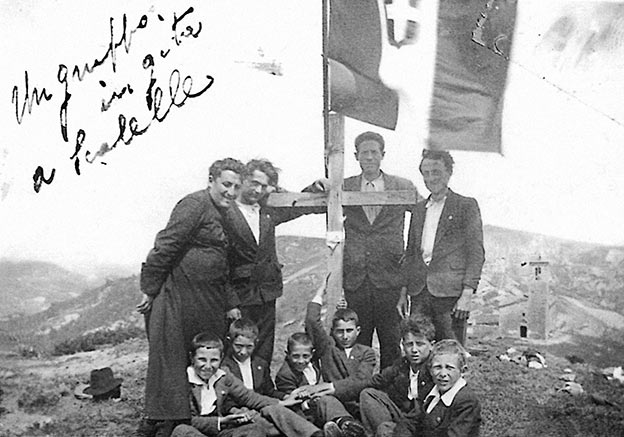
Don Giuseppe Ciabattoni (left), on a 1936 visit to the ninth-century church of Santa Maria di Scalelle; most likely he is accompanied by aspirants of the Catholic Action Youth
I am profoundly grateful to several individuals who have made possible access to the information for this post.
First, a hearty thanks to my friend Gian Paolo Ferretti of Ascoli Piceno, Italy. Paolo contacted me last November about his great grandfather Antonio Ferretti who, on his property in Falciano, sheltered several American POWs who had escaped from PG 59.
In emails with Paolo, I shared a few details about my father’s time on the run after his escape from PG 59. I explained that Angela Bianchini had protected my father (Armie Hill) and his friend Ben Farley in Roccafluvione.
In 2010, I had visited Roccafluvione hoping to learn more about Angela, and I wrote about that visit afterward (see “In Search of Armie’s Italian Angels”). It was during the trip to Roccafluvione that I learned the name of Don Giuseppe Ciabattoni.
Paolo surprised me with news that he had arranged a meeting with Guido Ianni, deputy mayor of Roccafluvione, to discuss our quest. The deputy mayor was eager to help us learn more about Angela and Don Giuseppe Ciabattoni, and during Paolo’s meeting with him he was introduced to Antonio Ferretti, a young man working on a research project in the comune archives.
Antonio immediately began to hunt for information.
First Lieutenant Mario Mancino, a pilot of the Italian Air Force; photo taken in 1943 at the Syracuse seaplane base, from which Mancino carried out his duties as the commander of the air rescue sectionCANT Z.506 seaplane of the 612th Squadron
On 30 April 1943, returning from a raid on the ferry slips at Messina, Sicily, the B-24 bomber on which American airmen John Gaffney and Albert Romero were crew members was shot down over the Mediterranean.
Seven crew members who died included 1st Lieutenant W. C. Swarner and Technical Sergeant Andrew Huska; both initially survived the crash but became panic-stricken, swallowed sea water, and drowned.
Survivors Staff Sergeant Gaffney and Sergeant Romero were picked up at sea by an Italian Air Force rescue plane.
Luigi Fedele recently wrote to me from Italy:
“My uncle—my mother’s brother—was the Pilot Crew Chief of the Italian CANT Z.506 seaplane who saved the two American ‘enemy’ airmen.
“He brought the body of Sergeant Huska on board the aircraft, even though the sergeant was already dead and the air rescue operational procedures did not allow it. In the report, to justify himself, my uncle wrote that Sergeant Huska had died during the return flight. He wanted him to be given a dignified burial as a Christian and a soldier.
When he saw Sergeant Romero crying for the death of his friend, my uncle approached him and kissed him on the cheeks, the way of offering condolences in southern Italy, to share in the pain of a ‘man’ who had lost his own ‘Brother.’
Of course, the rescue at sea by the Italian Air Force also meant capture.
Five P.G. 59 escapees who were sheltered in the Monte San Martino area; in back (left to right), Peter Calvagno, Edmond Petrelli, and Joe Mandese; in front, Tony Spicola and Phil Vacca
When American Tom Mandese traveled to Italy last September, he went with a dual purpose.
One reason for the trip was to attend the “Paths to Freedom” event in Servigliano and to see PG 59, the camp where his grandfather, Joe Mandese, had been interned during WWII. The other, equally important, purpose was to visit the descendants of Enrico and Rosa Cardinali, who had protected his grandfather from mid-September 1943 to early June 1944.
Enrico Cardinali and his wife Rosa, seated, with Enrico’s three sisters behind them
“One of my aunts, Aunt Rose—Rose Anne (Mandese) Serpa—had been to Italy a number of years ago and met some of the family,” Tom told me. “During that trip, she met the Cardinali granddaughters. So my family had already established a little bit of a relationship.”
When I saw Tom on the first day of “Paths to Freedom,” he had just come from the Cardinali home. He was aglow from the experience and keen to share it.






 Camp 59 Survivors