Author Archives: Dennis Hill

Scottish Escapee Thomas Penman

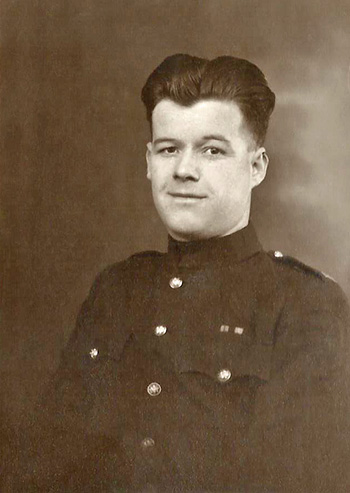
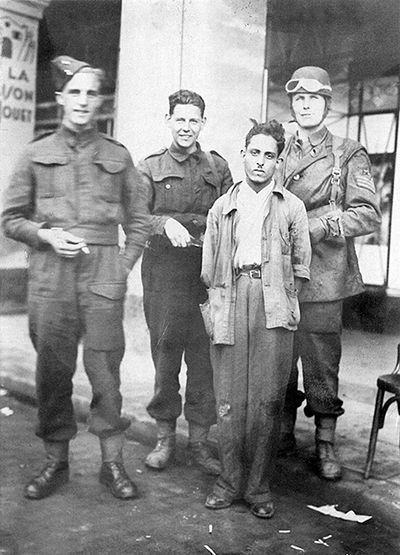
penman-1946_r72

A hale and hearty Thomas Penman in 1946, after medical treatment for malnourishment in Chepstow, Wales— a “fattening up” gradually on small amounts of food, chocolate, and milk

I received a note from Helen McGregor, who lives just outside Glasgow, Scotland, last month.

She wrote, “My father was one who escaped from the camp at Servigliano and lived with an Italian family for at least one year.

“He is dead now, but I know he was mentioned in dispatches and given a hero’s welcome home. His name was Thomas Penman and he was from Glasgow, Scotland.”

Thomas Penman, Highland Light Infantry, was captured in North Africa between El Alamein and Tobruk and shipped to Italy. He escaped capture twice.

The following accounts are among those Helen’s father shared with her older siblings over different periods of time. Although the details are sketchy, the stories are nonetheless compelling.

Continue reading

In Print—New Escape and Evasion Devices Book

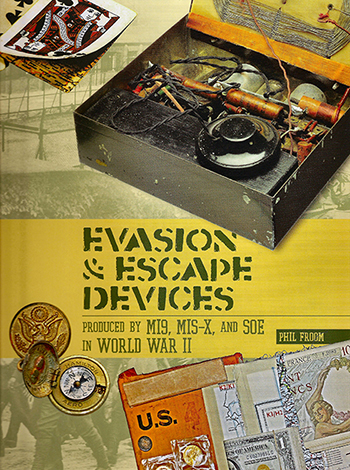
phil-froom-cover_r72

British researcher and author Phil Froom recently told me about his new book, Evasion and Escape Devices Produced by MI9, MIS-X, and SOE in World War II.

The book concerns the profusion of covert E & E devices produced during WW II by the British intelligence agency M.I.9 (Military Intelligence–Section 9, the parent organization of I.S.9, or Intelligence School 9), its mirror U.S. agency MIS-X (Military Intelligence Service–X), and SOE (British Special Operations Executive).

These organizations were responsible for the invention, production, and distribution of a huge variety of these ingenious devices issued to Allied air crew and Special Forces, which would enable them to evade capture after being forced down, or cut off behind enemy lines in occupied Europe.

Published by Schiffer Publishing, Ltd, the book was released in the UK in January of this year.

Continue reading

Letter from P.G. 59 Chaplain “Niel” Nye

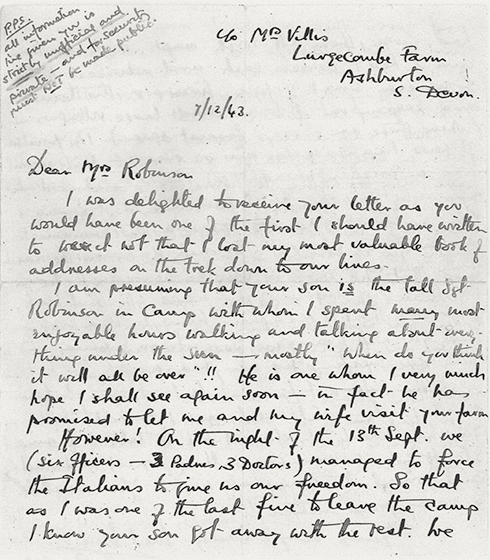
robinson-nye-letter1_r72

robinson-nye-letter2_r72

Georgina Stewart, daughter of Don Robinson, who was a prisoner in P.G. 59, shared a letter with me that was written by Reverend Nathaniel “Niel” Nye to her mother during the war.

The letter offered reassurance as to the likely current situation of Don Robinson, then missing in Italy after the breakout from P.G. 59 in September 1943. It also offers us insight into the character of Niel Nye, and it provides details about the breakout.

Nathaniel “Niel” Kemp Nye was an Anglican chaplain in the British Royal Air Force.

The London Gazette of February 6, 1940 indicates Niel (service number 77267) was granted a commission “for the duration of hostilities with the relative rank of Squadron Leader” on January 18, 1940.

After his capture, Niel was interned in Camp 59.

Here is the text of the letter:

c/o Mrs Villis
Lungecombe Farm
Ashburton
S. Devon.

7/12/43. [December 7, 1943]

Dear Mrs Robinson

I was delighted to receive your letter as you would have been one of the first I should have written to were it not that I lost my most valuable book of addresses on the trek down to our lines.

I am presuming that your son is the tall Sgt. Robinson in Camp with whom I spent many most enjoyable hours walking and talking about everything under the sun — mostly “When do you think it will all be over”!! He is one whom I very much hope I shall see again soon—in fact he has promised to let me and my wife visit your farm.

Continue reading

Trading Weapons for Ploughshares

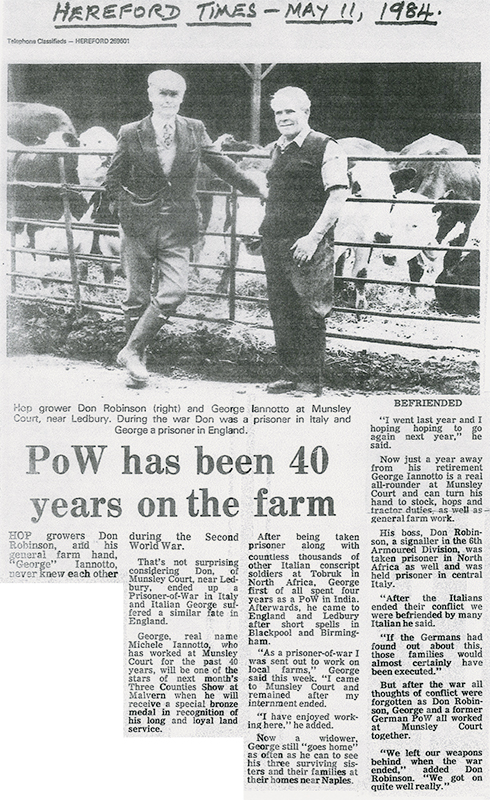
Former Camp 59 internee Don Robinson’s daughter, Georgina Stewart, sent me the heartwarming news story featured in this post, which appeared in the Hereford Time (Herefordshire, England) in 1984.

See also “Sergeant Don Robinson—Captive and Escapee.”

robinson-article-r72

PoW has been 40 years on the farm

Hereford Times
May 11, 1984

Caption: Hop grower Don Robinson (right) and George Iannotto at Munsley Court, near Ledbury. During the war Don was a prisoner in Italy and George a prisoner in England.

HOP growers Don Robinson, and his general farm hand “George” Iannotto, never knew each other during the Second World War.

That’s not surprising considering Don, of Munsley Court, near Ledbury, ended up a Prisoner-of-War in Italy and Italian George suffered a similar fate in England.

Continue reading

Sergeant Don Robinson—Captive and Escapee

robinson-africa-sm_r72

Algiers, late 1942. Don Robinson is on the far right.

Sergeant Donald George Robinson, Royal Artillery, was captured on January 21, 1943 during a night skirmish with Rommel’s Afrika Korp at Bou Arada in Tunisia. From North Africa, he was transferred to P.G. 59 in Servigliano.

In September 1943, Don escaped with the other prisoners during the general breakout from camp that followed the signing of the armistice.

For several months, he was protected by the Luciani and Dezi families who lived in the countryside near the camp.

Through the help of local partisans, Don returned to Allied control in May 1944.

Don and his wife Monica returned to Italy in the 1960s. They stayed with the Dezi family and visited with members of the Luciani family as well.

Don died in 1992, at the age of 76.

Twenty-two years later, Don’s daughter, Georgina Stewart, traveled to the Marche with her husband John. Aided by Ian McCarthy and his wife Gabriella, they succeeded in finding members of both the Luciani and Dezi families.

Georgina recounted this adventure in a story she wrote for the Monte San Martino Trust website. See “Where Donald Robinson Hid.”

robinson-visit-5_r72

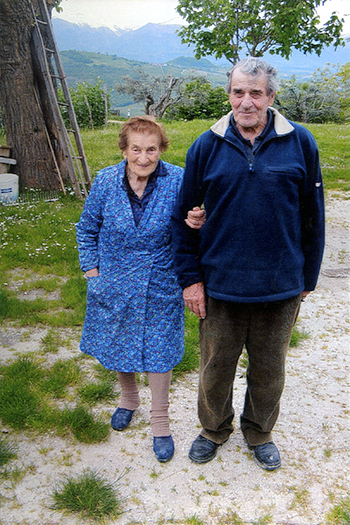
Nino Dezi with his wife Josephine. Georgina writes, “As as eight-year-old, Nino used to take food down the hill to my father, who was staying with the Luciani family. When my father and mother visited in the sixties, they stayed with the Dezi family.”

Continue reading

Update—Search for the Soldier Hidden in Petritoli

Petritoli-Monica-Vitali_r72

The comune of Petritoli in the Italian Marche. Photograph by Monica Vitali (Wikimedia Commons).

There is a new development in the search for information about the escaped POW who was helped in the comune of Petritoli during the war. (See “Escaped Prisoner Sheltered in Petritoli.”)

My earlier post explained that Roberto Lucci is attempting to make contact with the family of an escaped prisoner who was sheltered by his great-grandfather, Luigi Lucci, in 1943–44.

Recently, Roberto was told by elders in Petritoli that William and David were part or all of the first or last names, so the soldier’s last name might have been something like David Williams or William Davidson.

However, since I published the earlier post, a document has surfaced in Petritoli identifying the escapee as “David Grif. prigioniero inglese” (David Grif. English prisoner).

Although the first name was recorded as David, is is conceivable that William was his middle name, or that William was his first name and David his middle name and that he preferred to be called David.

Grif is not a common English name, and the period suggests the name might be abbreviated. The “Alphabetical List” sent to me by Brian Sims, contains 81 soldiers with names beginning with “Grif”—Griffin, Griffith, and Griffiths.

Continue reading

A South African Pilot’s Sacrifice Memorialized

indigo-soldier_r72

I received word today about an excellent short film available online.

The referral was from my friends at Associazione Salerno 1943—a group of Italian volunteers who are dedicated to investigation of WW II Allied plane crash sites in Italy, and to preservation of the memory of the airmen who lost their lives.

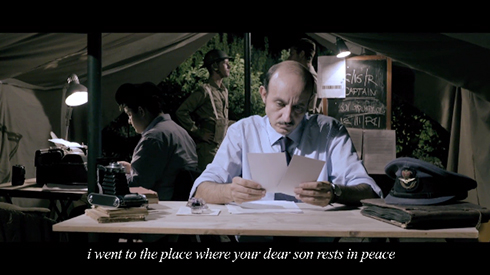
The film, A Soldier of the Second World War, (youtu.be/JSD5eBH9cAE) concerns Lieutenant Cornelius Cecil Geldard, an pilot of the South African Allied Forces of the Royal Air Force. His Spitfire fighter was shot down over southern Italy on March 30, 1944. He died in the crash at the age of 32.

A Soldier of the Second World War was written, filmed, and directed by Vincenzo Campitiello and Letizia Musacchia, and was recently released by INDIGO sas.

The sensitively-crafted film is a beautiful tribute not only to Lieutenant Gelgard, but to all who lost their lives during the war, many of whom are buried far away in foreign soil.

The Commonwealth War Graves Commission cares for cemeteries and memorials at 23,000 locations, in 154 countries.

There are many war cemeteries throughout Italy—ranging in size from Cassino, where 3,983 are buried, to communal cemeteries where a single soldier rests.

You can learn more about Lieutenant Gelgard and the recovery of the Spitfire in which he died on a page of the Salerno 1943 website, “Lo Spitfire JF879.” English speakers can access the page in English.

On this site, read also “Remembering Robert Dickinson.”

I.S.9—Periodic Report for January 15–25, 1944

Robb-15-25-Jan-44

First page of Captain Robb’s seven-page periodic report

The transcription and notes in this post—a January 1944 “periodic report” filed by Captain Andrew Robb—are by Dr. Luigi Donfrancesco, nephew of I.S.9 agent Andrea Scattini.

Our original access to this document (from the British National Archives) was courtesy of researcher Brian Sims.

This document is a treasury of information, including details on operations and future plans, POWs and evaders recently brought across the lines, and a list of Italian agents at work for I.S.9 at the time.

In a remarkable passage of the report, Captain Robb refers to the outstanding service of these agents:

“In the performance of their extremely difficult and dangerous tasks, the incentive to turn back is great; the incentive to stay on the other side of the line is greater. And yet, of the nine most recently returned, two are hospital cases, three others are receiving daily medical attention. One walked for twenty-four hours through the snow, despite a case of malaria and a bullet wound; another crossed the [Mount] Maiella with a foot too swollen and infected to permit the wearing of a shoe. Only unusual loyalty and determination would produce such results, which, were it allied personnel, we believe would win them immediate military awards.”

Luigi Donfrancesco wrote, “This report gives a perfect idea of all the efforts and risks of rescue operations. It shows the excellent organizational capabilities of I.S.9 officers of the 8th Army and the tremendous job done by Italian agents and guides in helping and saving the POWs.

“We have to remember that winter 1943-1944 was particularly severe in that part of Italy and there was a lot of snow. That made harder the transfer at night and by foot of POWs across the front to the Allied lines.”

See additional I.S.9 reports at “I.S.9 Progress Reports for November 4–21, 1943,” “I.S.9 War Diary—November 17–20, 1943,” “I.S.9 Situation Report—November 3–4, 1943,” “I.S.9 War Diary—December 16–29, 1943,” and “I.S.9 Situation Report—November 12–13, 1943.”

For background information on Captain Andrew Robb, see “I.S.9 Officers—Biography.”

Some corrections in spelling have been made in the transcript below, including the corrected spelling of the comune of Paglieta for Paglietta; Alberto Pietrorazio’s name, which is spelled Pietrorazzo throughout the original document; and the comune of Manoppello, which is spelled Manopelle in the document.

MOST SECRET

PERIODIC REPORT OF No. 5 FIELD SECTION 15 Jan – 25 Jan [January 15–25, 1944].

Following the interrogation of my agent by 5th Corps on Jan 8, and the interest his information aroused, I have, whenever possible, supplied formations with such items of information as were of immediate interest to them. This finally culminated in 4 Ind. Div. [4th Indian Division] sending to me a Cpl. [Corporal] Bjorkman who was about to penetrate to find certain information required by them. Fortunately, as it happened I could give them some indication of where to look and a route through the enemy lines, one of those used by my agents. This was immediately followed by inquiries by 13th Corps; they were contacted. I returned to Lanciano. I was phoned and then told that some of my agents were at 13th Corps H.Q. [Headquarters] where they had been held for interrogation. This meant another visit to Corps at Paglieta and I foresaw that these calls for information, the holding back of agents for interrogation might get out of hands and seriously impede our only object – that of getting exP/Ws [ex prisoners of war] out.

Continue reading

I.S.9 Officers—Biography

Dr. Luigi Donfrancesco, nephew of I.S.9 “A” Force agent Andrea Scattini, has discovered a number of online sites that offer information on six key I.S.9 officers.

These officers—Andrew Robb (New Zealand), Richard W. B. Lewis (United States), Bridges George McGibbon-Lewis (UK), Major John Francis Fillingham (UK), Major John Alec McKee (UK), and Raymond Lee Couraud (France)—are mentioned frequently in the official I.S.9 history and in I.S.9 situation reports and war diaries on this site.

The men were active in I.S.9 No. 5 Field Section operations along the the Adriatic coastline of Italy.

Captain Andrew Robb

An entry for Andrew Robb is included in unithistories.com, “British Army Officers, 1939–1945”:
http://www.unithistories.com/officers/Army_officers_R02.html

Here are a few details from that entry:

Born March 20, 1901 in Dunedin, New Zealand

Employed by the Colonial Service and lived in Malaya

Continue reading

I.S.9 Situation Report—November 12–13, 1943

SITREP-Nov-12-13-1943-r72

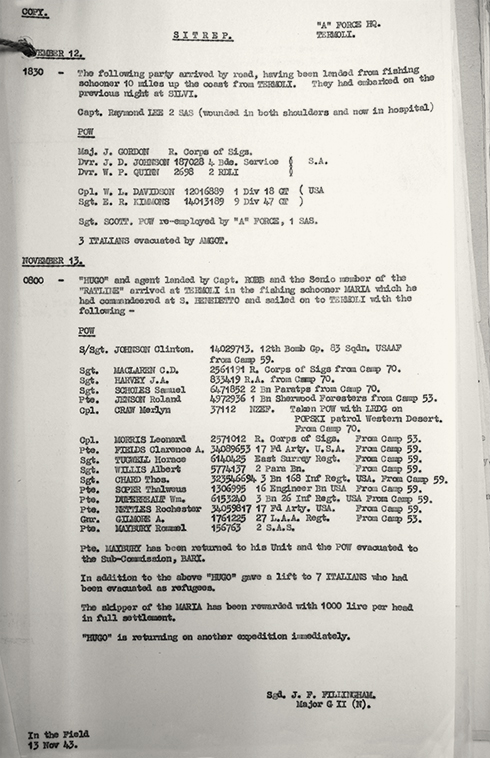
A one page I.S.9 “SITREP” (situation report) for November 12–13, 1943

The transcription and notes in this post are by Dr. Luigi Donfrancesco, nephew of I.S.9 agent Andrea Scattini.

Access to this document (from the British National Archives) was courtesy of researcher Brian Sims.

See additional reports at “I.S.9 Progress Reports for November 4–21, 1943,” “I.S.9 War Diary—November 17–20, 1943,” “I.S.9 Situation Report—November 3–4, 1943,” and “I.S.9 War Diary—December 16–29, 1943.”

This report is particularly interesting in that it contains lists of POWs rescued on these two dates, including several from P.G. 59.

Continue reading