
I’d like to direct readers to an exceptional list of books by or about Allied prisoners, many of whom escaped from their Italian prison camps.
This bibliography, compiled by my friend Julia MacKenzie, has already been shared through the Monte San Martino Trust website. I’m mentioning it here to further promote it as a resource; without a doubt it’s the most comprehensive list of stories about POWs in Italy compiled to date.
I asked Julia how she came to assemble her bibliography. She said:
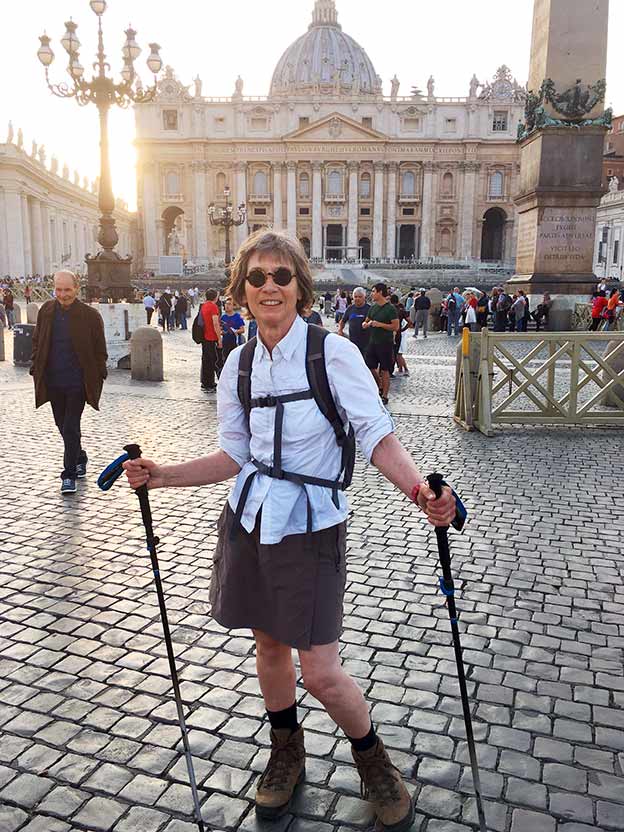
“I’ve been interested in the story of the Allied PoWs in Italy since I read John Verney’s two books (Going to the Wars and Dinner of Herbs) about his experiences. A 250-mile walk down Italy from Tuscany to Rome that I did in the month of September 2017, touching on the routes taken by the Allied PoWs as they made their way south to the Allied lines in 1943–44, led me to want to read more of the PoWs’ reminiscences. I started to look for books on the subject and for a list I could refer to. Not finding one, I started to compile my own bibliography as I located books.
“The list, now grown to 277 items, can be found on the Monte San Martino Trust website. It is also available in annotated form (a work in progress) on LibraryThing, with details of the contents of the books and tabs for the different PoW camps and nationalities of the PoWs to make it searchable. I hope it helps those doing research or who want to read more of these fascinating accounts of bravery and endurance complemented by the humanity of the Italian helpers in the midst of war. And if anyone finds a book that is not on the list, please let me know at jcgmackenzie@gmail.com.”
Below are titles taken from the bibliography that highlighting only those books that concern POWs held in the camps of Italy’s Marche region.
Keep in mind that this list is current as of February 2026. Julia continues to refresh her online bibliography with new titles, so consult the full LibraryThing list at any time for the latest additions!
Books by or about PoWs held in PG 53 Sforzacosta (Macerata), PG 59 Servigliano and PG 70 Monteurano (Monte Urano)—PoW camps in the Marche
Aceves, Crystal, Captured by the Enemy: The True Story of POW Carl Leroy Good. Privately published, 2015
Good (1919–2011) was a driver for the US Army, 3rd Division, 7th Infantry, Cannon Company. He was captured in Sicily on 17 July 1943 and after time in other camps ended up as a PoW in PG 59 Servigliano. He escaped through a hole in the wall as part of the mass breakout on 14 September after the Armistice. He teamed up with Jim Martelli and they hid in the mountains near the village of Monte San Martino for nine months, aided by Giovanni Straffi and his family. They started south in June 1944 and met British troops near Ascoli. By 2 August 1944 Good was back in the US. The book is written by Good’s granddaughter and is based on Good’s wartime diary and Aceves recordings of his stories.
Allardice, Dallas, Friendship in a Time of War (1939–46). High School of Dundee, Dundee, 2004; reissued in larger format by Createspace Independent Publishing Platform, 2015
William Dallas Allardice (1919–2003), from Huntly, Aberdeenshire, joined the London Scottish 1st Battalion at the start of the Second World War. He volunteered for an “Independent Company” that served in Norway, and then did commando training at Arisaig and at the School of Irregular Warfare at Inverailort. As a member of a Special Service Battalion he arrived in Malta in January 1941 (witnessing an attack on HMS Illustrious en route) for further training on submarines for possible raids on Sicily and Italy. From August 1941 he was in the Middle East, training in sabotage at Latrun, near Jerusalem, serving in Syria and then with the Long Range Desert Group. Although he was offered officer training, he declined. He was captured on a raid on Tobruk (Operation Agreement), in September 1942, with his friend John MacKay with whom he shared his subsequent adventures. They escaped from PG 70 Monteurano in the Marche dressed as Italian soldiers after the Germans had taken over the camp at the Armistice. They spent months in the Abruzzi mountains just north of the Pescara river helped by inhabitants of Scarafano (near Capostrano), who were members of the Pentecostal Church (converted by those who had returned from USA). They hid in grottoes and were fed and given shelter in the bad weather by the Ciccone family. Showing fortitude and sense, they narrowly missed capture on a number of occasions. They were Scots, which meant that the Pentecostals would not have to lie (which was against their religion) when they were asked by the Germans if they had seen any English PoWs. They finally made contact with the Allies in June 1944 (“Free after two years of hell”). The last part of the book covers his return to the UK, the end of the war (he trained recruits after his return) and restarting his life. As a rugby player, he gained eight international caps for Scotland between 1947 and 1949. He worked as a PE teacher at Aberdeen Grammar School and Dundee High School, where he rose to become assistant rector before his retirement in 1984. Photographs include some taken during his time with the LRDG. The book includes his brief diary entries 26 Sept 1943 – 4 July 1944. It also includes short biographies of key companions and a record of postwar encounters with the Ciccone family. An excellent first-hand account.
Bains, Lawrence, Nine Months Behind German Lines. Privately published (Lulu.com), 2013
In 1942 Lance Corporal Lawrence Bains (1920–2015), serving in the Middlesex Yeomanry, was captured in North Africa and sent to PG 53 Sforzacosta. He escaped at the Armistice in 1943, and went on the run in the hills and villages of the Marche. Starting with no supplies, no money and knowing no Italian, he lived with the peasant farmers of the Marche for nine months before being repatriated as the Allied Forces moved up the Italian peninsula. After the war he was a Conservative politician in London, becoming Chairman of the Greater London Council 1977–78, and was a member of Lloyd’s of London.
Baird, Archie, Family of Four. Mainstream Publishing, Edinburgh, 1989
Archie Baird (1919–2009) served in the medical corps in the British Expeditionary Force in 1940 and although he missed the evacuation at Dunkirk he managed to board the last ship out of St Nazaire when France fell. He was later sent to North Africa and at the fall of Tobruk in the summer of 1942 he was captured when his field ambulance was surrounded by German tanks. He was sent to Italy and escaped from PG 53 Sforzacosta at the Armistice. Severe winter weather set in as he made his way south with his comrade Harold Smith; Baird was sheltered by the Pilotti family who also found safe houses for Smith and another fugitive. He picked up Italian and posed convincingly as the son of his courageous benefactors, to whom he became devoted and with whom he embarked on a lifelong friendship. He finally made contact with the Allies in June 1944. After the war he played football for Aberdeen, making 104 league appearances, and was also capped once (1946) by the Scottish national football team. He became a PE teacher and sports writer in Aberdeen and earned degrees in English and Italian, later teaching Italian in an evening class. His brother-in-law was the journalist Magnus Magnusson.
Broadbent, Gilbert, Behind Enemy Lines. Anchor Publications, Bognor Regis, 1985
Broadbent was a signaller with the 60th Field Regiment Royal Artillery who was held in PoW in PG 59 Servigliano and PG 53 Sforzacosta. He escaped at the Armistice and eventually made contact with the Allies at Terni, northeast of Rome, in June 1944.
Buckland, John, Adriatic Adventure. Robertson and Mullens, Melbourne, 1945
John Cyril Buckland (1920–2004) was a Flight Sergeant in the Royal Australian Air Force attached to 14 Squadron RAF as a navigator when he became a PoW. The book begins with a flight from Algeria on 12 April 1943 in a Marauder 375 aircraft to bomb Naples. Buckland was one of three Australians in the crew (and was a last-minute replacement). The plane was shot down by a Focke Wulf 190 near the island of Ustica off the north coast of Sicily (five of the six crew survived the ditching), where they were taken by Italian fisherman who rescued them. He was held at PG 53 Sforzacosta with his pilot Flight Sergeant Len A. Einsaar DFM RAAF (1913–1994) and describes daily life in the camp. When the Germans took over the camp at the Armistice, Buckland and Einsaar with two members of the RAF and an artillery sergeant hid on the roof of one of the accommodation blocks when the rest of the prisoners were taken to Germany. On 24 September they cut through the fence wire and escaped. They spent time living with Italian farming families in the area of Urbisaglia until with the aid of British commandos they were evacuated by motor torpedo boat to Termoli on 25 May 1944. Buckland returned to Australia and the book was published in 1945, giving it the freshness of recent events. The book contains photographs of Buckland and Einsaar.
Chambers, George W., Keith Argraves, Paratrooper: An Account of the Service of a Christian Medical Corpsman in the United States Army Paratroops During World War II. The Southern Publishing Association, Nashville, Tennessee, 1946; reprinted by Kessinger Publishing, 2007
Keith Argraves (1914–1974) served as a medic with the 509th US Parachute Infantry Regiment. A Seventh-day Adventist, Argraves stated both the importance of his being able to observe the Sabbath, when he would need to be released from duty, and his refusal to carry a weapon. Following his capture at the El Djem Bridge Mission on 26 December 1942 in North Africa, and time in PG 98 near Palermo on Sicily, Argraves was imprisoned at PG 59 Servigliano until he escaped at the Armistice. He travelled south with a group of other American POWs and they were given shelter in the village of Falciano from 3 October to 15 January, aided by Saturnino Brandimarte. While there, they made two abortive attempts to be picked up by boat from the Adriatic coast. Ultimately, they were betrayed by a German priest in Falciano and six of the group including Argraves were recaptured (two others made it to the Allied lines). After time in Rome, they were marched 70 miles to PG 82 Laterina. Argraves made two further unsuccessful escape attempts on the train journey to Germany, where he was held until released in a swap of 74 medics for 71 German nurses via Switzerland and sent back to the US on a ship from Marseille. His story was told to George W. Chambers, an Arizona businessman, civic leader and amateur historian shortly after his return to the US.
Copley, Anne, The Girl with a Peach. Monte San Martino Trust, 2024
Drawing on personal memoirs of former PoWs (many in the Marche camps), Anne Copley recounts the remarkable story of the escape of Allied PoWs after the Italian Armistice in September 1943. What distinguishes Copley’s account from other books on the subject is that it is told from the perspective of the ordinary soldier, which has been too long neglected. It tells of Allied servicemen being given shelter by the most oppressed in Italian society, the contadini or sharecroppers, who risked death and destruction by doing so. The highs and lows of this extraordinary coming together of former enemies, as PoWs dodged capture by Fascists and Nazis, is captured in telling detail.
Dann, Len, Laughing We Ran. Privately published, Tucann, Heighington, Lincolnshire, 1995
A gunner in the Royal Artillery, Dann was captured at Tobruk in 1942 and was a PoW in PG 53 Sforzacosta. He escaped at the Armistice and was on the run until June 1944 when he made contact with the Allies. He wrote this memoir of life behind enemy lines in 1968 but it was not published until after his death in 1995.
Davison, G. Norman, In the Prison of His Days: The Memoirs of a Captured World War II Gunner. Scratching Shed Publishing, Leeds, 2009
Norman Davison (1913–1986) signed up in 1938 in Sheffield as gunner in the 37th Battery of the 13th Light A/A regiment in the Royal Artillery (T.A.). He was shipped to Egypt in 1940 and took part in Operation Compass before being captured on 8 April 1941 near Mechili, Libya. He spent nearly eight months in Tripoli working for the Axis in gruelling conditions. In January 1942 he was transported to Sicily and then from February was held in PG 59 Servigliano, remaining there until June 1943 when he moved to a work camp at Vigevano, southwest of Milan, in Lombardy. The PoWs worked in the rice fields and were better fed. They were well treated by one of the farmers, Giovanni Belazzi, who aided Davison, Gerald Blake (a commando) and other PoWs at the Armistice and they continued working on his farm until late October 1943. Belazzi helped Davison and Blake to escape to Switzerland via Milan and Como, where two mountain guides enabled them to cross under a border fence, arriving on 28 October. Davison spent a year in Adelboden before being repatriated via Marseilles, arriving in the Clyde four years after his departure for Egypt. Davison kept a diary and wrote up his account after his return, typing it up shortly before his death. It was discovered in an attic by his son and published in 2009 with photographs. It is a well written, honest and vivid account, with valuable detail of life as a PoW, culminating in the uncertainties following the Armistice and the dangerous journey to Switzerland. After the war Davison became Chief Inspector of a Life Insurance Company and never left the UK again.
Dorney, Richard, An Active Service: The Story of a Soldierʼs Life in the Grenadier Guards, SAS and SBS, 1935–58. Helion, Solihull, 2009
Sid Dowland joined the Guards in the 1930s and took part in the retreat to Dunkirk and served in North Africa. He volunteered for the SAS and was captured during Operation Hawthorn in Sardinia (July 1943). He escaped from PG 59Servigliano and made it back to England. He told his story to Richard Dorney. See Keith Killby’s account (also captured on Operation Hawthorn).
Duke, Vic, Another Bloody Mountain: Prisoner of War and Escape in Italy 1943. Iron City Publications, Hebden Bridge, 2011
Lance Corporal Wallace (Wally) Douglas Duke (c. 1915–2002) was a regular soldier serving with the Kings Own Royal Regiment in India when the Second World War broke out. He first saw action in Iraq in 1941, then sent to North Africa in 1942 as part of the 10th Indian Division. He was captured during the first battle of El Alamein in June 1942 and became a PoW. Following the Italian Armistice, he escaped from PG 53 at Sforzacosta on 15 September 1943, with four other PoWs. After a few days, he struck out on his own and trekked south via the Gran Sasso (which he crossed with the aid of partisans) and the Maiella to reach the British front line at Guglionesi, south of the Trigno river, on 15 October after a 30-day 438 km (274 miles) walk. This account by his son, Vic, tells of Wally’s capture, life as a POW and escape south, which Vic retraced in 2009 by car. The story is supplemented by colour photos taken of PG 53 and the route through the Apennines. As a regular soldier, Duke kept to his own rule of staying in a place only one night and moving on. Those he escaped with did not follow this and were all recaptured.
Ellis, Ray, Once a Hussar: A Memoir of Battle, Capture and Escape in the Second World War. Pen & Sword, Barnsley, 2013
Ray Ellis (1920–2014) was a gunner in the 107th RHA, South Notts Hussars, who fought in the Western Desert and was the last soldier to fire on advancing German troops in the Battle of Knightsbridge in 1942. After his capture, he was held in PG 53 Sforzacosta, from which he escaped, and was sheltered by a family from the hill village of Massa Fermana, near Ancona. He frequently returned to visit the family after the war. See also Anne Copley’s interview with Ray Ellis.
Harris, G.H., Prisoner of War and Fugitive. Gale & Polden, Aldershot, 1947 (digital version)
Harris was captured while serving with Anti-Tank Platoon, 2nd Bn. KRRC, Western Desert, June 1942. He was a PoW in PG 53 Sforzacosta, but in June 1943 was moved to a work camp ten miles south of Verona. The PoWs walked out of the camp at the Armistice and Harris spent ten months behind the lines before contacting the Allies near Macerata in June 1944. His companion [unnamed in the book] was William Gleave.
Ieranò, Filippo, A People’s Courage: Civil Resistance in German-occupied Italy. Monte San Martino Trust, 2022; Italian edition: ‘Antigone nella Valle del Tenna’, Consiglio Regionale delle Marche, Ancona, 2002
In September 1943 the quiet, rural region of Le Marche, in central eastern Italy, was thrown into turmoil by Italy’s Armistice with the Allies. The region’s prisoner of war camps were holding about 22,000 Allied servicemen who had been captured in North Africa. At the news of Italy’s surrender many of the prisoners escaped into the countryside. Hunted by the occupying German army and Italian fascists, they were in danger and in desperate need of food and shelter. They threw themselves on the mercy of ordinary people, in the main subsistence farmers, who themselves risked severe punishment, even death, if they were caught offering protection. Through interviews with members of the Italian families who hid escaped prisoners, historian Filippo Ieranò describes the tension and fear that afflicted the region until the Allies arrived to liberate it. He makes clear, too, the sacrifices made by these farming families, known as contadini: though poor, they shared what little they had with their unexpected guests.
Killby, J. Keith, In Combat, Unarmed: The Memoir of a World War II Soldier and Prisoner of War. Monte San Martino Trust, London, 2013; also published in Italian, In Guerra Disarmato. Privately published (Antonio Millozzi), 2015
Killby (1916–2018) was a conscientious objector serving as a medic who was captured on a SBS (Special Boat Service) raid on Sardinia (Operation Hawthorn) in July 1943 and became a PoW in PG 59 Servigliano. He escaped at the Armistice and walked south but was recaptured near the Allied lines and transferred to Germany. In 1989, he founded the Monte San Martino Trust, which offers scholarships to young Italians to study in the UK to honour the help given by Italians to escaped PoWs in the Second World War.
Mann, George, Over the Wire. Fremantle Arts Centre Press, 1988
Mann (b. 1909) describes his upbringing and life in South Acton, London before he became a soldier in the Rifle Brigade in 1940. He arrived in Egypt in November 1941 and was captured west of Mersa Matruh not long afterwards. After three months in PG 66 Capua he was transferred to another camp before moving to PG 53 Sforzacosta later in 1942. Mann’s book has good detail on camp life and tells of how he starts trading items with a camp guard. He makes friends with Rex and Bob of the King’s Royal Rifles and they acquire a pair of wire cutters that enable them to cut their way out of the camp in late August 1943 (before the Armistice). They spent time in and around Gualdo, Penne and Ascoli, meeting a partisan group and tried to make it to the Allied lines but came back to be sheltered by the Morganti family, who had first helped them after their escape. In their wanderings Bob and George lost contact with Rex. The two men finally made contact with the Allies in the Ascoli area in June 1944. Mann returns to work as a milkman and became a trade-union shop steward. With his wife and young family, he emigrated to Perth, Australia in 1956.
Mayhead, Chas, Rumours: A Memoir of a British POW in WWII. Pleasure Boat Studio, New York, 2002
Charles ‘Chasʼ Mayhead served with the Royal Army Service Corps. After capture in North Africa in 1942, he was held for a short while in a camp near Naples, then transported north and was in PG 53 Sforzacosta. Later, in 1943, he escaped from another camp and managed to hide out for two months near Novara. As the Germans entered the area, he made for Switzerland, but was recaptured near the Swiss border and ended up at Stalag XIB at Fallingbostel near Hanover.
Millar, J.H.D., The Memoirs of J.H.D. Millar written for his family, edited by Vermiglia Concetti, Filippo Ieranò, Antonio Millozzi and Giuseppe Millozzi. Associazione Casa della Memoria, Servigliano, 2008 [bilingual English/Italian]
Captain J.H. Derek Millar (1914–2004), Royal Army Medical Corps, who was captured in the Western Desert and held in PG 59 Servigliano, was both the camp’s chief medical officer and highest-ranking British officer. Millar was responsible for defying the War Office’s “Stay Put Order” after the Armistice and was instrumental in securing the escape of about 2,000 prisoners from Servigliano. Millar himself left the camp with Corporal Howard Jones and they were assisted by Italians as they travelled to San Benedetto del Tronto on the Adriatic coast. From there they escaped on a fishing boat with other escaped prisoners to Allied-controlled Termoli.
Moss, Eric, Solvitur ambulando (Saved by Walking). Amberwood, Swanage, 1990
Moss (b. 1918) was a wireless operator/air gunner in the RAF and the book starts with his training. He writes about his time in Gibraltar, Malta and Egypt before his Baltimore bomber was shot down on 9 October 1942. He was shipped from Tripoli to Italy in December 1942. After less than a month in PG 66 Capua he was moved to PG 70 Monteurano and he gives a good description of camp life. Moss escaped with Fusilier John McHugh in the days following the Armistice when they crawled under the wire while the guards were distracted. They were sheltered by the villagers of Monte Giberto about ten miles from the camp. They remained in the area until being evacuated by sea from a beach near Porto San Giorgio in a party of 98 PoWs by A-Force on 24/25 May 1944. The long-drawn out and frustrating process of dealing with red tape as a former PoW and getting back to England is well told, giving an insight into the attitude of other ranks to superior offices. The book concludes with a description of a return visit to Italy in 1989 and finding those who had helped him when on the run.
Newton, Robert A., Soldiers of the Strange Night. Freedom Street Press, Hillsboro, Oregon, 2015
This is the harrowing story of two Americans who escaped in the mass breakout from PG 59 Servigliano on 14 September 1943, written by the nephew of one of them (with the same name). Corporal Robert Alvey Newton, a gunner in the tank corps of the US Army’s 1st Armored Division, had been captured at Sidi Bou Zid in North Africa on 15 February 1943. He and Martin Majeski (from an artillery unit attached to the 1st Armored Division) were sheltered by the Viozzi family for nearly six months until 9 March 1944, when they were betrayed to an elite German commando unit, caught and immediately executed.
Page, Arthur, Una Bella Passeggiata: Or a Walk in Wartime Italy. Air Forces Publishing Service, 1995 (The full content of Una Bella Passeggiata has been shared on the Camp 59 Survivors site courtesy of the family of Arthur Page.)
Sergeant Arthur Page of the Hampshire Regiment was captured at the Battle of Tebourba Gap in North Africa in December 1942. He was a PoW in PG 59 Servigliano and escaped at the Armistice, reaching the Allies in August 1944.
Reynolds, Ben, Call Me Corp. New Holland, London, 2015
Corporal E.F. Reynolds MM (1920–2004), South Wales Borderers, was captured at the Battle of Gazala, 18 June 1942 and held at a camp at Tarhuna, south of Tripoli, until October, when he was moved to Italy. He was a PoW in PG 70 Monteurano until the Armistice in 1943 and was then involved in an abortive escape attempt. But on the train journey taking him to Germany he jumped somewhere between Pesaro and Senigallia and was on the run for 58 days. Near Foligno he joined an Italian on the walk south. He was recaptured by Germans near Agnone but escaped when there was an air attack just before he was to be shot as a spy, and crossed the lines, meeting a Canadian patrol. The book was written in the 1970s and prepared for publication in 2015 by Reynolds’ daughter Gina. Illustrations include Reynolds’ plan of PG 70.
Robillard, Chris, From Barry to Bari. Devon Matters Publishing, Bovey Tracey, 2015
Account by the son of David Robillard, Corporal, Royal Army Service Corps. In November 1942, Robillard was a PoW in PG 53 Sforzacosta but later was moved to a work camp at Zevio, east of Verona. He escaped in July 1943 and from November was hidden by a family about 30 miles south of Verona for 18 months. He worked on the farm and provided his services to the village as a butcher. In April 1945, he was recaptured and taken up to the Brenner Pass. He escaped again with the help of two Gurkhas and reached the American lines on 7 May 1945.
Rogers, Bob, Sixty Bonus Years: A Tale of Survival. Privately published, Palmerston North, NZ, 2003 (digital version)
Rogers was brought up in North Shields, where his father worked in the ship-repair yard. When war was declared he joined the Durham Light Infantry. He spent five months on Cyprus and time in Iraq before fighting in Egypt. He was captured in July 1942 and boarded the ‘Nino Bixio’, but survived when it was torpedoed on 17 August. He was held at PG 70 Monteurano before transfer to work on a farm near Parma. At the Armistice he escaped with his mate Les Stewart. After help from local Italians, they later moved north by train to the village of Gaina near Brescia. With Fred Oliver, another member of the DLI (who had transferred to the RAF), Rogers escaped to Switzerland in April 1944. He emigrated to New Zealand in 1957.
Smith, Ruby Simon, Wine, Cheese & Bread: A POWʼs Story of Survival in Italy, as told by Charles Webster Smith. Woodburner Press, Austin, Texas, 1998
Smith (b.1915), a US Army medic and driver from Texas, serving in the 47th Medical Detachment, First Armoured Division, went ashore at Algiers on 8 November 1942 as part of Operation Torch. On 26 November he was captured during the battle of the Kasserine Pass. He was flown to Italy and after a brief stay in PG 66 Capua he arrived in PG 59 Servigliano on 8 December 1942. His description of his nine months in the camp is brief. At the breakout from the camp on 14/15 September he escaped through a hole in the wall. He took shelter in a cave with three other American escapers – Charles Gallo, Everett Kidd and William F. Teschoerner – and they were fed by local families near Comunanza. Smith helped his host with farm work and in January took part in a raid in the snow by the local people on a grain store liberated from fascist control. After months hiding in caves Smith was taken through the lines in a party of 12 US PoWs by three former Italian soldiers, making contact with British troops in Teramo on 20 June 1944. He sailed from Oran and arrived at Boston, Massachusetts on 2 August. The book is in the first person and as recounted to Smith’s wife.
Souza, Ken de, Escape from Ascoli: Story of Evasion and Escape. Newton, Cowden, Kent, 1989; also published in Italian, Fuga dalle Marche. Prigionia ed evasione di un ufficiale di aviazione inglese (1942–1944). Affinità Elettive Uguccione Ranieri Di Sorbello Foundation, Ancona, 2005
Ken de Souza was an RAF navigator who was captured after bailing out over the Western Desert when his Wellington bomber caught fire on a raid to Tobruk in 1942. He was imprisoned at PG 70 Monteurano in Fermo. He escaped at the Armistice and was hidden by the Brugnoni family before he got away from Porto San Giorgio in January 1944 with the help of the SAS.
Symonds, A.J., ‘Youʼre free!ʼ The Story of Life and Service in Campo PG 53. Christian Endeavour Union of Great Britain and Ireland, London, 1948
Symonds (d. 1966) was an Army chaplain who was posted to 7th Battalion 32nd Army Tank Brigade in Egypt in March 1942. He was captured on the run in the desert with his batman about a week after the fall of Tobruk in June 1942. On 3 July he was flown to Lecce and spent four months in PG 75 Bari transit camp from which he was transferred to PG 53Sforzacosta in early November. He was billeted in a room partitioned off from the hospital in the camp and was the first of three padres to arrive in a camp that contained 2,000 PoWs but rose to 8,000. The short book (94 pages) contains quotations from his war-time diary. It is an unusual account as it is from a padre’s point of view. His first experience was of the Christian Endeavour Society that had been set up by some of the PoWs and he describes how some of its members helped him ministering to the sick and dying in the camp hospital. He covers life in the camp: the creation of a church in a storeroom where books of the Camp Library were also shelved, the formation of a Male Voice Choir and lectures organised by a branch of Toc H, publication of ‘The Camptown Daily News’ and two other newspapers as the camp expanded, an arts and crafts exhibition in March 1943, and a Best Cake competition. He tells of the death of Trooper Aaron, a Jew and a Communist who was shot on 2 February 1943 when his foot was just a few inches over the trip wire surrounding the camp. Symonds make visits to Macerata to conduct funeral services for PoWs who had died in the town hospital. The book finishes with the minutes of the meetings of the Christian Endeavour Society from 3 November 1942 to the last one on 15 September 1943 after which Symonds and thousands of the PoWs were transferred to Germany.
Tomkins, Steve, Of Mice and Angels: The Story of a Welsh Prisoner of War. Privately published, Torquay, 2018
Winston Tomkins (1916–1997), a lorry driver in the RASC, was captured at the fall of Tobruk in June 1942 while in a convoy resupplying the Long Range Desert Group. He was held in PG 87 Scalia and from November 1942 in PG 53 Sforzacosta. Tomkins was transferred to work camp PG 148 Bussolengo near Verona in May 1943 and after a month there to the satellite work camp PG 148/6 Bonvagio. He walked out at the Armistice in 1943 and with Clive Gordon Davies was sheltered by the Bonato family in Poiano Maggiore until US troops arrived on 30 April 1945. The book includes photos and extracts from letters and was written by Tomkins’ son, who reconnected with the Bonato family in 2014. Copies can be ordered from elizabethtomkins@btinternet.com
Vaughan, Geoffrey D., The Way it Really Was: A Prisoner of War during World War II Recounts. Granary Press, Budleigh Salterton, 1985
Vaughan, a driver in the Royal Army Service Corps, was captured at Tobruk in June 1942 and spent some weeks in a camp outside Benghazi. After transport by ship to Brindisi he was held in PG 65 Gravina-Altamura from August 1942 and this publication (only 72 pages) contains a lot of good detail about camp life. After the Allied invasion of Sicily in July 1943 he was moved north to PG 53 Sforzacosta. With a group of other PoWs he escaped at the Armistice but within a few hours they were recaptured by the Germans and moved to Germany. He was held at Stalag VIIIB at Lamsdorf and then at a work camp at Landskron. In the chaos of the last days of the war he made it to the American lines at Pilsen. ‘Having seen films about prisoner of war life giving, in my opinion, a totally inaccurate and glamourised picture, I felt I wanted to set the record straight. It was not at all glamorous, it was squalid with very little light relief or humour, and it was completely demoralising.’
 Camp 59 Survivors
Thank you
Sent from Outlook for Androidhttps://aka.ms/AAb9ysg ________________________________