
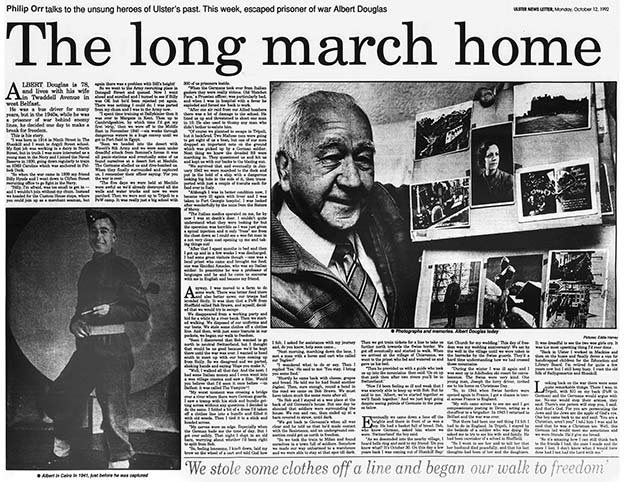
Last September, I was pleased to receive a newspaper clipping from Richard Minshull regarding POW Albert “Paddy” Douglas, about whom I’ve written several posts.
Albert Douglas was Richard’s wife‘s grandfather.
The clipping, published in 1992 in Belfast, Northern Ireland, had been overlooked when Richard sent me a wealth of other clippings, documents, and photos several years ago.
The long march home
Philip Orr talks to the unsung heroes of Ulster’s past. This week, escaped prisoner of war Albert Douglas
Ulster News Letter
Monday, October 12, 1992
Albert Douglas is 78, and lives with his wife in Twaddell Avenue in west Belfast.
He was a bus driver for many years, but in the 1940s, while he was a prisoner of war behind enemy lines, he decided one day to make a break for freedom.
This is his story.
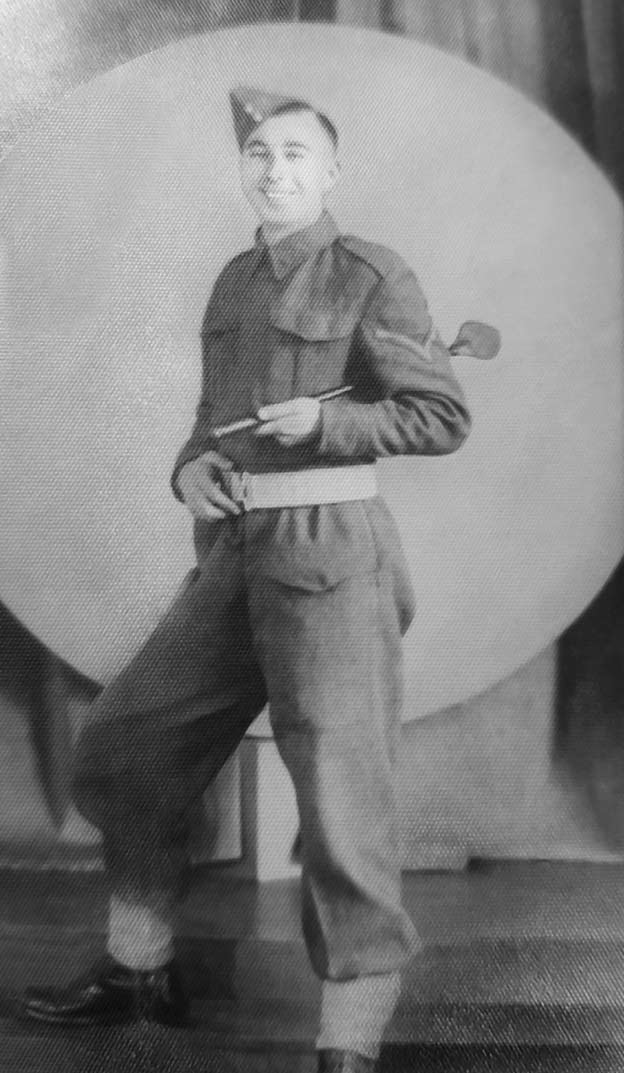
“I was born in 1914 in Ninth Street in The Shankill and I went to Argyll Street school. My first job was working in a dairy in North Street, but in truth I was more interested as a young man in the Navy and I joined the Naval Reserve in 1930, going down regularly to train on HMS Caroline which was anchored in Pollock Dock.
“So when the war came in 1939 my friend Billy Hynds and I went down to Clifton Street recruiting office to go fight in the Navy.
“Billy, I’m afraid, was too small to get in and I wouldn’t join without my chum. Instead we headed for the Custom House steps, where you could join up as a merchant seaman, but again there was a problem with Bill’s height!
“So we went to the Army recruiting place in Donegall Street and queued. Now I went ahead and enrolled and I turned to see if Billy was OK but he’d been rejected yet again. There was nothing I could do; I was parted from my chum and I was in the Army now.
“I spent time training in Ballykinler then it was over to Margate in Kent. Then up to Cambridgeshire, by which time I got my first ‘stripe,’ then we were off to the Middle East in November 1940—six weeks through dangerous waters in a huge convoy until we got to Port Said in Egypt.
“Soon we headed into the desert with Wavell’s 8th Army and we were soon under dreadful attack from Rommel’s forces: it was all panic-stations and eventually some of us found ourselves at a desert Fort in Mechile. The Germans shelled us and dive-bombed us. When they finally surrounded and captured us, I remember their officer saying: ‘For you the war is over.’
“The five days we were held at Mechile were awful and we’d already destroyed all the wells and water trucks and now we were parched. When we were sent up to Tripoli to a PoW camp. It was really just a big school with 300 of us prisoners inside.
“When the Germans took over from Italian gaolers they were really vicious. Old ‘Hatchet Face,’ a Prussian officer, was particularly bad, and when I was in hospital with a fever he exploded and forced me back to work.
“After one air raid from our Allied bombers there was a lot of damage to the school. He lined us up and threatened to shoot one man in 10. You also used to thump any man who didn’t bother to salute him.
“Of course we planned to escape to Tripoli, but it backfired. Two Maltese men were growing to get eight of us a boat, but one of our men dropped an important note on the ground which was picked up by a German soldier. Next thing we knew the dreaded SS were marching in. They questioned us and hit us and kept us with our backs to the blazing sun.
“We survived that and eventually in January 1942 we were marched to the dock and put in the hold of a ship with a dangerous looking big hole in the side of it, then transported with just a couple of biscuits each for food over to Italy.
“Although I was in better condition now, I became very ill again with fever and I was taken to Fort Georgio hospital. It was looked after wonderfully by the nuns from the Sisters of Mercy.
“The Italian medics operated on me, for by now I was at death’s door. I couldn’t quite understand what they were looking for but the operation was horrible as I was just given a spinal injection and it only ‘froze’ me from the chest down so I could see a wee fat man in a not very clean coat opening me up and taking things out!
“After that I spent months in bed and then I got up and in a few weeks I was discharged. I had some great visitors though—one was a local priest who came and brought me food; one was Rinidini Amadeo, who was in the Italian soldier. In peace time he was a professor of languages and he came to converse with me in English and became my friend.
“Anyway, I was moved to a farm to do some work. There was better food there and also better news; our troops had invaded Sicily. It was then that a PoW from Sheffield called Bob Brawn, and myself, decided that we would try to escape.
“We disappeared from a working party and hid for a while by a river bank. Then we started walking. We disposed of our uniforms and our boots. We stole some clothes off a clothes line. And then, with just some biscuits in our pockets, we began to walk to freedom.
“Soon I discovered that Bob wanted to go north to neutral Switzerland, but I thought that would be no good because we’d be kept there until the war was over. I wanted to head south to meet up with our boys coming up from Sicily. So we disagreed and we parted, shaking hands and saying ‘Hope you make it.’
“Well, I walked all that day. And the next. I had some Italian money and I even went into a wee village cinema and saw a film. Would you believe that I’d seen it once before—in Belfast: it was called The Vampire!
“My worst moment was crossing a bridge over a river where there were German guards. I saw a tramp with his stick and bundle getting across without any questions. I decided to do the same. I folded a bit of a dress I’d taken off a clothes line into a bundle and filled it with old weeds. Then I tied it to a stick and headed across.
“My nerves were on edge. Especially when the German bade me the time of day. But I got over safely. That night I slept in an old barn, worrying about whether I’d been right to split from Bob.
“So, feeling lonesome, I knelt down, laid my brow on the wheel of a cart and told God how I felt. I asked for assistance with my journey and, do you know, help soon came…
“Next morning, marching down the lane, I met a man with a horse and cart who called out ‘Inglesi?’
“I wondered what to do or say. Then I replied ‘Yes.’ He said to me: ‘You stay. I bring you some food.’
“Shortly he came back with cheese, grapes and bread. He told me he had found another Inglesi. Then, sure enough, round a bend in the road we came on Bob Brawn. We must have taken much the same route after all.
“So Bob and I stayed at a wee place at the back of old Giovanni’s house. But one day he shouted that soldiers were surrounding the house. We ran and ran, then ended up at a barn covered in straw, until dark.
“We got back to Giovanni’s when all was clear and he told us that he’d made contact with the Resistance, and an underground connection could get us north to freedom.
“So we took the train to Milan and found ourselves in a town full of soldiers. Somehow we made our way unharmed to a warehouse and we were able to stay at that spot till dark.
“Then we got train tickets for a line to take us further north toward the Swiss border. We got off eventually and started to walk. When we arrived at the village of Chiavenna, we went to the priest who fed and watered us and gave us our his bed.
“Then he provided us with a guide who took us up into the mountains then said ‘Go on up that path then after two rivers you’ll be in Switzerland.’
“Now I’d been feeling so ill and weak that I was scarcely able to keep up with Bob. But he said to me: ‘Albert, we started together so we’ll finish together.’ And we just kept going despite seeing patrols of Germans in the passes below.
“Eventually we came down a lane off the heights and there in front of us was a boy. He had a basket full of bread. Bob, who knew German, asked him where were. ‘Switzerland’ the boy said.
“As we descended into the nearby village, I heard bells ring and said to my friend: ‘Do you know what? It’s October 30. On this day a few years back I was coming out of Shankill Baptist Church for my wedding.’ This day of freedom was my wedding anniversary! We sat by the well in the village until we were taken to the barracks by the Swiss guards. They’d a hard time understanding how we had crossed those mountains.
“During the winter I was ill again and I was sent up to Adelboden ski resort for convalescence. The Swiss were very kind. One young man, Joseph the lorry driver, invited me to his home on Christmas Day.
“So, in 1944 when Swiss borders were opened again to France, I got a chance to travel across France to England.
“My wife came across to see me and I got compassionate posting in Devon, acting as a chauffeur to a brigadier. In 1945 I returned to Belfast and the war was over.
“But there had been one sad thing I’d felt I had to do in England. In Tripoli, I stayed by the bedside of a soldier who was dying. He asked me to try to see his wife and family. He had been caretaker of a school in Sheffield.
“So I went to see her and to tell her that her husband died peacefully, and that his last thoughts had been of her and the daughters. It was dreadful to see the two wee girls cry. It was the most upsetting thing I’d ever done.
“Back in Ulster I worked in Mackies and then on the buses and finally drove a van for handicapped children for the Education and Library Board. I’m retired for quite a few years now but I still keep busy. I visit the old folk of Ballygomartin and Shankill.
“Looking back on the war there were some quite remarkable things. There I was, in Tripoli, with KG on my back (PoW in German) and the Germans would argue with me. No-one would stop their armies, they said. There’s one person will stop you, I said. And that’s God. For you are persecuting the Jews and the Jews of the apple of God’s eye. One boy came back to me and said: ‘You are a Christian, aren’t you? I told him I was and he said that he was Christian too. Well, this German lad would meet me sometimes and we were friends. He’d give me bread.
“So it’s amazing how I can still think back to friends I had, the ones I made and the ones I lost. I don’t know what I would have done had I not had the Lord with me.”
Here are links to other posts about Albert Douglas and Robert Brawn:
“The Nightmare Journey of Albert “Paddy” Douglas,” “Albert Douglas—First Letter as a Prisoner,” “Bible Returned to Family after 70 Years,” “The Sunday Telegraph Covers the Returned Bible,” “Robert Brawn—the ‘Escape to Happiness’,” and “Brawn/Douglas—A Reunion of Families.”
 Camp 59 Survivors