

The Girl with a Peach: Courage and compassion in wartime Italy, a new work by Anne Copley, was published in June 2024 by London-based charity Monte San Martino Trust.
At 494 pages, this ambitious book is arranged chronologically—just as the POWs’ experiences flowed—from capture, transit, internment, and breakout from the camps, to the experiences of the POWs on the run, their being taken in by Italian families, and their ultimate reunion with the Allied forces.
Special emphasis is given to key aspects of the experience, such as relationships, dangers, and motivations.
Anne’s approach is novel: alternating POWs’ first-person accounts with her own commentary to create a seamless, compelling narrative—the effect is a kind of dialog, or conversation, where a full half of the book reflects the voices of the POWs themselves.
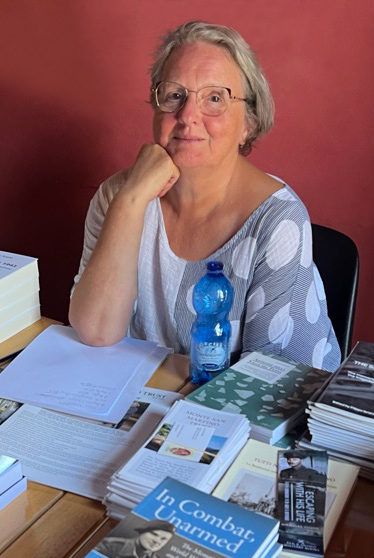
Here is a description of book and author that accompanied the book’s release:
In September 1943 the biggest mass prison breakout in history occurred when Italy changed sides in the Second World War and signed an armistice with the Allies, providing an opportunity for 50,000 Allied PoWs to make their escape from prison camps all over Italy. They had spent up to three years enduring severe privation and sometimes inhuman treatment following capture in North Africa and transfer across the Mediterranean. Now huge numbers quietly merged into the surrounding countryside, with little idea as to what to do next or of the dangers they might face from the encroaching Germans and the local Italian Fascists.
To their surprise they were immediately welcomed by the local populace, their sworn enemies only days before. In great numbers the poorest section of Italian society – the contadini (sharecroppers) – took them into their homes and sheltered them from harm for up to 18 months as Italy was slowly liberated by the Allies. During that time these young men from many different nations who had never before been far from home found themselves immersed in the medieval existence of the Italian peasant, learning the language, working in the fields, socialising in their clandestine communities, and all the while dodging recapture by their enemies.
Anne Copley tells this unique story from the perspective of the ordinary soldier, which has been too long neglected in accounts of one of the most remarkable acts of humanity in the midst of war. It is a tale of the courage shown by the most oppressed in Italian society and their harbouring of ex-PoWs despite risking death and destruction in doing so; together with the forging of bonds of friendship that have continued down through the generations to the present day.
For The Girl with a Peach, Anne has drawn material from nearly five dozen published memoirs and online resources, as well as her own interviews with POWs, POWs’ families, and families of Italian helpers.
For many years Anne and her husband David Runcimen, who live in Oxford, have owned a second home in the Marche—a renovated contadini farmhouse nestled in the Apennine foothills. On learning of Anne’s interest in the history of the area, her Italian neighbors eagerly shared stories of how their families and neighbors took in hungry, ragged camp escapees who turned up at their doorsteps.
Savoring these stories and reading voraciously on the topic led Anne to her own scholarship.
As Anne writes in the introduction to her book, the camps nearest her home—PG59 Servigliano, PG70 Monte Urano, and PG53 Sforzacosta (Macerata)—held only “Other Ranks” soldiers; officers were sent elsewhere. Many books about the POW experience have been written by officers. These books of course tended to reflect the officer’s own experience, which was somewhat different than that of the non-officer ranks.
Anne writes:
“ … there remained the largely untold stories of the ordinary scripted soldiers and their extraordinary journeys from the homes of their youth, through the horrors of war and imprisonment, culminating in a relationship forced with erstwhile enemies who became their protectors and extended family. For a variety of reasons the ORs were more likely to bed down within an Italian community and stay quiet, and so—long before the era of mass travel and at a time when going abroad was out of reach for most ordinary people—their stories described the unlikely meshing of vastly different cultures that gave rise to bonds of friendship that have continued down through the generations. Their accounts can at least partially answer some of the questions that interested me: what did the conscripted insurance clerk from Birmingham make of living a feudal existence with Italian sharecroppers; who were these people who took in these young men; why do they do it; how did they get on; what dangers were they all facing; and what have been the lasting consequences?”
Therefore, Anne chose to devote her book to the rich, but often underappreciated, Other Ranks stories.
Readers will come away from this book with a fuller understanding of the nuances of the average soldiers’ POW experience, and admiration for the unwavering humanity and courage of their Italian helpers.
The Girl with a Peach: Courage and compassion in wartime Italy is available for purchase on Amazon in the UK, Amazon in the U.S., and elsewhere in the world through various countries’ Amazon service.
Non-Amazon users can order the book through their local bookstore. You might wish to bring the following ISBN numbers to your bookseller for easy reference: ISBN-10 0957610238 and ISBN-13 978-0957610231.
All profits from sale of the book will support the activities of Monte San Martino Trust.
 Camp 59 Survivors