
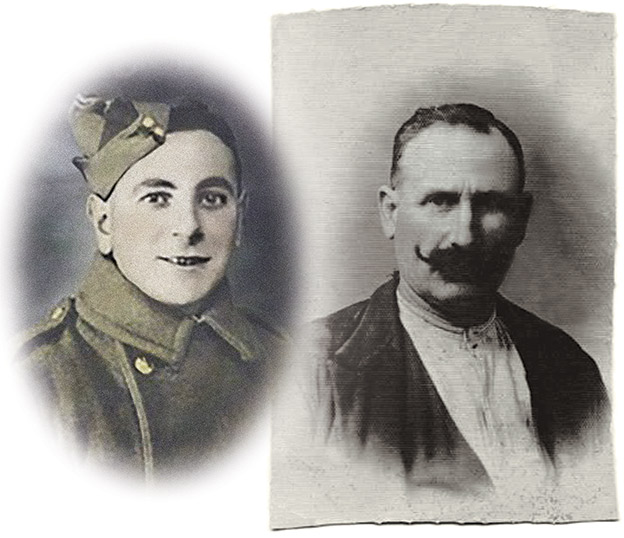
Last September, at the “Paths to Freedom” (Sentieri di Libertà) event in Servigliano, I had the pleasure of meeting Linda Quigley, daughter of British POW David Garcia, Linda’s daughters Annabel Heath and Miranda Quigley, and Miranda’s husband Roger Bickmore.
Pte. David Garcia, 1/4 Battalion, Essex Regiment, was deployed to North Africa during WWII, and was captured near Mersa Matruh in June 1942.
Unlike most POWs featured on this site, David had not been an internee in PG 59 Servigliano. Rather, he was interned in PG 102 L’Aquila, nestled in the foothills of the Apennine Mountains some 130 kilometers (around 80 miles) south of Servigliano.
Following the September 1943 Italian Armistice, prisoners of PG 102 left the camp. A War Office document, dated April 1945, in the British National Archives, explains:
“After the Armistice with ITALY had been signed, the Italian Commandant opened the gates of the camp and marched the P/W out into the hills, as it was reported that Germans were approaching. A certain number of escapers were rounded up by German paratroops and taken back to camp, but the majority got safely away.”
David and another escaped prisoner, whom the family believes was named Patrick, made their way to San Giacomo, where they were protected by the family of Umberto Capannolo.
The exact dates that David and Patrick were with the Capannolos is not known to the family. However, David retained a slip of paper certifying that he had “rendered a statement of his experiences to the British Section, C.S.D.I.C., C.M.F. [Combined Services Detailed Interrogation Centre, Central Mediterranean Forces].” The document is dated 5 July 1944, therefore David may have been on the run in enemy-occupied Italy for as long as 10 months.
On returning home to England, David attempted to contact the Capannolo family in order to let them know he was safely home and to thank them for their kindness.
When the letter was returned to David, he wrote to the British Red Cross asking if they would assist in his contacting the family.
The Red Cross replied:
WAR ORGANISATION
of the BRITISH RED CROSS
and ORDER OF ST. JOHN OF JERUSALEM
FOREIGN RELATIONS DEPARTMENT
CLARENCE HOUSE
ST. JAMES’S, LONDON S.W. 1
November 22nd 1944
Mr. D. Garcia,
302, Evelyn Court,
Amhurst Road,
London E8
Dear Sir,
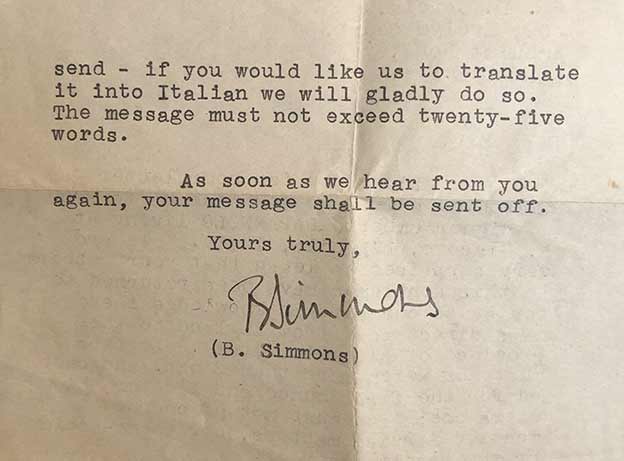
Thank you for your letter enclosing a message you wish us to send to Signor Umberto CAPANNOLO living at S. Giacomo, L’Aquila, Italy. We are very surprised to learn that your letters to this gentleman have been returned to you as to our certain knowledge there is a direct post from England to the province of L’Aquila, Italy. Letters must not weigh more than 2 ozs. and cost 3d for the first ounce and 1½d for the extra one; you must not of course mention Service matters, nor enemy-action or the results thereof.
We shall however, be delighted to send a message for you to make quite sure that it will reach Signor Capannolo, through our own representative in Italy. As you have said you cannot write direct in the message you send us, will you please let us have a fresh message to send – if you would like us to translate it into Italian we will gladly do so. The message must not exceed twenty-five words.
As soon as we hear from you again, your message shall be sent off.
Yours truly,
[signature]
(B. Simmons)

David’s family had turned up no evidence that communication with the Capanollo family was successful, but more recently they decided to revive the effort.
Sharing a table with Linda Quigley’s family one evening during “Paths to Freedom,” I learned of arrangements they had made to visit the Capannolos the following week.
After that visit, Linda’s son-in-law Roger wrote to tell me about it.
“We have just returned from a rather extended vacation after the events in Servigliano and our visit to the Capanollo family in L’Aquila.
“Linda knew almost nothing about her father’s experience during the war, other than he escaped from an Italian POW camp and was looked after by a very kind family. But she had a box of his papers in her attic. One afternoon my wife Miranda and I went through them. We discovered the letter sent in November 1944 to David from the Red Cross. David had been reaching out to the organisation so that they could get a message through to a gentleman called Umberto Capannolo in San Giacomo near the city of L’Aquila.
“We assumed that this was the family, so we wrote to the handful of Capannolo entries in the telephone directory for that area. We got a hit. Umberto died in 1976 we later learned, but his descendants still lived in the area. We received a message back from his grandson Franco. The story of the prisoners of war who came to stay with them had been passed through the generations. They were very excited to hear from us.
“We stayed with Franco and his wife for a couple of days after leaving you in Servigliano. During our time we met several other relations, including Franco’s Uncle Gaetano, who is Umberto’s last surviving child. He is now a sprightly eighty-eight years old, so was seven when David was hiding out at the Capannolo farm. He remembered the time very well. Linda and Gaetano talked a lot together, which was lovely to see.

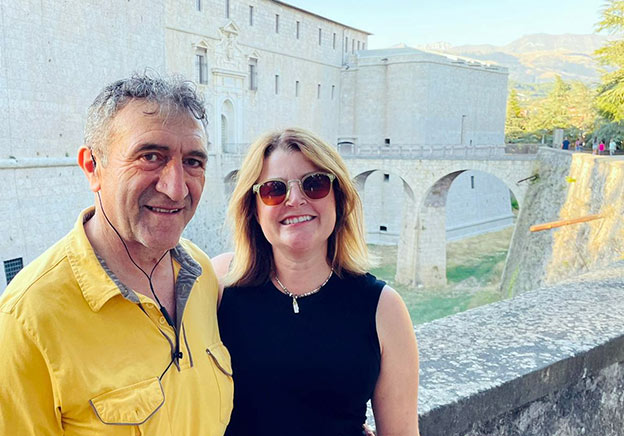
“David was imprisoned in the PG 102 work and transit camp in the centre of L’Aquila. He was probably part of an attachment of 250 soldiers sent there in July 1943 from the much bigger camp at Sulmona, 60km away. Their job was to construct the Passquali Campomizzi Barracks. Today it has become a large military training base. Franco arranged with the colonel in charge for us to look round. This was quite a privilege. We were taken on a tour of the facility and went to their museum, which is not open to the public, serving just the cadets. There was no mark left that we could see of the POWs, but the architecture of the buildings definitely fitted the era in question. The sentry posts and watch towers almost certainly dated from that time.

“On armistice day, 8 September 1943, it appears that the camp guards went home and the POWs headed for the countryside in small groups. Gaetano explained that his elder brother Armando was active with the partisans. Evidently Armando bumped into David and three other soldiers (Patrick, Thomas and Septimus) walking around the outskirts of the village. He directed them to his father’s farm, telling them that they would be safe there. Umberto took them in, and his wife fed them. According to Gaetano, they were very tired and extremely hungry. After a couple of days sleeping in the stables, the men decided to leave, but Thomas and Septimus were soon recaptured. David and Patrick ran back to the farm in utter panic. The timing of their departure could not have been worse.

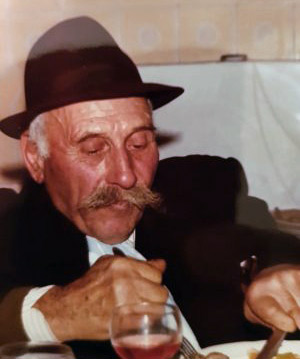
“The small village of San Giacomo is situated in the foothills of the Apennines. The mountain range dominates the view to the north-east. When Mussolini was overthrown shortly before the armistice, he was imprisoned in the Hotel Campo Imperatore which sits on a 2,000m plateau, directly in front of the largest of the peaks, the Grand Sasso. During our stay with Franco, he took us to see the disused hotel, which is only a 45-minute drive away up a windy road.
“On the afternoon of 12 September, the Germans launched a daring glider raid on the hotel and successfully rescued Il Duce. The road from L’Aquila to the Grand Sasso passes through San Giacomo, so it was bad luck for David and his friends that there were a large number of German patrols in the area because of the important operation taking place nearby.
“The Germans remained around L’Aquila in high numbers. On 23 September, whilst searching for POWs, a patrol arrested a group of local teenagers, claiming they had fired a rifle towards their position. When we visited the PG 102 camp with Franco, we were shown a shrine at a spot where these nine martyrs, as they became known, were murdered by the Nazis. The bullet holes are still in the wall where they had been lined up to be executed.
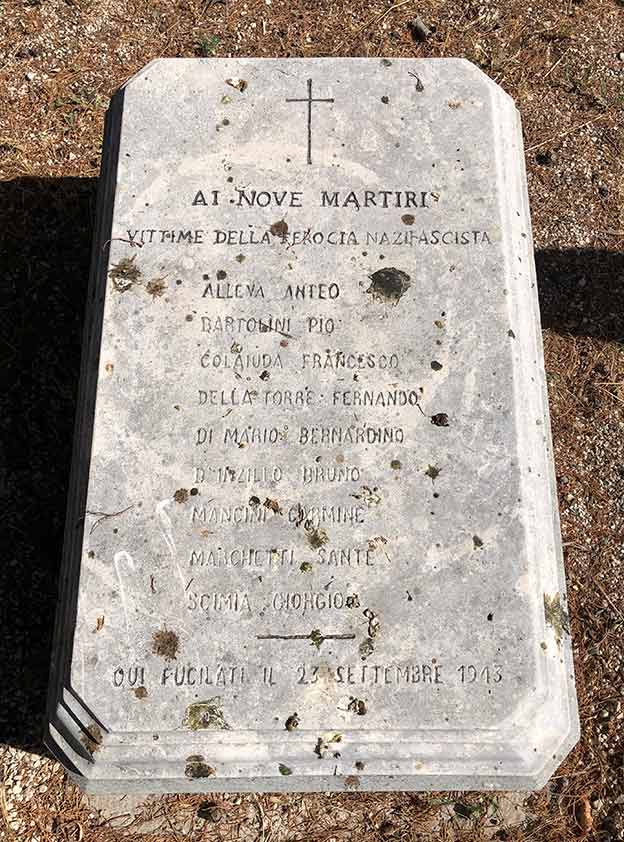
“It was not safe for David and Patrick to stay with Umberto’s family, so his sons established a bivouac for them in a cave at the edge of some woods. They then considered it to be too close to the road and found another cave deeper in the forest.
“Franco and a number of his relations joined us at their old farmhouse. It is a ruin now, abandoned in the 1960s, the terrible earthquake in 2009 levelling it mostly to the ground.
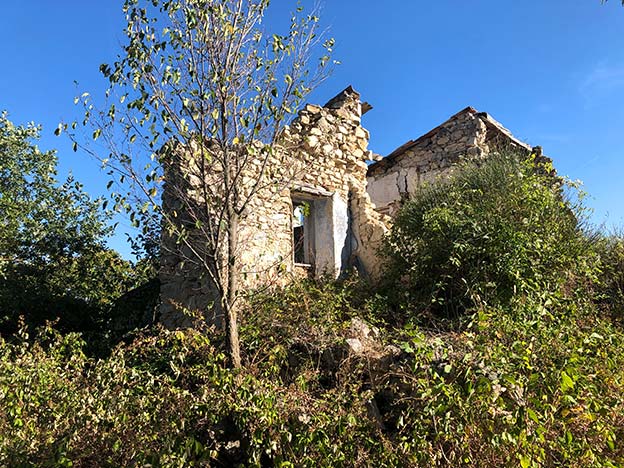

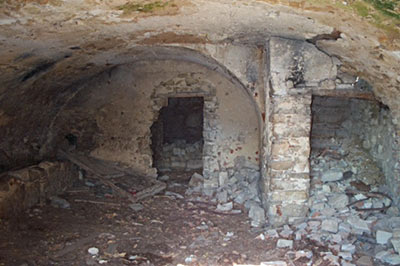
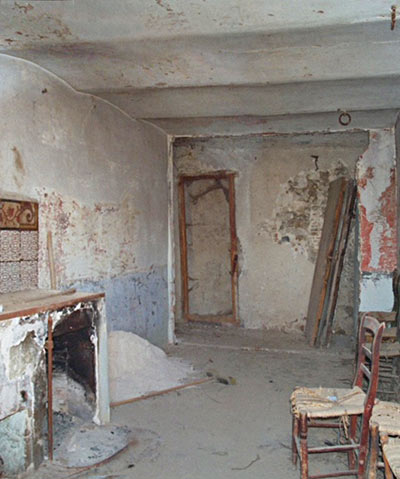
Across the fields, we were shown where the first cave was located, now completely overgrown. Gaetano almost leapt over the fence to explore, but his nephew told him to come back, worried he would fall over.

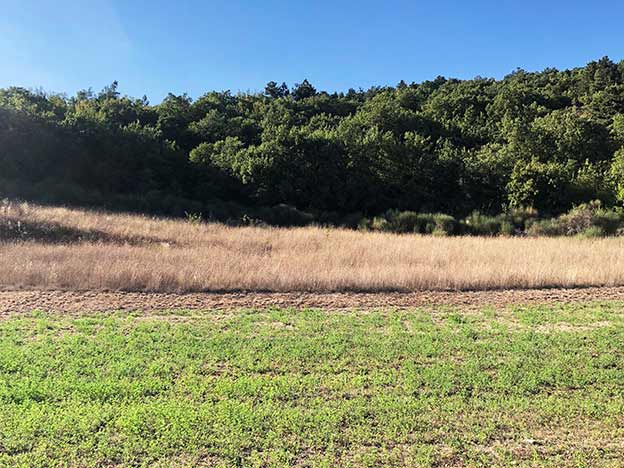
“On that wonderful late summer’s afternoon, we strolled around the rough tracks by the old farm listening to more of Gaetano’s stories. One of his chores was to take David and Patrick fresh water and food. His father considered that it would be less suspicious if the young boy was seen doing it. They were nervous about the prying eyes of neighbours.
“The two men taught Gaetano some English and in return he helped improve their Italian. David gave Gaetano some chocolate from his Red Cross parcel. It was the first he had ever tasted. Quite a moment for a seven-year-old. He also recalled seeing a photograph of David’s wife Rachel with their baby Leonard, a son that David had yet to see in the flesh.
“Before long, the mountainside was covered with snow and the temperature plummeted. Gaetano said that David became ill with a fever and was moved into the house for a couple of weeks. They had a hidden hole in the wall where they put up a makeshift bed, still worried about a possible raid on their property.
“As the weather improved in the spring, more positive news came of Allied advances in Italy. By this time David was working in the fields. He had a Mediterranean look, so could pass off as a local. During the day Patrick was sent by donkey and cart to give another relation, Beniamino, some help at his small holding.
“Gaetano had no recollection of when or in what circumstances the two men finally left the farm. By mid-June 1944, the Eighth Army had liberated L’Aquila. It is quite likely that through his partisan connections, Armando would have let David and Patrick know when it was safe to go. They probably walked down into the city and simply presented themselves to the first friendly troops they saw.
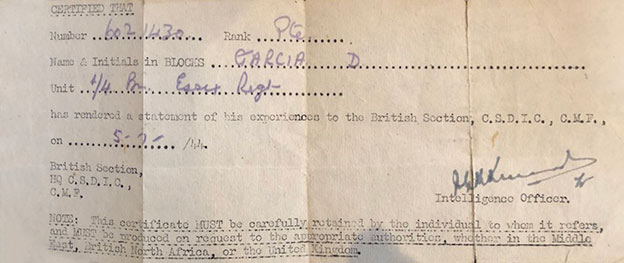
“We found a certificate amongst David’s papers that on 5 July 1944 he rendered a statement of his experience to the British authorities. Unfortunately, despite research, we have been unable to track his escape and evasion report, which seems to have been lost. David returned to the UK sometime before mid-September. He was on reserve for the reminder of the war and was finally discharged in March 1946.
“The years that followed were not easy for David. He withdrew into himself and certainly did not wish to talk about the war. When we met the other participants at the event in Servigliano, we realised this was very common amongst the returning men. It was reassuring for Linda, who in recent years had wished she got more out of her father about what happened to him.
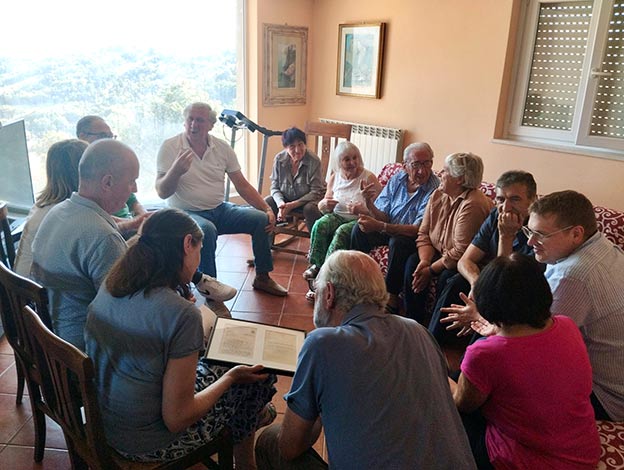
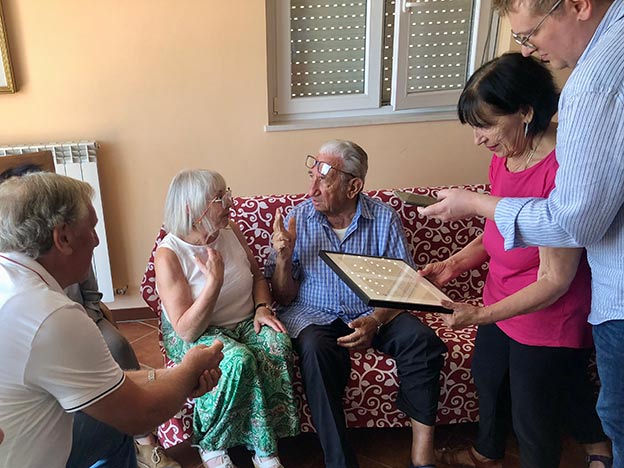
“The Capannolo family could not have been more gracious and welcoming. It meant so much to Linda that, despite of all the deprivation and anxiety, David would have been well looked after by these kind people in those desperate months on the run.
“She was also thrilled to learn from Gaetano that many years earlier David had indeed got a message through to Umberto, thanking him for everything he done. Gaetano recalled them receiving a letter, which they got the teacher in the local school to translate into Italian for them.
“Going forward we shall keep in close contact with Franco, and hopefully will arrange another visit to San Giacomo. The mountains are stunningly beautiful, so it is perfect for a vacation in any event.
“I am continuing to do more research. I have no information at all about David after he was captured in North Africa on 27 June 1942 until he showed up at the Capannolo farm shortly after 8 September 1943. I am interested in what his internment in Libya would have looked like, the journey by sea to Italy, and how he made his way through to Sulmona. If indeed he was at Sulmona. I am wondering if there are any lists that confirm he was once there, and also some accounts of what that camp was all about.
“I am also interested in David’s companion Patrick. I know only one fact—that he was South African. I would love to track him, so any suggestions on how to do that would be gratefully received.”

 Camp 59 Survivors
Post very well done and very interesting, congratulations, Luigi Donfrancesco
I have just obtained copies of the Allied Screening Commission files from the US archive in Washington and have further information.
Umberto Capannolo was awarded LIRE 11,000 compensation, largely due to a short handwritten testimonial that David must have left with him when he departed from the farm. We now have a copy of that note. Furthermore David also wrote a letter in 1945 to Umberto thanking him for his help, which did get through to Italy, and was presented to the allies by Umberto to support his claim. We have that also.
In addition Umberto’s brother Beniamino put forward a claim for accommodating Patrick and was awarded LIRE 2,500. We now know that Patrick’s surname is Callan. Like David, he provided a short handwritten testimonial. It seems Patrick served in the Kings Royal Rifle Corps, service number 6852883. This suggests that he more likely was British or Irish, not South African, although I need to dig deeper on that point. I do not have his date of birth (or death) either so tracking him down via his military records may prove tricky.
Roger