

This is the last of four posts concerning the 2023 “Paths to Freedom” (Sentieri di Libertà) event in Servigliano, Italy. The September event was a celebration of both the 80th anniversary of the Italian Armistice and the subsequent breakout of thousands of Allied POWs from camps across Italy—including camp PG 59 in Servigliano.
Read also “‘Paths to Freedom’—the First Day,” “‘Paths to Freedom’—the Second Day,” and “‘Paths to Freedom’—the Third Day.”
“Paths to Freedom” (Sentieri di Libertà)—10 September 2023
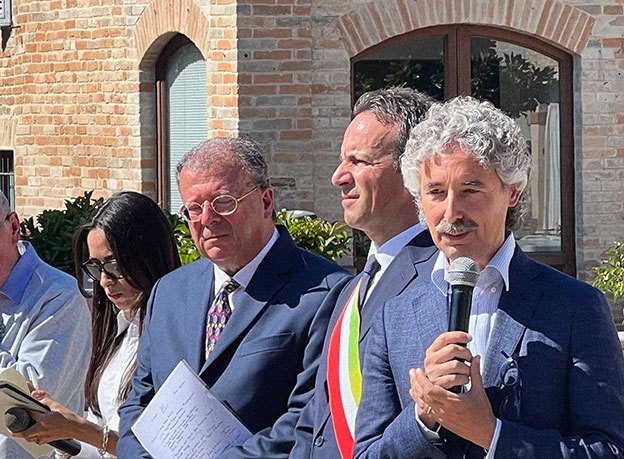
Our final day together began with commemorative speeches at the war memorial in Servigliano’s Piazza Roma. Wreaths were laid at the base of the memorial by representatives of the three event-sponsoring organizations.
An additional, a hand-made herbal wreath to represent “Wales, Australia, and the Camp 59 reunion” was laid by Linda Veness and Rona Crane.

After the ceremony, church bells rang out invitingly, and all were welcome to attend Sunday Mass in the Church of San Marco, just a few steps away from the memorial.
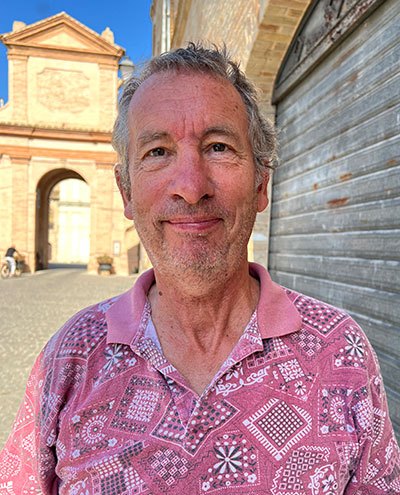
I chatted with Ian McCarthy after the ceremony.
In 2006, Ian was my first contact with anyone who had a connection to PG 59. Ian immediately put me in touch with several family members of other former POWs—I saw some of them in person for the first time at this event.
The Casa della Memoria association had been in existence for only five years in 2006. Ian wrote, “I must say it’s very good to feel that all this work is beginning to bear fruit, but it’s also a shame we didn’t do it 20 years ago when most of the people involved were still alive.”
Ian’s family was originally from County Cork, Ireland, but they moved to Cardiff, Wales, in about 1850, at the time of the famine. Ian’s father, who served in the Pacific, moved the family to Kent when he returned from World War II.
Ian married an Italian woman, and now has lived in Italy for over 40 years.
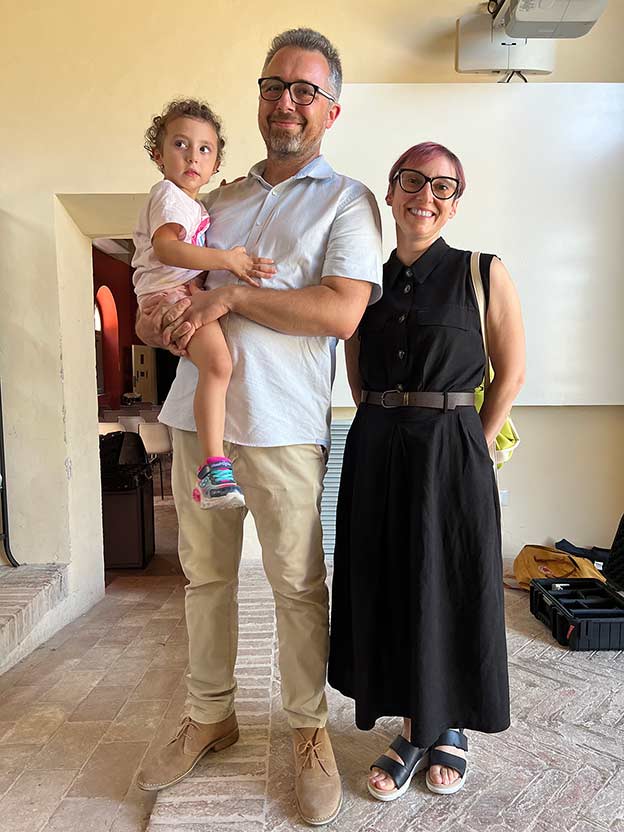
I was also pleased to get to know Giordano Viozzi, who is the current chair of Casa della Memoria. The organization is thriving and, empowered by its recent designation as an Italian National Memorial, it has big plans. Giordano’s unique skillset in creative communications will no doubt be an asset as these projects come to fruition.
Sue Procko, who had been conducting interviews with many of the attendees and local Italians during the week for a documentary she is creating, interviewed me and several others in the afternoon. Giordano, as videographer, was involved in this project.

In the afternoon a caravan took attendees to PG 70 Monte Urano, and to Casa Brugnoni, where Ken de Souza, the author of Escape from Ascoli, was sheltered.
Late in the day, the museum hosted a bookstall and featured video loops of interviews with Italians and escapers.

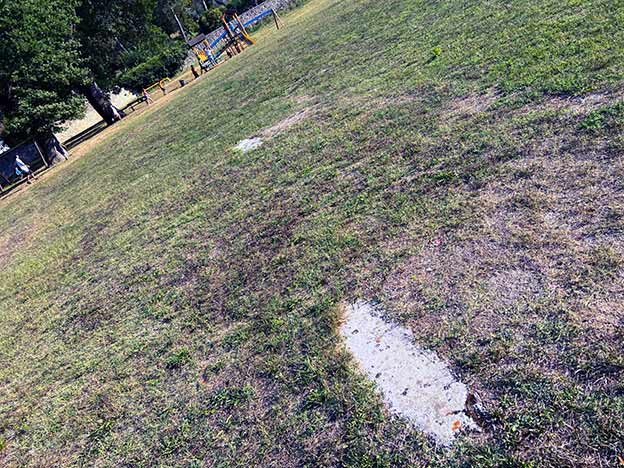
I took advantage of a little free time to wander one last time within the walls of the old camp, now Parco della Pace—the Peace Park.
I was accompanied by Ed Cronin and his daughter Jessica. Soon Crystal Aceves joined us.
The park was well used on this late Sunday afternoon. Children and teenagers were playing on the sports fields and in the playground. Parents with babies in strollers walked on the sidewalks, and a lively family party—complete with a picnic meal and balloons—was under way in a little grove trees. To our delight, the partiers broke into song—the now universally-familiar “Happy Birthday” song—but sung in Italian.
We were admiring the new camp signage when a family of three approached on bicycles.
On hearing our English conversation, Victor Cordari said hello and introduced us to his wife Barbara and son Edward.
When Victor learned that our fathers/grandfathers has been interned in this camp, he kindly offered to walk around the camp with us and show us details we might have missed—as well as buildings outside the walls.


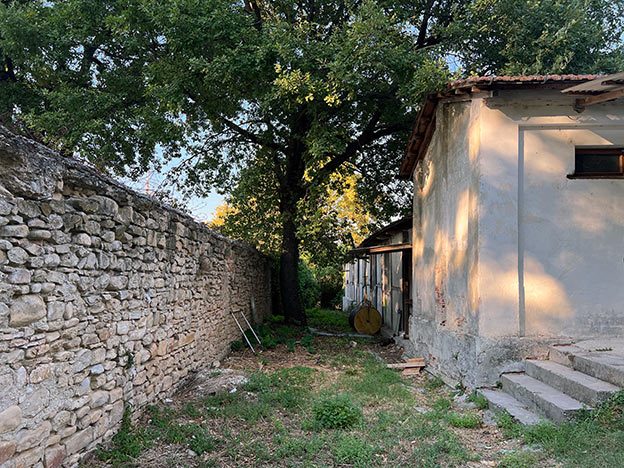
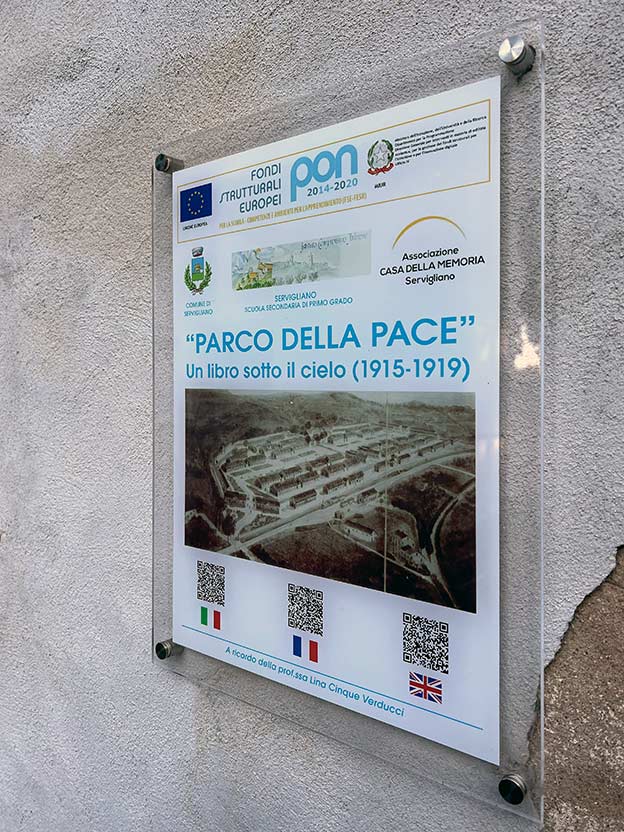
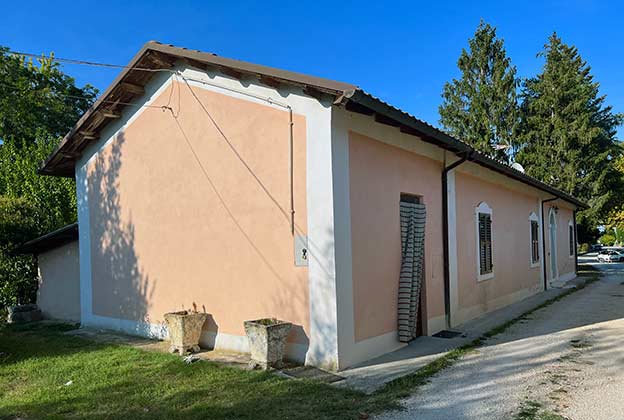
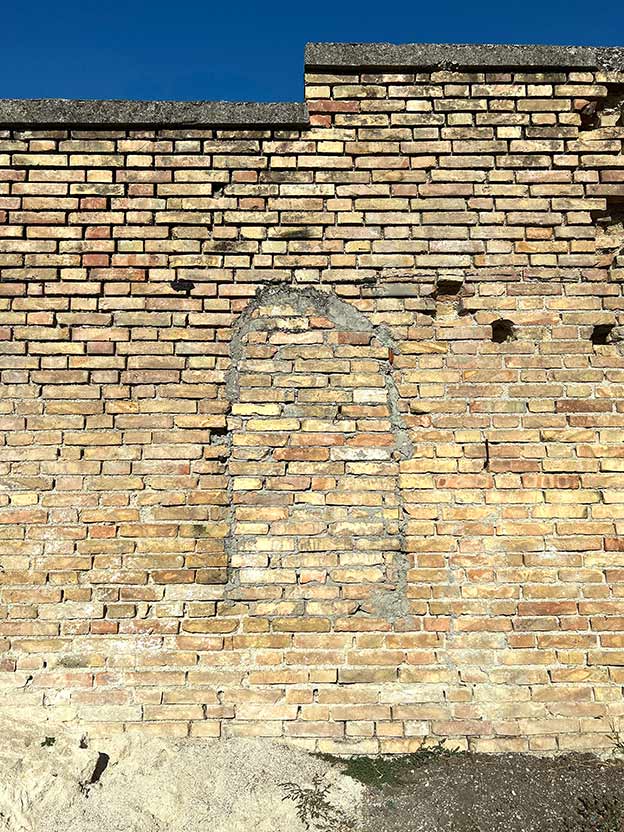
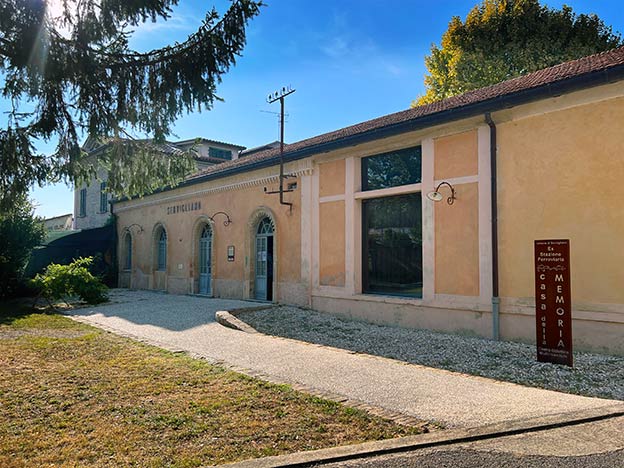
After Victor’s generous tour, I also spent more time in the museum exhibitions.
On the walls of one room are photographs that are divided into different periods of the camp’s history—POW internments, Nazi internment of Italian and foreign Jews awaiting deportation to Germany, and temporary housing for Slovenian refugees and later for refugees from Julia and Dalmatia.
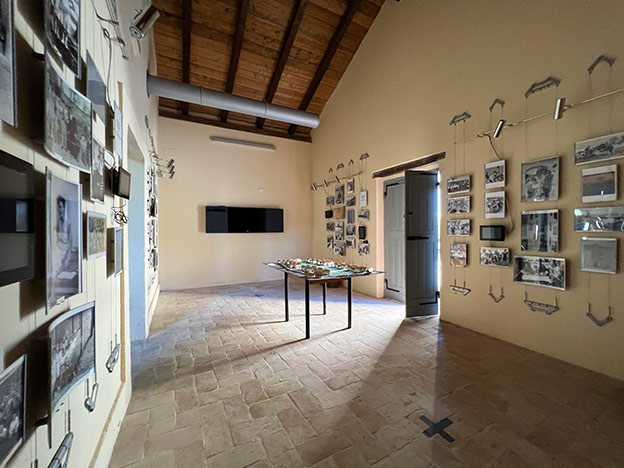

In another room, three interactive digital display terminals provide further information on camp life.


A display with a broad view of the camp grounds allows participants to select a targeted location in order to learn what was formerly located in that spot.
The museum also now allows visitors to experience the former camp by means of virtual reality headsets.

An evening farewell dinner was held in Chiostro da Zena, the cloisters of the former convent in Servigliano. The meal for all three organizations—Monte San Martino Trust, ELMS, and Casa della Memoria—was an opportunity to reflect and celebrate “the long-lasting bonds formed through the shared experiences of soldiers from so many nations and their Italian helpers in September 1943.”
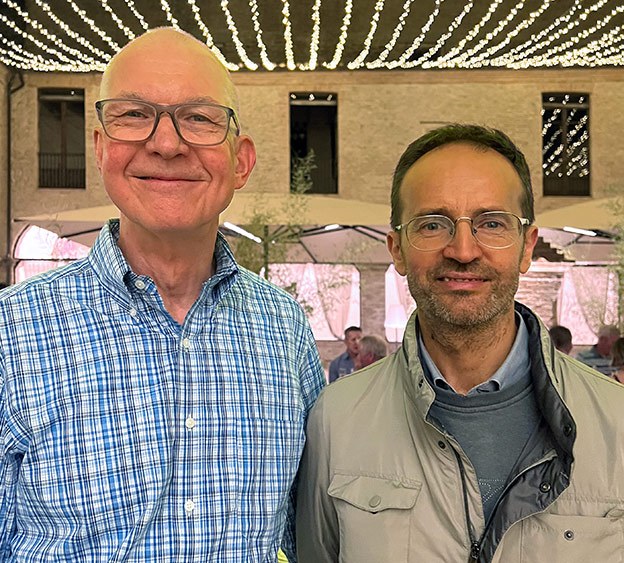
At the dinner I had a chance to talk with Giuseppe Millozzi.
My earliest access to PG 59 history was through Giuseppe’s excellent dissertation, Allied Prisoners of War in the Region of the Marche and Prison Camp at Servigliano. Among other important discoveries, Giuseppe, in conducting research at the British National Archives, uncovered the role Captain J. K. Derek Millar played in the release of prisoners from PG 59 on 14 September 1943. See “Captain Millar—Valor in the Hour of Crisis. Giuseppe has been deeply involved in Casa della Memoria from its founding.
Giuseppe’s father, Antonio Millozzi, was also in attendance at the dinner. Antonio has served as Monte San Martino Trust’s Italian representative since its founding in 1989. Ten years ago he was awarded an honorary MBE (Member of the British Empire) by the crown.
It was clear from Letitia Blake’s acknowledgments at the farewell dinner that many people had contributed to the success of this event. I would like to call out two of them here: MSMT trustees Anne Copley and Nermina Delic. As event coordinators, this duo pulled off a truly first-class event!

As sad as it was to see our four days together come to a close, participants returned home with firsthand experience of the camp and surrounding area, new friendships, and a greater appreciation for what our loved ones endured during POW internment in Italy.
When have I ever been to a conference or event that was this enriching? Certainly none has been so emotionally satisfying. Attendees will be savoring this event for years to come. I’m hoping that in five years there will be an 85th anniversary event in Servigliano—I know many others are already hoping for this as well!
A Parting Glance
As the event came to a close, I asked several friends what the event had meant to them.
I feel it’s appropriate for them to have the final word:
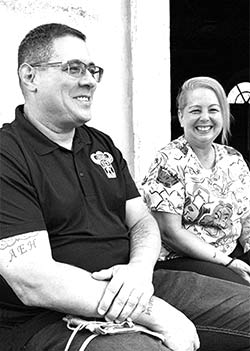
Eric Hunt, who is researching PG 59 internee Manuel Serrano, attended the event with his wife Annette:
“I’ve come here to research the period of his life when Manuel was a POW, and to experience what he saw—the mountains, the hills, the people who were helpful to him—because I felt I needed to see it with my own eyes. I’ve gotten an amazing insight into his experience. I’ll be taking that back with me!” —Eric Hunt
“I never thought I would fall in love with this area—it’s just magnificent, it’s beautiful! And I’m so happy Eric and I have met such amazing people here.” —Annette Hunt
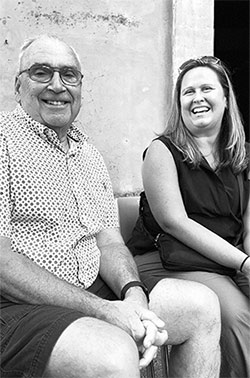
Ed Cronin, son of Tom Cronin, attended the event with his daughter Jessica:
“I had been here once before, with my wife—that visit was stunning. But during this visit I’ve come to understand my father more deeply. He came away from the war with a lot of psychological and physical damage. After this visit, I now feel an element of being able to forgive.” —Ed Cronin
“I’ve enjoyed being here with this entire group, hearing about their family members, but also hearing my dad tell me about my grandfather, who I didn’t know very well at all, and understanding what he went through.” —Jessica Thompson

Crystal Aceves, granddaughter of Carl Good, attended with her husband Ali and their son Tristan:
“This trip has been on my ‘to-do’ list. I had researched the history of my granddad, but it’s a completely different experience being in the area—you feel it and you see it, and you understand the story on a different level. When you see the terrain where the escapees were hiding you more fully understand what it would have been like for them.” —Crystal Aceves
“More than anything, I feel closer to the history of World War II. I was making a comment earlier that it’s hard to grasp how such a peaceful and beautiful place as this could have experienced something so harsh, so devastating.” —Ali Aceves
“My favorite part about being here is that I’ve learned about what my great grandfather went through, and I’ve seen where it happened—that was cool!” —Tristan Aceves
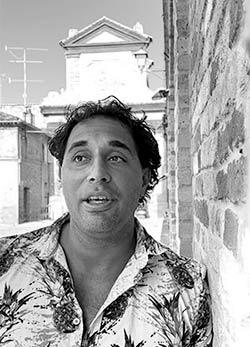
Tom Mandese, grandson of Joseph Mandese said:
“To summarize, this week? ‘Surreal,’ ‘emotional,’ come to mind. It’s been everything—getting the chance to meet the descendants of the family that took my grandfather in and spending the day with them, going to the exact spot where they hid my grandfather. Also, seeing the camp, hearing incredible numbers of stories, hearing about everything—not just what my grandfather went through, but also the dozens and dozens of survivors, and hearing from their descendants … children, and other grandchildren—every day has kept getting better and better. It was an honor to be here!” —Tom Mandese

Lauren Procko Boxer, granddaughter of John Procko— who attended with her mother, Sue Procko—said:
“Being here leaves me in awe of the men who were captured, for the bravery they had in spite of the fear they must have felt—fear that they pushed aside to keep going. I have so much respect for each and every one of them!” —Lauren Procko Boxer
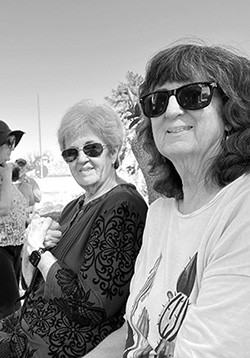
Judy Ingersoll and Renee Geeting, daughters of Luther Vaughn, said:
“This is my second trip to Servigliano, but it’s my first experience with Casa della Memoria and all the activities, so this has been emotional. It’s been a wonderful experience, something that I’m hoping I can do again.” —Judy Ingersoll
“We’ve also been able to get answers to questions that we had we’d been unable to answer—that we’ve wondered about for years.” —Renee Geeting
 Camp 59 Survivors