

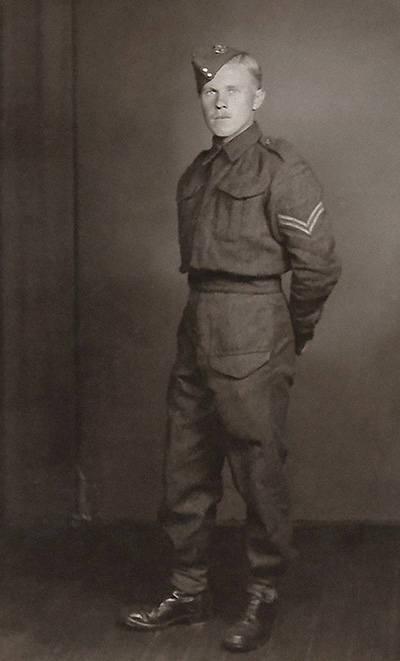
In March 2015, I published a short post on Camp 59 Survivors about British Sergeant Arthur Page. (See “P.G. 59 Prisoner Arthur Page.”)

Five years later, in December 2020, I received a surprise comment on the post:
“I am proud to be this man’s son, forever in our thoughts.”
I was thrilled and wrote immediately to the commenter, Arthur’s son Mike, saying I would very much like to know more about his father.
Mike wrote back to me, recounting how his father came to write his memoirs, Una Bella Passeggiata (A Walk in Wartime Italy):
“It was 1992 when the story first came to light at a gathering of friends round my father-in-law’s when another book, Love and War in the Apennines, was introduced to dad and he thought that maybe it was time he shared his story. Up until then his experiences were known to nobody but himself. We had visited Pietro in the ’70s as children, but we did not know what they had been through together.
“I remember that day well—he held the floor for hours as the story was told. It was as if 50 years of suppressed memories were released.”
Mike sent me several family photographs and the memoirs in digital format.
“Dad thought it wise to learn the language of his adversary; when he escaped captivity in Italy he only spoke limited Italian, but circumstances soon deemed it necessary to learn the language.”
“There are two books,” Mike explained. “Dad wrote the first book in English, obviously. He was blessed with the ability to speak five languages, and—as the book was dedicated to the Italian contadini—he then translated it into Italian. Although this version was not published, it was used in Italian schools for education.
In 1994, Bella Passeggiata was published by Air Forces Publishing Service (Swindon, Wiltshire, UK).

Arthur Page was owner of the copyright. According to Mike, “Air Forces Publishing Service was a husband-and-wife outfit. The husband had been a serving bomber pilot during the war and his wife was a similar age.” Apparently, they published only a few books—each related to WWII. As I understand, copyright routinely passes on to the author’s family—in this case to Mike and his brother.
As the book has been out of print for nearly 30 years and used copies are very difficult to come by, I suggested to Mike the possibility of sharing the memoirs on Camp 59 Survivors.
Mike responded, “You certainly have my support and backing—along with my brother Duncan—to post the story on your website.
“It is so important to keep these experiences alive to the next generations. We must not forget the sacrifices our parents and the Italian people made for our wellbeing.”
Because the version Mike shared with me is what they sent to the publisher prior to editing, he welcomed my reading over it for errors and to amend punctuation where necessary. I was careful to not alter the story in any way—the words are Arthur’s and I have not changed them.
As I read through the memoirs and made my light edits, I kept in touch with Mike.
He wrote, “Glad you are approaching dad’s account with such sensitivity, I think the story just flowed freely when he wrote it, just like he was telling the story to a bunch of friends down the pub.”
Mike sent me Google Earth coordinates, saying, “I thought you may like to know where dad was holed up in the winter of 1943; he spent the winter in a barn in a small hamlet, Roccafranca. You can see the hamlet on Google Earth.
“The main village was Verchiano. When dad was researching his book in 1992, we visited the village early in the morning. We got there at 08:00 and were looking around when a chap on a moped rode by and went off down the road. He must have gone about 500 metres before turning around. He came up to us and said to dad ‘Arturo.’ He had been a young boy at the time and recognised dad after all that time.
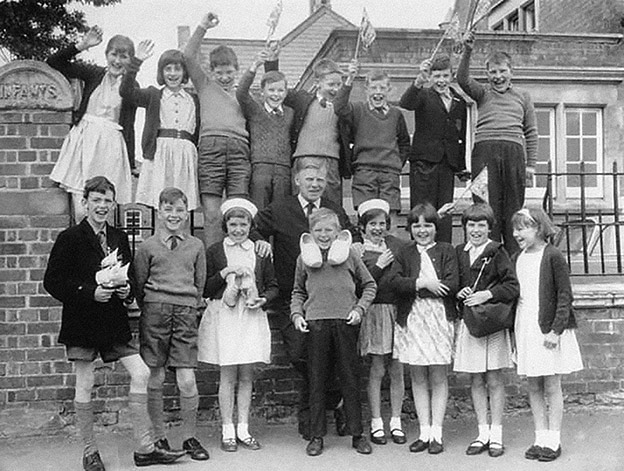
“After the war, dad became a schoolteacher with the ambition to create a better world through education.”
Mike concluded, “Unfortunately, we lost touch with the families involved about 20 years ago, and who have probably by now passed on.”
I cannot adequately say what a privilege it is for me to share Arthur’s memoirs through Camp 59 Survivors. As I read through Arthur’s story, it was clear to me that this is truly a classic WWII escape saga. Like memoirs of J. Keith Killby, G. Norman Davison, and Niel Nye, Arthur’s story is detailed, candid, occasionally spiced with humor, and always reflects his profound sense of humanity and gratitude for the helpers he encountered during his time on the run.
Arthur included these acknowledgements in the printed memoirs:
My wife Patricia—for her forbearance
My son Michael and his wife Alyson—for typing and processing
Juliana Tamburrini—for seeking data and illustrations
Lt. Col. C. D. Darroch D.L.—for advice, information, and correction of Regimental detail
Eric Anstead—for help and encouragement in initial stages
‘Des’ Jones, Hon. Sec. the Army POW Escapers Club—for providing useful material
Keith Kilby, Hon. Sec. Monte San Martino Trust—for providing useful material
My nephew Roy George—for processing and solving computer problems
In a foreword to the book, Air Vice Marshal Ross P. Harding CBE. MA. RAF Ret. (who died in 2013) commented:
“It all took place a very long time ago; yet, as Arthur Page himself says, the events of those years behind the wire and rambling through the countryside remain as fresh now as if they had occurred only yesterday. Indeed, the pictures in the mind are sharper and the recollections happier by far than 50 years ago when to regain one’s freedom was a constant concern.

“My only credentials for acting as the prologue to this story are as an ex-POW and current President of the National Ex-POW Association. It is in that capacity that the author approached me. The manuscript has been easy and enjoyable reading and is essentially an unpretentious narrative of Arthur Page’s capture in Tunisia in 1942, his release from prison camp in Italy at the time of the Italian armistice in September 1943 and subsequent wanderings to regain the Allied lines in the Autumn of 1944. There are many setbacks along the way, but the story adds something new to this class of literature in that it concentrates on the way of life and generosity of the Italian peasants who befriended the evaders without any concern for their own safety. It is this theme that provides the main incentive of the book, and the story serves as a stirring tribute to natural human kindness in the face of constant danger from German and fascist security forces.

“It is also a remarkable tale of fortitude and perseverance during the year-long journey of some 300 miles on foot through the mountainous country of central Italy; qualities which eventually prevailed against all vicissitudes and saw our traveller safely home.”
I will divide Arthur’s memoirs into installments—with several chapters per post—to appear on this site in the coming days. If you have not had the pleasure of reading Arthur’s story, you have a treat in store!

 Camp 59 Survivors