Monthly Archives: August 2016

Airman Robert McIntosh “Back Home Again”

1lt-robert-mcintosh_r72

1st Lt. Robert McIntosh (right), U.S. Army Air Force
Photo—Young-Nichols Funeral Home/family photo

Eddy Arnold’s Back Home Again in Indiana, one of the state’s most beloved songs, is an expression of sweet, sad longing for a return to the past—to youth and the comfort of a loving rural home.

The song has had a special resonance for me and many others here in Indiana this week, as the state welcomed home a native son, U.S. Army Air Forces’ 1st Lieutenant Robert McIntosh. Robert was killed in Italy during the Second World War.

The 21 year old pilot was on his way back to base from a strafing mission against an enemy airfield in Piacenza, Italy, on May 12, 1944 when his aircraft went missing.

Sixty-nine years later, during a crash site excavation in Santa Cristina, Italy, Robert’s remains were discovered by Archeologi dell’Aria, a group of Italian avian archaeology volunteers. U.S. government DNA testing confirmed the plane’s pilot was Robert McIntosh.

Robert’s remains were flown to Indiana on Tuesday.

A public funeral will be held today at the Tipton High School auditorium, and burial with full military honors will follow.

You can watch a memorial video that aired Tuesday on 13 WTHR Indianapolis on the channel’s website, wthr.com.

Also, read a story about Robert’s life and the return to Indiana by the Fort Wayne Journal Gazette.
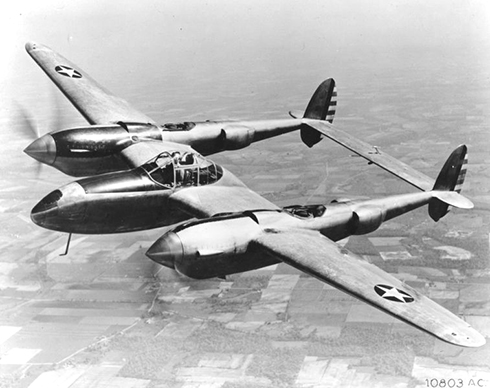
P-38-Lightning-USAF_r72

Robert McIntosh was flying a single-seat P-38 Lightning aircraft, as shown here, before he was reported missing in action. Photo—United States Air Force

Listen to an arrangement of Back Home Again In Indiana by Straight No Chaser. The professional a cappella group began at Indiana University, where Robert was a student before enlisting in the Army.

See also “After 72 Years—Dewey Gossett Home at Last.”

I.S.9 Captain R. W. B. Lewis

city-florence

Recently, Luigi Donfrancesco—nephew of I.S.9 Italian agent Andrea Scattini—and I have been in touch with Nancy Lewis, the wife of Captain Richard W. B. Lewis, an American officer with I.S.9 POW rescue operations in Italy during the war.

Richard Lewis served his role during the war admirably, and was discharged from service in 1946 with the rank of major.

After the war, he had a long, distinguished career in teaching at Smith College, and Princeton, Rutgers, and Yale Universities. A profic writer, recognition for his work included a Pulitzer Prize in 1976 for Edith Wharton: A Biography. He retired from Yale in 1988. He died in 2002.

Richard Lewis is mentioned in a number of posts on this site, including I.S.9 diaries, situation reports, and other documents.

Mrs. Lewis has kindly given permission for us to share a section of her husband’s book The City of Florence: Historical Vistas and Personal Sightings (1995, pp. 64-68), in which he recounts his experiences with the I.S.9 rescues.

We are very grateful to Mrs. Lewis.

Notes in brackets were written by Luigi Donfrancesco.

“My own knowledge of the Casentino [province of Arezzo, Tuscany, Italy] began in the autumn of 1944. The first stay in Florence had, after all, been a short one, and during it I housed our little headquarters – two American officers, two British sergeants, and half a dozen Italian agents – in a luxurious apartment on Lungarno [Riverside] Vespucci (it had belonged to the former Fascist mayor of Florence, who had fled with the Germans and was later brought back and tried). It was a time of curious contrast, for while the German shells whistled about the Bailey bridge being thrown up below our windows, we inside, having for the moment nothing to do, indulged in a mild and continuous orgy.

“In early September, the front line had sufficiently established itself across the Apennines to permit us to go back to work, and we moved to a farmhouse just beyond the village of Rufina, about fifteen miles northeast of Florence and a few miles into the hills above Pontassieve. From here we could dispatch agents through the relatively unguarded mountain areas north toward Imola and Forlì and east into the Casentino.

Continue reading