Category Archives: Robert Brawn

Albert Douglas—the Long March Home

Last September, I was pleased to receive a newspaper clipping from Richard Minshull regarding POW Albert “Paddy” Douglas, about whom I’ve written several posts.

Albert Douglas was Richard’s wife‘s grandfather.

The clipping, published in 1992 in Belfast, Northern Ireland, had been overlooked when Richard sent me a wealth of other clippings, documents, and photos several years ago.

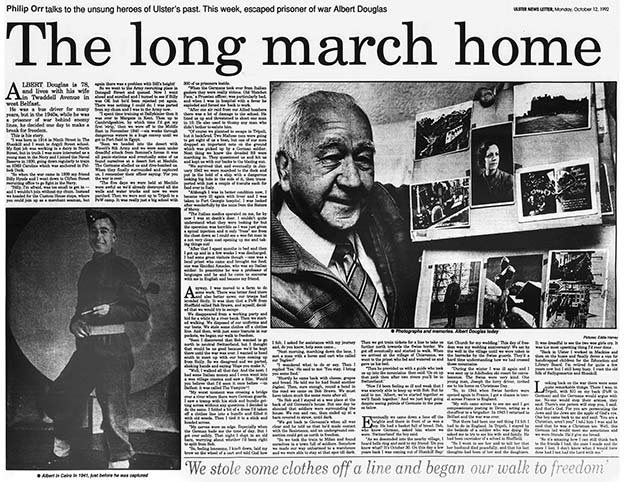
The long march home

Philip Orr talks to the unsung heroes of Ulster’s past. This week, escaped prisoner of war Albert Douglas

Ulster News Letter
Monday, October 12, 1992

Albert Douglas is 78, and lives with his wife in Twaddell Avenue in west Belfast.

He was a bus driver for many years, but in the 1940s, while he was a prisoner of war behind enemy lines, he decided one day to make a break for freedom.

This is his story.

“I was born in 1914 in Ninth Street in The Shankill and I went to Argyll Street school. My first job was working in a dairy in North Street, but in truth I was more interested as a young man in the Navy and I joined the Naval Reserve in 1930, going down regularly to train on HMS Caroline which was anchored in Pollock Dock.

“So when the war came in 1939 my friend Billy Hynds and I went down to Clifton Street recruiting office to go fight in the Navy.

“Billy, I’m afraid, was too small to get in and I wouldn’t join without my chum. Instead we headed for the Custom House steps, where you could join up as a merchant seaman, but again there was a problem with Bill’s height!

“So we went to the Army recruiting place in Donegall Street and queued. Now I went ahead and enrolled and I turned to see if Billy was OK but he’d been rejected yet again. There was nothing I could do; I was parted from my chum and I was in the Army now.

“I spent time training in Ballykinler then it was over to Margate in Kent. Then up to Cambridgeshire, by which time I got my first ‘stripe,’ then we were off to the Middle East in November 1940—six weeks through dangerous waters in a huge convoy until we got to Port Said in Egypt.

“Soon we headed into the desert with Wavell’s  8th Army and we were soon under dreadful attack from Rommel’s forces: it was all panic-stations and eventually some of us found ourselves at a desert Fort in Mechile. The Germans shelled us and dive-bombed us. When they finally surrounded and captured us, I remember their officer saying: ‘For you the war is over.’

Continue reading
Robert Brawn—the “Escape to Happiness”

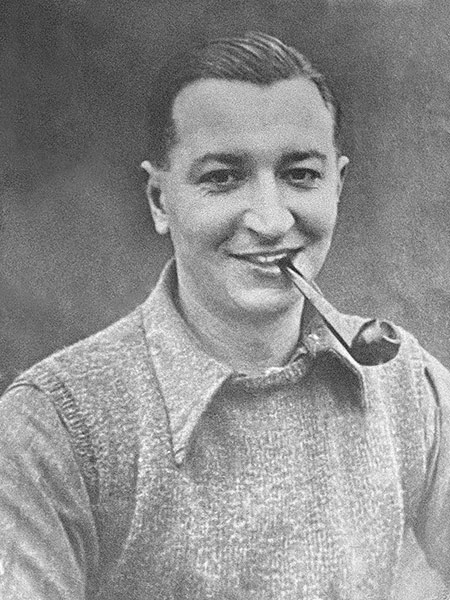
Robert Brawn

Tim Brawn shared with me this narrative written by his father Robert.

Escape to Happiness

When reading this, remember I was a young man when it all happened, I was unarmed and therefore any risks taken could have had no repercussions—and the events took place in a world at war.

Firstly, I must stress that I’m no hero and therefore the story contains no heroes, but it is the truth. 

Secondly, if from time to time I say we and not I, it is because for part of the journey I had the company of an Ulsterman, (Paddy) Albert Douglas.

At the time of the overthrow of Mussolini and the return of the monarchy, I was in charge of a working camp of 100 British POWs at a small village on the banks of the river Po in the fertile Po valley, growing crops and rice. The POWs worked on local farms, and as camp leader (capo banfo) it was my job to act as liaison with the detaining power, see that what the POWs were asked to do was within the terms of the Geneva Convention referring to POWs—and what I didn’t know about the Geneva Convention I made up! How I came to be in the north of Italy is another story. 

In September 1943, the Germans were pouring vast numbers of troops into the north of Italy under Field Marshal Kesselring to fight the Italian Campaign, and to keep as many Allied troops occupied and therefore away from the European second front—which was overdue.

Continue reading

Brawn/Douglas—A Reunion of Families

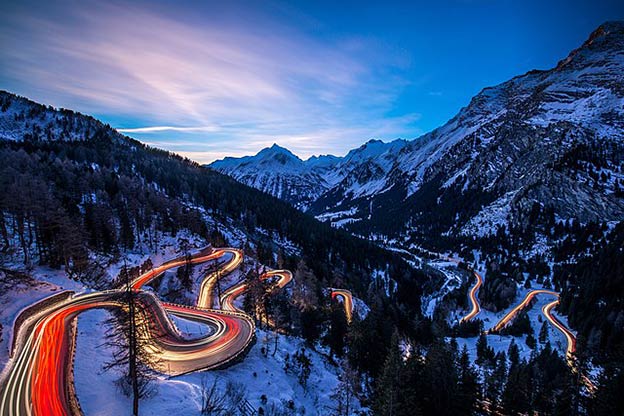
In 1943 Robert Brawn and Albert “Paddy” Douglas escaped through the Maloja Pass (pictured here) into Switzerland. Photo courtesy Wikimedia Commons / Böhringer.

This story begins with two POWs during wartime whose lives became intertwined, and who formed a tight friendship in Italy.

Corporal Robert Brawn (1433896, Royal Artillery—from Sheffield, England) and Lance Corporal Albert “Paddy” Douglas (T/150993, Royal Army Service Corps—from Belfast, Northern Ireland) were both captured in North Africa. They were interned in Feldpost 12545 and P.G. 59 Servigliano before being transferred north to the Po Valley working farms of P.G.146/25 Chignolo Po. 

They escaped captivity on 8 September 1943, met up again on the run, and then made their way together to Switzerland—arriving on October 30. 

After the war, the men returned to home and family life. 

Robert married his fiancée, Betty Wray, in 1945, and together they had two children—a a son, Tim, and a daughter, Debby. Betty had had her own war service at home—she was cited in Sheffield newspapers as a hero for collecting the dead and injured in an ambulance during the blitz on Sheffield when she was aged 17.

Albert and his wife Ellen had their son Albert, who like his father also goes by the nickname of Paddy. 

The two POWs never met again. 

Continue reading