Category Archives: Prisoners—Camp 59

“Servigliano Calling” Poem #24

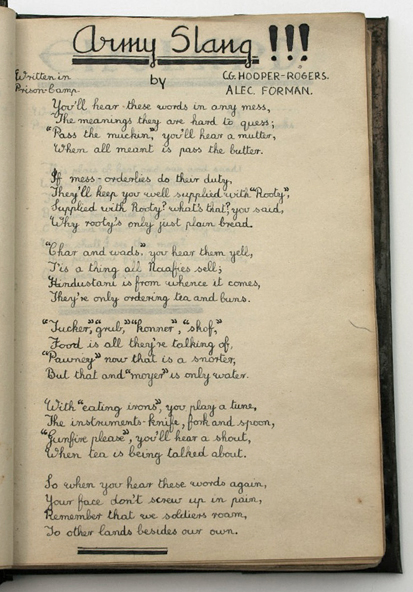
“Army Slang!!!” by C. G. Hooper-Rogers and Alec. Forman is the only poem in Robert Dickinson’s journal credited to two poets.

C. G. Hooper-Rogers authored two other poems that Robert recorded in “Servigliano Calling,” and Alec. Forman (or A. Forman) authored three other poems.

The colloquialisms in this poem might have been lost to time except for their having been defined here.

Army Slang!!!

You’ll hear these words in any mess,
The meanings they are hard to guess;
“Pass the muckin”, you’ll hear a mutter,
When all meant is pass the butter.

If mess-orderlies do they duty,
They’ll keep you supplied with “Rooty”,
Supplied with Rooty? what’s that? you said,
Why rooty’s only just plain bread.

“Char and wads”, you hear them yell,
T’is a thing all Naafies sell;
Hindustani is from whence it comes,
They’re only ordering tea and buns.

“Tucker”, “grub”, “konner”, “skof”,
Food is all they’re talking of,
“Pawney” now that is a snorter,
But that and “moyer” is only water.

With “eating irons”, you play a tune,
The instruments—knife, fork and spoon,
“Gunfire please”, you’ll hear a shout,
When tea is being talked about.

So when you hear these words again,
Your face doesn’t screw up in pain,
Remember that we soldiers roam,
To other lands besides our own.

Jack Kirkpatrick—A Returned War Hero

Sgt. John Kirkpatrick of Johnstown, Pennsylvania was considered a war hero on his return to the States. Here he is honored at a Red Cross fundraising event. Caven Point Marine Terminal is located in Jersey City, New Jersey.

ESCAPED PRISONER OF WAR WELCOMED AT JERSEY CITY WESTERN ELECTRIC RALLY FOR 1945 RED CROSS WAR FUND

Sergt. Jack Kirkpatrick of Caven Point Terminal, who was a prisoner of War in Italy for six months—then escaped and fought guerrilla warfare behind German lines for 10 months, being welcomed by Henry Jackson, superintendent of Western Electric Jersey City Plant. Left to right: Charles M. Wiest, labor-management war production Red Cross representative; Sergt. Kirkpatrick; Sterling P. Henry, Jr., Jersey City Red Cross speakers’ bureau, who delivered principal address; Superintendent Jackson, and Mike D’Allesando, elected representative of the Western Electric Employees Association, affiliate of N.F.T.W. [the National Federation of Telephone Workers union]

Sending Packages to Prisoners

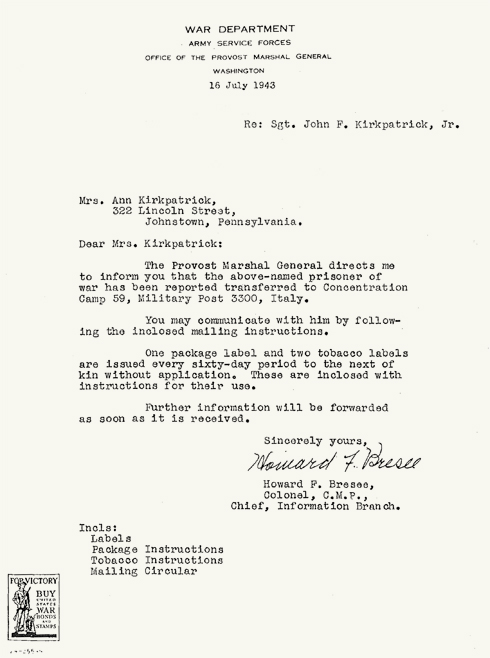
This letter from Colleen Nisewonger, Jack Kirkpatrick’s daughter, contains an interesting bit of information—that families of imprisoned servicemen were allowed to send their loved one a single package of supplies and two packages containing cigarettes (or perhaps other tobacco products) every two months.

Unfortunately, I do not have the detailed instruction sheets and circular that were enclosed in this letter, but the letter itself is valuable evidence that each family was able to send supplies to their serviceman in captivity.

Here is the text of the letter:

WAR DEPARTMENT
ARMY SERVICE FORCES
OFFICE OF THE PROVOST MARSHAL GENERAL
WASHINGTON

16 July 1943

Re: Sgt. John F. Kirkpatrick, Jr.

Mrs. Ann Kirkpatrick,
322 Lincoln Street,
Johnstown, Pennsylvania.

Dear Mrs. Kirkpatrick:

The Provost Marshal General directs me to inform you that the above-named prisoner of war has been reported transferred to Concentration Camp 59, Military Post 3300, Italy.

You may communicate with him by following the enclosed mailing instructions.

One package label and two tobacco labels are issued every sixty-day period to the next of kin without application. These are enclosed with instructions for their use.

Further information will be forwarded as soon as it is received.

Sincerely yours,

Howard F. Bresee,
Colonel, C.M.P.,
Chief, Information Branch.

Incls:
Labels
Package Instructions
Tobacco Instructions
Mailing Circular

“Servigliano Calling” Poem #23


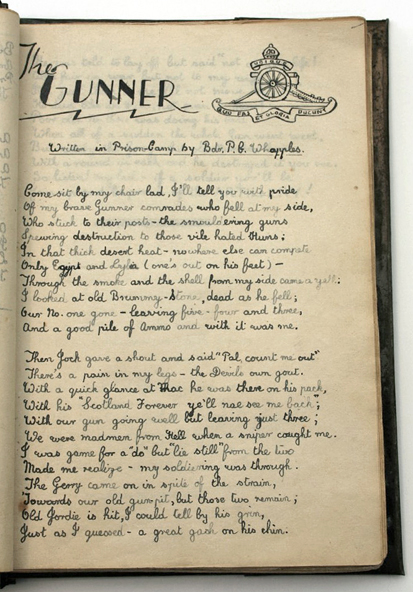
This ballad of heroism by Bdr. P. G. Whapples would have had special significance for Robert Dickinson, who was himself a gunner in the Royal Artillery.

The crest Robert drew to illustrate this poem is the same crest that adorns his grave marker at Milan Military Cemetery.

The Artillery’s motto, “Quo Fas et Gloria Ducunt,” translates “Where Duty and Glory Lead.”

The Gunner

Come sit by my chair lad, I’ll tell you with pride
Of my brave Gunner comrades who fell at my side,
Who stuck to their posts—the smouldering guns
Spewing destruction to those vile hated Huns;
In that thick desert heat—no where else can compete
Only Egypt and Lybia (one’s out in his feet)—
Through the smoke and the shell from my side came a yell;
I looked at old Brummy-Stone, dead as he fell;
Our No. one gone—leaving five, four, and three,
And a good pile of Ammo and with it was me.

The Jock gave a shout and said “Pal, count me out”
There’s a pain in my legs—the Devil’s own gout.
With a quick glance at Mac he was there on his pack,
With his “Scotland Forever ye’ll nae see me back”;
With our gun going well but leaving just three;
We were madmen from Hell when a sniper caught me.
I was game for a “do” but “lie still” from the two
Made me realize—my soldiering was though.
The Gerry came on in spite of the strain,
Towards our old gun-pit, but those two remain;
Old Jordie is hit, I could tell by his grin,
Just as I guessed—a great gash on his chin.

He was told to lay off but said “not on your life!
All’s fair in war but not to my wife;
It’s just them or me; I’ll not move an inch.”
He died like a Hero, not even a flinch;
Poor old No. three was doing his best
When all of a sudden the whole Gun went west,
But not by the Gerry—but old Number three
With a round in each end he destroyed it you see.
So listen! my lad—if a soldier you’ll be
Join up and be proud of the ARTILLERY!

“Servigliano Calling” Poem #22

The elaborate script, art deco typography, and art that decorate the titles of poems in Robert Dickinson’s journal, “Servigliano Calling,” are worthy of special attention in their own right.

Compare the drawing below of a Camp 59 lire to an actual Camp 59 lire bill; it is accurate down to the signature of Commandant Enrico Bacci.

It only takes a glance at Robert’s 1942 Christmas postcard home to his Mum, Dad, and younger brother Len to recognize Robert’s own artistry in these poem titles.

The brilliant, satirical “And They Pay Us a Lire For That” is one of three by Harry Stewart (or H. Stewart) in the journal. It’s one of my favorites.

Historian Giuseppe Millozzi had this to say about payment for work accomplished in the camp:

“Approximately fifty POWs worked in the administration of the camp. Being workers, they were entitled to double ration of food. A prisoner was the barber and he received a 60 liras pay per month. Among POWs there were numerous tailors and shoemakers who worked for a monthly pay of 30 lira.”

And The Pay Us a Lire For That

I’m really quite glad I’m a prisoner of war,
Although it seems silly to state,
We’re doing much better than ever before,
We’re far the best off, up to date,
We all look resplendent in clothes that are new.
We get lots of sauce and rice in our stew,
And we’ve none of our blinking “Arbieten” to do,
And they pay us a Lire for that.

The cookhouse fatigues here are really quite good,
And easy, or so I am told,
That’s I should say, if you dodge chopping wood,
And inside you get from the cold,
You go round and stir up a pot when you please,
And then help yourself to a large lump of cheese,
And if the stew’s thin, add a pair of split peas,
And they pay us a Lire for that.

They really look after our health quite a lot,
And look to our comfort and needs,
And p’raps when the Red Cross man’s looked at the spot,
We might get some sensible feeds,
We might swop the white wine again for the red,
And instead of muster, count us in bed,
They may even make’ em flour the bread,
And they pay us a Lire for that.

So really, I think we’re a fortunate swarm,
And just think how nice it will be,
Lazing around when the weather turns warm,
Just knocking back pints of sweet tea,
But now it’s quite warm in these beds without doubt,
And I lie there in luxury thinking about,
The poor “Iti.” sentry who’se freezing without,
And they pay us a Lire for that.

Note: Arbeiten is German “to work.”

“A Mother’s Intuition Rewarded”

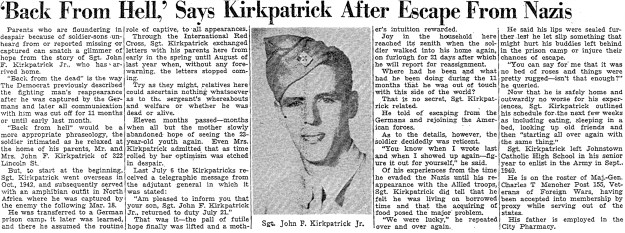
For this Memorial Day, here is a glad report of one captured American soldier’s return home. The solder is Sergeant John F. Kirkpatrick Jr. of Johnstown, Pennsylvania.

The news article is one of several items about Jack Kirkpatrick saved by his daughter, Colleen Nisewonger. She had been to this site a number of months ago looking for information about her father and found that his address was one of 55 addresses of servicemen recorded on Luther Shield’s deck of American Red Cross Aviator playing cards. The post is “Dual Purpose Deck of Cards.”

Colleen wrote that in the deck of cards, “much to my surprise, was my fathers name and old address, in his own handwriting. He was Jack Kirkpatrick on the 7 of hearts.”

Here is the article:

‘Back from Hell,’ Says Kirkpatrick After Escape from Nazis

The Democrat (Johnstown, Pennsylvania), July 1944

Parents who are floundering in despair because of soldier-sons unheard from or reported missing or captured can snatch a glimmer of’ hope from the story of Sgt. John F. Kirkpatrick Jr., who has arrived home.

“Back from the dead” is the way The Democrat previously described the fighting man’s reappearance after he was captured by the Germans and later all communication with him was cut off for 11 months or until early last month.

“Back from hell” would be a more appropriate phraseology, the soldier intimated as he relaxed at the home of his parents, Mr. and Mrs. John F. Kirkpatrick of 322 Lincoln St.

Continue reading

Jack Kirkpatrick—Returned to Duty

Sgt. Kirkpatrick, Captured in 1943, Returns to Duty

Johnstown, Pennsylvania, June 1944

Sgt. John F. Kirkpatrick Jr., reported captured on Mar. 28, 1943, in the North African area, has returned to active duty with the American troops overseas, according to a War Department message received last night by his parents, Mr. and Mrs. John F. Kirkpatrick of 322 Lincoln St.

“Am pleased to inform you that your son, Sgt. John F. Kirkpatrick Jr., returned to duty June 21 [1944],” the telegram stated. “Undoubtedly he will communicate with you at an early date concerning his welfare and whereabouts.”

The family had been informed in May, 1943, that he was missing and a short time later that he was a prisoner. The solder left Catholic High School in his senior year to enlist in the Army in September, 1940, and was sent overseas in October, 1942.

L’informatore on the Davison Rescue

Since publishing his father’s memoirs last year, John Davison has continued to search for information about the people in northern Italy who protected Norman Davison and arranged for his safe passage to Switzerland.

This spring, Anne Copley told John that she had discovered a Web site dedicated to the resistance history of Vigevano—La Resistenza a Vigevano—and John’s subsequent contacts with this historical group led to a Vigevano newspaper’s research and publication of a two-page story on Norman’s rescue and the brave Italians who risked their lives to protect him.

L’informatore‘s report, translated into English, is below.

Courage and gratitude

L’informatore (The Informer), April 22, 2010
Commentary (“Coraggio e gratitudine”)
by Margherita Natale

We want to tell you a beautiful story, of those who, in the midst of so much misery and penury, keep true human values in their hearts. In a society which rewards highest the scramble for worthless honours and tin medals, here’s this book, written by an Englishman—Norman Davison—dedicated to a group of citizens of Vigevano who, in October 1943, saved him and his friends from raids by the Germans in the woods of Ticino, and arranged for their safe passage to Switzerland.

This was an episode we had not heard of, as it had been kept private by relatives of those who had taken part in the adventure. Their reserve and modesty is a sign of their honor.

Continue reading

William Redman—Captivity, 1941–45

William Redman was one of 20 men recorded in Robert Dickinson’s Address List in his journal, “Servigliano Calling.”

To date we have learned more about three of these fellows: Fred Druce, Jack Davies, and now William Redman.

In February, Jo Millard of Littlehampton (Sussex, England) wrote, “I have been researching my family tree, and I always knew my Mother’s brother was a prisoner of war in Italy but never knew where, as he very rarely talked about those days.

“Just by chance I stumbled onto your site and saw his name and address. So I now have a little bit more of the puzzle that is my family.”

Two months later, Jo sent her uncle’s story, which she found archived at the local government records office.

William’s POW Story

In due course, I joined up and very soon found myself in the Middle East, where I met up with Sef [William’s younger brother] in Cairo. After a short spell in the Artillery base, which was at Heliopolis—the biblical “City of the Sun”—I got posted to a unit somewhere up the desert. I was miles away from anywhere and after a while our captain warned us to be ready to move “up to the wire,” as the sappers would be cutting the wire for us to go into Libya.

The wire was a monstrous affair, quite eight feet high, four feet at the base, and tapered up until it finished at two feet at the top. It was one mass of barbed wire. I met up with a chap who had been with the Long Range Desert Group. He came with us to the quarry in Germany [the quarry—described later—was a work camp in Grimma, Germany]. He told me that they ranged all over Libya and as far as he knew the fence was all around the country.

We went through the cutting and turned south. There, in the vast uninhabited interior, we spent our time on maneuvers, getting ready for “the big one.” We had several skirmishes with the Germans and Italians whilst we prowled around there. Not too bad. I cannot remember if we lost any men. Then one day we were ordered to pack and go north to take up our positions for attacking the Germans, who were dug in around Tobruck. It was in November 1941. We opened up at about 10,000 yards according to our No.1, who timed another gun’s shell explosion. It was the commencement of the Battle of Sidi Rezegh. The 6th Tanks came through our guns, and their commanders, with their heads out of the turrets, waved gaily to us as they rolled on towards the enemy.

Continue reading

Patrick Cahill—Capture and Liberation

Patrick Cahill with fellow servicemen. Patrick is the fellow leaning against the chair just left of center.

Notification of Pat’s capture and imprisonment at Camp 59, sent to his parents in August 1942.

Dean Cahill of Leicestershire, England, has provided some information for this site about his grandfather, Pvt. Patrick Cahill of the 12th Lancers. Pat was captured at Tobruk in North Africa. Information about Patrick’s war experience is sketchy because, as Dean put it, “He was the type that wanted to forget!”

Dean’s father, Ralph Cahill, said that the civilians in this picture somehow helped Pat with his escape. Pat Cahill is seated at far right, holding the dog.

According to Dean:

“Pat had escaped before and been re-captured. I’m not sure if this was from Camp 59. After the mass escape though the hole in the wall, Pat made his way, along with two other Brits to Switzerland, living for six months with a kind mountain farming family. He then passed though France and managed to reach Britain undetected.

G. Norman Davison recounts an early tunneling breakout from Hut 4 of Camp 59 in his published memoirs, In the Prison of His Days. All of the men were recaptured. Perhaps Pat took part in that breakout.