Category Archives: Antonio Ferretti

Antonio Ferretti—“A Bird of Passage”

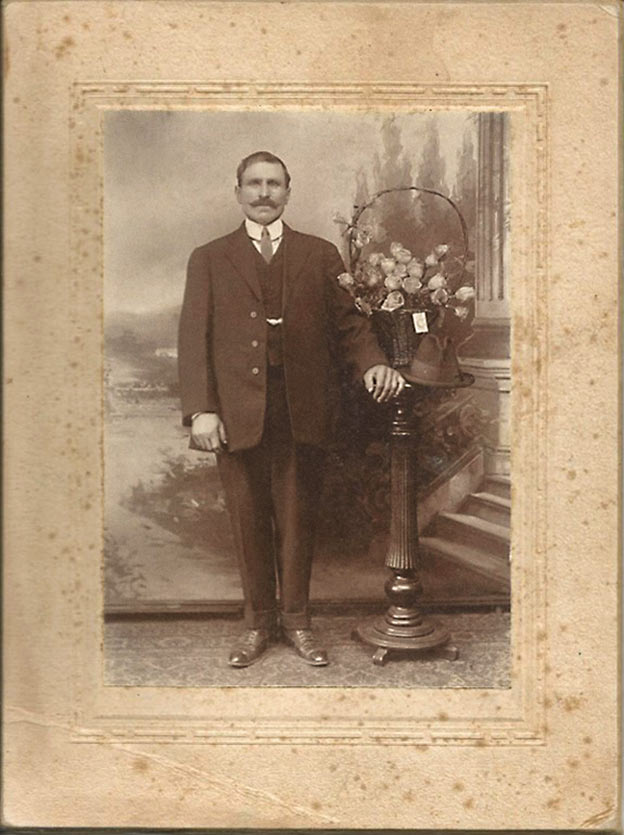
Formal portrait of Antonio Ferretti taken in America
An address stamped on the back of the image notes the photograph was taken by Fotografia Artistica Italiana in Pittsburgh, Pennsylvania. The photographic studio apparently catered to Italian immigrants.

Growing up in American, I’ve been aware all my life of the many contributions Italian immigrants have made to the fabric of American culture. However, until recently I was not familiar with Italian seasonal migrant labor in the early 20th century. These “birds of passage” found temporary employment in the U.S. in order to provide for their families in Italy, eventually returning to their homeland.

Migrant workers often worked alongside permanent Italian immigrants in booming U.S. industries such as mining and steel production.

Italian Migrants

Historian Joan L. Saverino, in her publication “‘Domani Ci Zappa’: Italian Immigration and Ethnicity in Pennsylvania,” writes: “[Most Italian immigrants to America] were contadini, a word variously translated as farmers, farm hands, or peasants. Even an expression used by Italian immigrants to indicate work the next day, ‘Domani ci zappa (Tomorrow, it’s work)’ suggests that these immigrants formerly made a living as farm laborers or lived closely connected to the agricultural cycle. The use of the verb ‘zappare,’ is translated literally ‘to hoe.’”

Continue reading

A Visit to Falciano

I have written about the sheltering in Falciano of escaped prisoners of war from Camp 59 in 1943–44, but I have not had the pleasure of seeing the village in person.

When Gian Paolo Ferretti—great-grandson of Antonio Ferretti, who helped to protect the escapees—invited my friend Anne Copley to Falciano for a tour, I was excited for her, but wishing I could join them.

So I was delighted when, a few days later, Anne sent me notes on her visit and a slideshow of some 20 images she took while there.

“Paolo pointed out that in the ’40s there was no road to the village, just footpaths and mule tracks,” Anne explained. ”It would have been pretty safe as a hiding place, as it would have taken the Germans an hour to reach Falciano from Aquasante Terme. The two spies in the village would have only been able to deliver information that would have been out-of-date by the time they got down into the valley.

“At its height there were over 100 people living up in Falciano. All the now heavily-wooded land would then have been cultivated—everywhere terraced for growing crops. The locals mostly owned their land, rather than working it as sharecroppers. It’s a very different landscape to where I live in Montefalcone—very steep hills and nowhere available as actual fields. 

“There are lots of little waterfalls and fonte, where a stone trough was carved out to capture the water. And there are amazing rock formations making grottos where produce was stored and animals kept—and where the escapers were sheltered, with villagers bringing them food on a rota system. Each overhanging rock was fashioned (carved by hand) so that a lip prevented the rain running down inside and ruining the stuff stored there. Since they were taxed according to the number of animals they had, a few were hidden away in these grottoes!

Continue reading

Antonio Ferretti—A Welcome in Falciano

Antonio Ferretti (seated, far right, with handlebar mustache) with a few of the villagers of Falciano. Falciano had a population of 110 residents in 1940. Today the village has 15 residents.

My good friend Gian Paolo Ferretti, who lives in Ascoli Piceno, was born in Falciano—a small village within the comune of Acquasanta Terme, Italy. His family moved from Falciano in 1975, when Paolo was very young.

Paolo’s great grandfather was one of many Falciano villagers who assisted a group of escaped POWs—including Keith Argraves—who turned up in their village in the fall of 1943.

(See “Keith Argraves and Friends—‘Prisoners and Fugitives’.”)

“American soldiers who were escaped prisoners from Camp 59 were given refugee in my small village. Tales of them are becoming legend,” Paolo wrote. “A cave/stable where they slept is on the property of my family. The book Keith Argraves, Paratrooper has been the start of all my research.”

I asked Paolo about the spelling of the village name, because on today’s maps the village is spelled Falciano, but Keith Argraves refers to it as Falgiano. Paolo answered, “In the past the village name was Falgiano, now Falciano. These are changes in the language. Also, those with the name Brandimarte now spell it Brandimarti.” (As you will see, Captain Saturnino Brandimarte figures prominently in this village rescue saga.)

“The soldiers were in a wood of chestnuts. They slept in a cave or stable on the property of my family. During the day they came to the village and stayed with local people. The soldiers helped with farm work.

“One of those villagers was my great grandfather Antonio Ferretti. The prisoners usually talked with him, because Antonio once went to work in the U.S.—in Pittsburgh—during the 1908–1914 period.

Continue reading