By way of my friends Gian Paolo Ferretti and Antonio Ferretti I’ve learned of a British officer who was sheltered in the comune of Roccafluvione in late 1943.
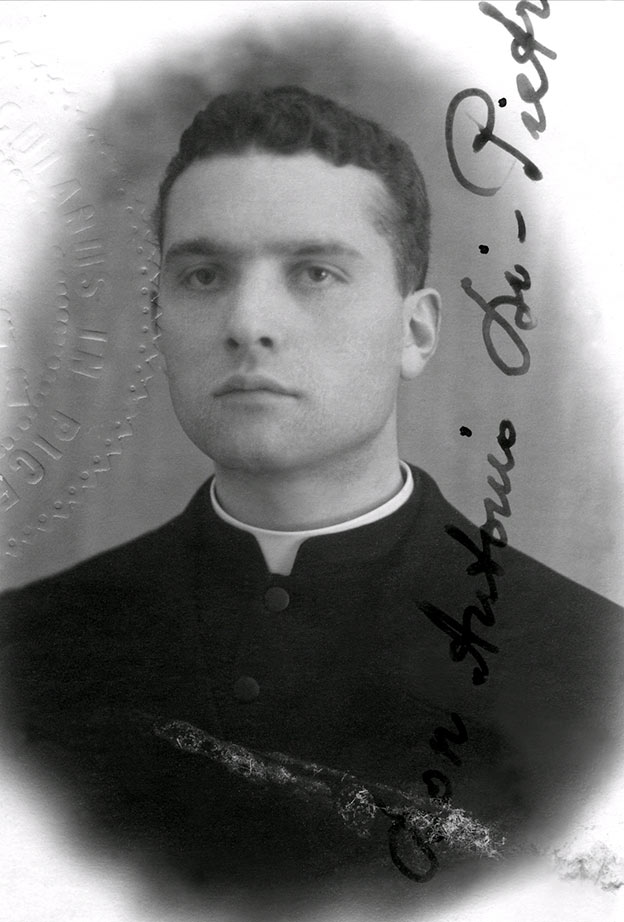
The officer, Major Patrick Clayton, was the guest of two Catholic priests: Don Antonio Di Pietro, who served the parish in Osoli, and Don Giuseppe “Don Peppe” Ciabattoni, who served the parish in Marsia, both within the comune of Roccafluvione.
The road distance from the Roccafluvione villages (frazioni) of Osoli and Marsia is 6.8 kilometers (about 4 miles)—Google Maps
Antonio Ferretti had previously shared segments of Don Peppe’s chronicon diary, in which the priest briefly mentions Patrick Clayton. (See “Don Giuseppe Ciabattoni—A Hero of Faith.”)
Now Antonio has accessed the chronicon of Don Antonio Di Pietro, which is housed in the Archivio Diocesano.
Paolo notes that Osoli has two churches—one dedicated to San Martino and the other to San Giovanni. Both are outside of the village, and San Martino was chosen as the church of the parish because it is nearer to Osoli.
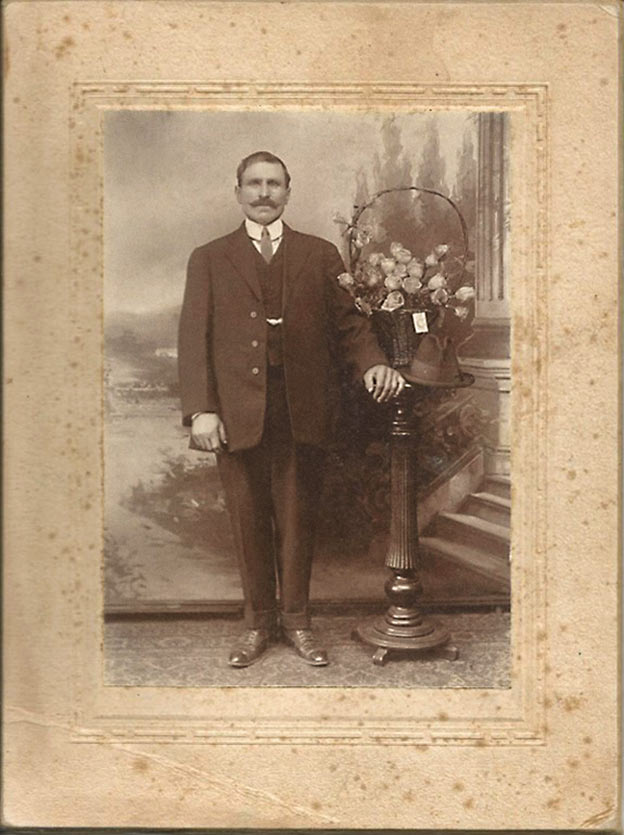
Formal portrait of Antonio Ferretti taken in AmericaAn address stamped on the back of the image notes the photograph was taken by Fotografia Artistica Italiana in Pittsburgh, Pennsylvania. The photographic studio apparently catered to Italian immigrants.
Growing up in American, I’ve been aware all my life of the many contributions Italian immigrants have made to the fabric of American culture. However, until recently I was not familiar with Italian seasonal migrant labor in the early 20th century. These “birds of passage” found temporary employment in the U.S. in order to provide for their families in Italy, eventually returning to their homeland.
Migrant workers often worked alongside permanent Italian immigrants in booming U.S. industries such as mining and steel production.
Italian Migrants
Historian Joan L. Saverino, in her publication “‘Domani Ci Zappa’: Italian Immigration and Ethnicity in Pennsylvania,” writes: “[Most Italian immigrants to America] were contadini, a word variously translated as farmers, farm hands, or peasants. Even an expression used by Italian immigrants to indicate work the next day, ‘Domani ci zappa (Tomorrow, it’s work)’ suggests that these immigrants formerly made a living as farm laborers or lived closely connected to the agricultural cycle. The use of the verb ‘zappare,’ is translated literally ‘to hoe.’”
I have written about the sheltering in Falciano of escaped prisoners of war from Camp 59 in 1943–44, but I have not had the pleasure of seeing the village in person.
When Gian Paolo Ferretti—great-grandson of Antonio Ferretti, who helped to protect the escapees—invited my friend Anne Copley to Falciano for a tour, I was excited for her, but wishing I could join them.
So I was delighted when, a few days later, Anne sent me notes on her visit and a slideshow of some 20 images she took while there.
“Paolo pointed out that in the ’40s there was no road to the village, just footpaths and mule tracks,” Anne explained. ”It would have been pretty safe as a hiding place, as it would have taken the Germans an hour to reach Falciano from Aquasante Terme. The two spies in the village would have only been able to deliver information that would have been out-of-date by the time they got down into the valley.
“At its height there were over 100 people living up in Falciano. All the now heavily-wooded land would then have been cultivated—everywhere terraced for growing crops. The locals mostly owned their land, rather than working it as sharecroppers. It’s a very different landscape to where I live in Montefalcone—very steep hills and nowhere available as actual fields.
“There are lots of little waterfalls and fonte, where a stone trough was carved out to capture the water. And there are amazing rock formations making grottos where produce was stored and animals kept—and where the escapers were sheltered, with villagers bringing them food on a rota system. Each overhanging rock was fashioned (carved by hand) so that a lip prevented the rain running down inside and ruining the stuff stored there. Since they were taxed according to the number of animals they had, a few were hidden away in these grottoes!
Last November Willman King’s daughter Rena Buhr met Donato Giancola. As an escaped POW in Italy during WWII, Willman was protected by Donato’s family. Gian Paolo Ferretti (left) arranged their meeting.Willman King
Willman, from Detroit Lakes, Minnesota, was inducted into the service in October 1941. After training in the U.S., he was sent overseas. He participated in the November 1942 Allied invasion of North Africa, and the following month was captured in Tunisia. He was interned in PG 59, from which he escaped in September 1943. Like many other escapees, Willman was cared for by local Italians.
Willman’s son Joseph was my contact when I wrote those five posts. Confident that Joseph and I had exhausted all the material there was to share about Willman, I didn’t expect to hear further from Willman’s family. So I was surprised in September to hear from Rena Buhr, one of Willman’s daughters.
”I am preparing to visit Italy in early November,” Rena wrote. ”I would love to have any insight into a visit to Camp 59—what to expect and amount of time to explore.” We began an exchange of emails. She used the word “pilgrimage” to describe the trip.
In my 2020 post A Haven in Smerillo, I shared a story about the sheltering of two escaped POWs by a remarkable woman, Letizia Galiè in Del Gobbo, a widow with six children.
The story of Letizia Del Gobbo’s heroism came to me from her grandson Marco Ercoli. When Marco contacted me, he recalled that the family simply referred to the two escapees as “Michele” and “Beo.”
Letitia Del Gobbo carrying gathered firewood
Marco recalled that “Beo” had years ago returned to Smerillo with his wife, Nadine. The 1990 homecoming was deeply emotional for both the American couple and everyone in Smerillo—both family and older neighbors. In relaying the story, Marco described the event best as he could from memory—taking a degree of creative liberty to enliven it with recreated conversations and detail.
The only evidence of the visit was a photograph of the American couple with Marco’s uncle Antonio and Antonio’s wife Viola, with a notation on the back: “Nadine and Bill.” That made it clear that the man they called “Beo” was Bill, or William.
“Michele” in English would be Michael, and Marco’s uncle Antonio, who was a teenager when his mother sheltered the POWs, confirmed that “Michele” was American serviceman Michael Rotunno.
Since then, in spite of delving into archives, no further information about Bill and Michael came to light until last March, when I discovered that after the war Letizia had submitted a claim to the Allied Screening Commission requesting compensation for sheltering POWs. From the U.S. National Archives (NARA) I ordered a digital copy of Letizia’s helper claim.
The claim turned out to be a goldmine of information.
When American soldiers from PG 59 turned up in Falciano just days after their escape from the camp in September 1943, they were welcomed warmly by the residents of the entire village. In the weeks to come help was provided by 17 families. The coordination of this effort was undertaken by Saturnino Brandimarte, a captain of Italy’s Royal Army, who was now serving as the village schoolteacher.
Although the individual families filed Allied Screening Commission claims requesting compensation for their assistance given to the POWs, Captain Brandimarte himself filed a highly detailed report with the ASC to bolster these claims.
Note that although there are frequent references to six prisoners, two others—Ira Powers and Jack Hayes—also received help in Falciano. Ira and Jack left sooner than the others and succeeded in crossing the Allied lines. The other six were recaptured.
Antonio Ferretti (seated, far right, with handlebar mustache) with a few of the villagers of Falciano. Falciano had a population of 110 residents in 1940. Today the village has 15 residents.
My good friend Gian Paolo Ferretti, who lives in Ascoli Piceno, was born in Falciano—a small village within the comune of Acquasanta Terme, Italy. His family moved from Falciano in 1975, when Paolo was very young.
Paolo’s great grandfather was one of many Falciano villagers who assisted a group of escaped POWs—including Keith Argraves—who turned up in their village in the fall of 1943.
“American soldiers who were escaped prisoners from Camp 59 were given refugee in my small village. Tales of them are becoming legend,” Paolo wrote. “A cave/stable where they slept is on the property of my family. The book Keith Argraves, Paratrooper has been the start of all my research.”
I asked Paolo about the spelling of the village name, because on today’s maps the village is spelled Falciano, but Keith Argraves refers to it as Falgiano. Paolo answered, “In the past the village name was Falgiano, now Falciano. These are changes in the language. Also, those with the name Brandimarte now spell it Brandimarti.” (As you will see, Captain Saturnino Brandimarte figures prominently in this village rescue saga.)
“The soldiers were in a wood of chestnuts. They slept in a cave or stable on the property of my family. During the day they came to the village and stayed with local people. The soldiers helped with farm work.
“One of those villagers was my great grandfather Antonio Ferretti. The prisoners usually talked with him, because Antonio once went to work in the U.S.—in Pittsburgh—during the 1908–1914 period.
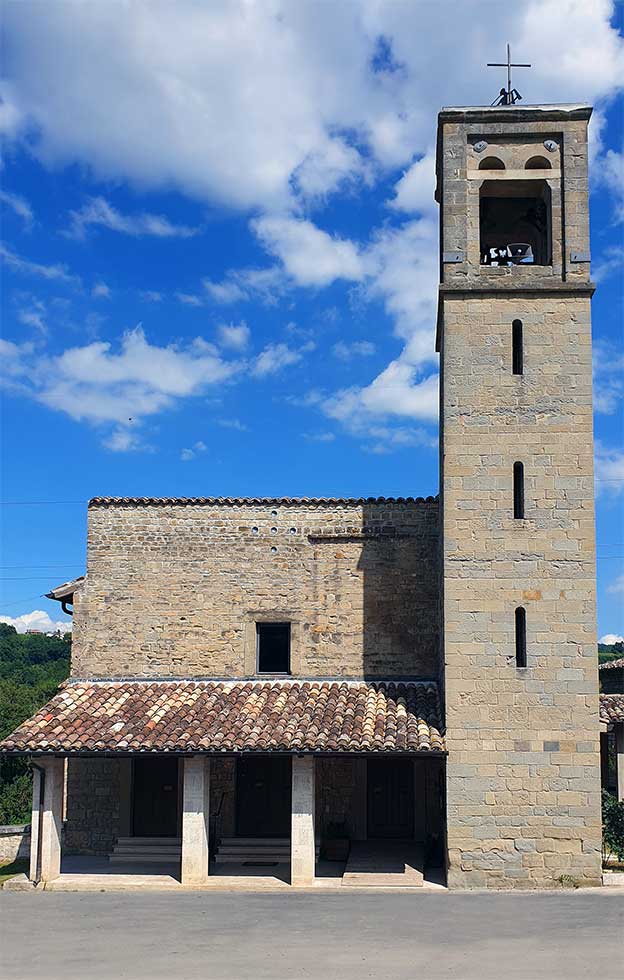
The Church of Santo Stefano Protomartire in Marsia, Roccafluvione. Image—Wikimedia Commons
An entry for 17–21 May 1938 from the “chronicon” of Don Giuseppe Ciabattoni offers insight into the turbulent political climate in Italy that presaged World War II. (The priest’s chronicon was a journal where activities of the parish were recorded.)
Then, in the latter two entries in this post, Don Peppe—as he was affectionately called by his parishioners—contrasts the oppression of war with the joy and spirit of thanksgiving felt by the parishioners after liberation from the Nazis.
Don Peppe used the phrase “in casa di Pietro” “(in Peter’s house”) in sharing the story of his own arrest and imprisonment by the fascists. This allusion is to the Biblical imprisonment and beating of Saint Peter.
I’ve recently posted another excerpt from Don Peppe’s chronicon on Camp 59 Survivors, an entry covering the period of Nazi-fascist oppression from 8 September 1943 to liberation on 17 June 1944. Read “Don Giuseppe Ciabattoni—A Hero of Faith.” That excerpt includes the Marsia parish’s escaped POW rescue work.
Chronicon excerpts are here translated into English; however, I’ve also included the original Italian transcription (in italics).
Once again I wish to thank Gian Paolo Ferretti for his ongoing support and for guiding me through the translation of the chronicon.
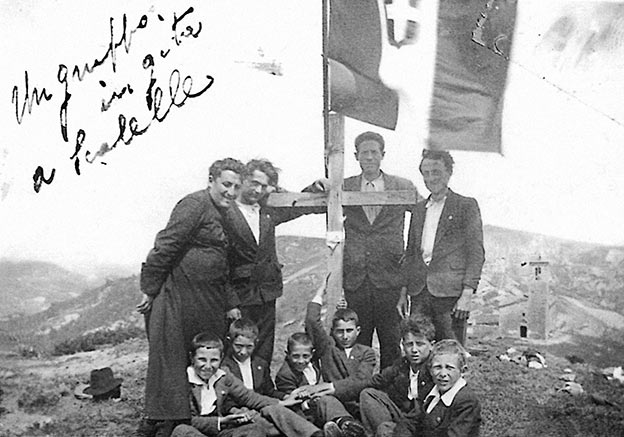
Don Giuseppe Ciabattoni (left), on a 1936 visit to the ninth-century church of Santa Maria di Scalelle; most likely he is accompanied by aspirants of the Catholic Action Youth
I am profoundly grateful to several individuals who have made possible access to the information for this post.
First, a hearty thanks to my friend Gian Paolo Ferretti of Ascoli Piceno, Italy. Paolo contacted me last November about his great grandfather Antonio Ferretti who, on his property in Falciano, sheltered several American POWs who had escaped from PG 59.
In emails with Paolo, I shared a few details about my father’s time on the run after his escape from PG 59. I explained that Angela Bianchini had protected my father (Armie Hill) and his friend Ben Farley in Roccafluvione.
In 2010, I had visited Roccafluvione hoping to learn more about Angela, and I wrote about that visit afterward (see “In Search of Armie’s Italian Angels”). It was during the trip to Roccafluvione that I learned the name of Don Giuseppe Ciabattoni.
Paolo surprised me with news that he had arranged a meeting with Guido Ianni, deputy mayor of Roccafluvione, to discuss our quest. The deputy mayor was eager to help us learn more about Angela and Don Giuseppe Ciabattoni, and during Paolo’s meeting with him he was introduced to Antonio Ferretti, a young man working on a research project in the comune archives.
Antonio immediately began to hunt for information.
I received word this morning from Marida Parks that her father, Nicola Lagalla, passed away yesterday, February 15th, in Perth, Western Australia, at the age of 98.
Visitors to this site may be familiar with the story of Nicola and his brother Liberato’s heroic sea transport of POWs through reading “Nicola and Liberato Lagalla—Rescue by Sea.”
Among the soldiers aboard the boats navigated by the young Lagallas was Captain J. H. Derek Millar, PG 59’s chief medical officer and—at the time of the camp breakout—the camp’s commanding officer. (Read “Captain Millar—Valor in the Hour of Crisis.”)
After the camp breakout in September 1943, Captain Millar and Corporal Howard Jones, along with Italian Lino Papiri, led a dozen or more escapees to the Adriatic port of San Benedetto del Tronto. There the men were loaded onto two diesel-powered fishing boats that were owned by the Lagalla family.
Captain Millar wrote in his memoirs, “no one knew how to work a diesel engine, until we got a 16 year old Italian boy who said he could do it ….”
That boy and his brother, Nicola and Liberato Lagalla, skippered the prisoners along the coast to the safety of Allied-controlled Termoli.
After the war the brothers were awarded the British Bronze Medal for Civilian Bravery.
Nicola had a zest for life and a rich sense of humor.
Marida once wrote to me, “Dad & Liberato were clowns & somewhat different to the rigid Italian way of thinking, especially in San Benedetto. They would often get up to no good. Playing tricks on both family & strangers.
“I can tell you without hesitation, that the one to start it would’ve been dad. A rebel his entire life, which I think may have served him well at the time of the escape.”
Last July, Marida wrote, “You would wonder how dad is doing? He’s been amazing given what he’s had to endure. One thing about this man, he’s determined, relentlessly compelled to overcome obstacles.
“Dad feels deeply. Yet, has finite processes—you can see the cogs turning. Not much different to the boy back then, to the man he is today. Resilient.
“Dad never passes up the opportunity to sing and dance during festa time at the residences. Did you know he was an amazing Boogie Woogie dancer? That he has an amazing voice?”
Preceded in death by his wife and their son Robert, Nicola left life in the way he certainly would have wished—with his loving children, Marida, Sabrina, and Paul, by his side.





 Camp 59 Survivors