Author Archives: Dennis Hill

Mail Sent from the Prison Camps

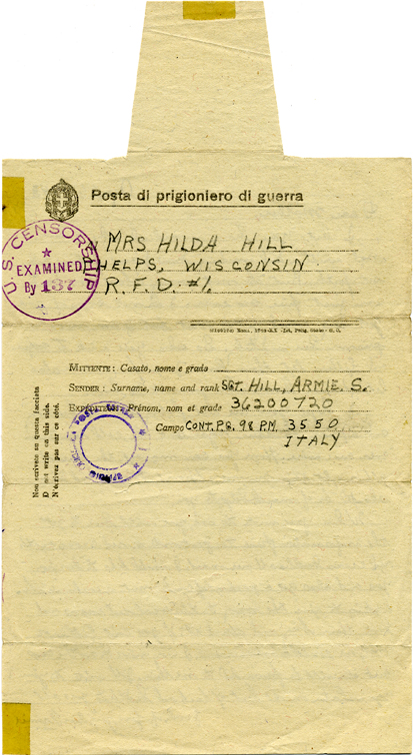
Each POW was entitled to send one postcard and one letter from camp each week. The letters were an early form of aerogram, a lightweight piece of paper that became its own envelope when folded. Note the shape of the following aerogram sent by Armie Hill from Camp 98 on Sicily to his mother.

ahill_let-back_apr-6-43.jpg

ahill_let_apr-6-43.jpg

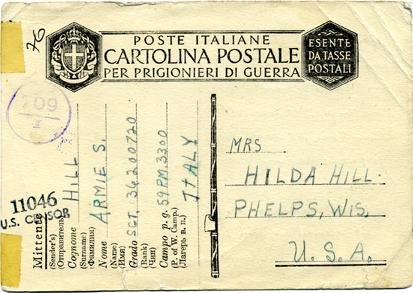
The following postcard was sent by Armie to his mother from Camp 59. Note the letters and cards are lined with 24 lines and 10 lines, respectively, thereby limiting the writer’s message space. Note also that the correspondence bears the stamps of both Italian and U.S. censors.

ahill_postback_aug-10-43.jpg

ahill_post-front_aug-10-43.jpg

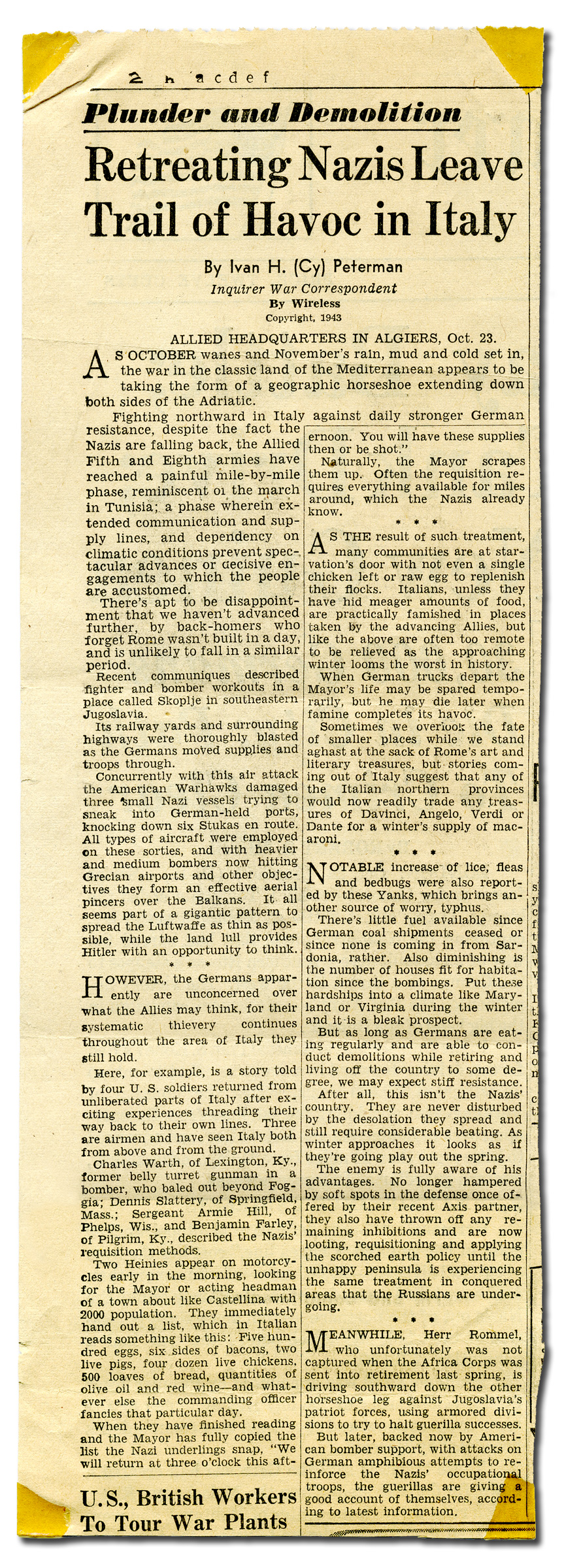
Trail of Havoc

trail_havoc_hd.jpg

The attached clipping is one that Armie Hill had saved for many years. It is an article submitted for publication on October 23, 1943 to the Philadelphia Inquirer by the paper’s war correspondent Ivan H. (Cy) Peterman.

Armie and his traveling companion Ben Farley, who just reached British lines eight days earlier, served as informants for the story. As they traveled across Italy they had seen first-hand the dire situation of the Italian farmers and had heard stories of how poorly the Nazis were treating the Italians. Also serving as sources for the article were American servicemen Charles Warth and Dennis Slattery.

Click on the thumbnail below to view the full article (1MB).

trail_havoc_oct-23-4.jpg

Armie Hill’s Camp Journal

journalcov.jpg

Armie Hill kept a journal while he was in Camp 59. This journal contains some lines of poetry, a list of the men in Armie’s hut, two drawings, notes about his own personal interests, Italian lessons, and notes on technical English and sciences from the lectures prisoners gave to one another.

The journal also contains a diary of the first 10 days following the escape from Camp 59, as Armie and Ben Farley traveled cross country in their attempt to reach the landing Allied forces.

The following PDF file (4MB) contains scans of each page of the journal and ends with a section of explanatory notes:

journal_armie_hill.pdf

Recollection of Camps 98 and 59

Of two audio recordings that I made with my father, Armie Hill, about his war experiences, this account of Camps 98 and 59 is from the first. The recording was made in February 1976.

The story begins with transport of the prisoners from North Africa to Sicily. Note how different camp conditions at Camp 98 were from Camp 59. My notations are in brackets.

“Finally one morning they succeeded in landing their planes. There were about fifty planes and they loaded about fifteen men to a plane. We flew over the Mediterranean to Sicily. We flew low and many times the plane almost touched the water. The machine guns in the fighter planes pointed up. That way the British planes couldn’t fly low enough to fire at us. Occasionally we hit an air pocket. The propellers would keep turning, but the plane wouldn’t move forward—it just dropped down ten or twenty feet. Then suddenly it would move forward again. It took about an hour to get across. When we landed I didn’t know where we were, but there the Germans turned us over to the Italians.

“I thought the Italians would treat us better, but they were poorly organized. We had to stand for hours while they counted us. Hitler and Mussolini had made an agreement that the Italians would receive the German’s prisoners. We were valuable to the Italians because their control of us helped to ensure that their men who were prisoners were treated well. Or, in case of surrender, they could use us to barter for better terms. On Sicily they loaded us into trucks while it was pouring rain and they drove us into the mountains. It was cold in the mountains. I had a field jacket but little other clothing that was appropriate for the cold climate. The other men were just as poorly dressed. We all had summer underwear and light outer clothing. Our prison camp was far up in the mountains. It was almost impossible to escape from that camp. No one lived near the camp, so even if someone managed to get out of the camp there would be no place to get food.

Continue reading

A First-Hand Account of Camp 59

I made two audio recordings with my father, Armie Hill, about his war experiences. This account of Camp 59 is from the second recording he made, on August 1987.

I just learned today, in reading Italian historian Giuseppe Millozzi’s dissertation on the prisoners of war, that the doctor Armie refers to is actually J. H. D. Millar, not A. B. Miller, as Armie recalled. My corrections are in brackets.

“I was in a prison camp in Tunis until we were flown across to Sicily. I was in prison camp on Sicily—Camp 98.

“Just before the Allies landed in Sicily, I was taken by a transport to Italy and then by train to a prison camp in northern Italy—Camp 59. The British ran that camp. When I got to the camp I was in bad shape. I couldn’t even walk. Some of the Italians were in charge. They ordered us off the back of the truck. I couldn’t even get up at the back of the truck so they had some of the fellows carry me to an area that was like a small hospital within the prison camp. I was there for a couple of weeks. The doctor said I had rheumatic fever and he gave me about 10 aspirins a day.

“I got more rations there. In a bunk by me was a British soldier who was ready to die. He was just skin and bone almost. He had tuberculosis. He couldn’t eat anything, so he gave me all his rations. He ate a few bites and then he gave me the rest of his rations. He was a really nice fellow. We talked. He was from Great Britain. I can always remember the doctor’s name because they called him Alphabet Millar—his name was A. B. Millar. [Note: The doctor’s name was J. H. D. Millar, and the three initials help to explain why the men called him ‘Alphabet Millar.’] In time he was put in charge of the camp. In got to know him when I was sick.

Continue reading

A Kid’s Perspective

Armie with his youngest son, Dennis, at home in Phelps, Wisconsin. July 1961.

As the youngest of Armie and Eini Hill’s four children, I was affectionately called “the kid” by my siblings.

As a boy, I liked to rummage in my dad’s old Army trunk, which was full of treasures, including his medals, photographs, and foreign coins. I asked questions, but Dad let me know when it was time to shut the trunk and return to the present.

Growing up, I didn’t know much about my dad’s prison camp experience. He rarely talked about it. Once in awhile, he would count in Italian for us kids, “Uno, due, tre, quattro, cinque, sei, sette, otto, nove, dieci….” And he’d explain, “I used to count the men in Italian, in the prison camp, every morning.”

Sometimes he would wake at night crying out, “Who’s there! Who’s there!” And I knew he had been dreaming about the war and being hunted after his escape from the prison camp.

In 1976, when I was in college, I got my dad to tell his story on tape. The taped story began in August 1942, when he and his fellow troops left the States, and ended with his work as a guard at the Port of Embarkation in New York City near the end of the war.

In 1987, my dad again recorded a part of his story for me on tape, this time beginning with his induction in 1941 and ending with his return to the States after the escape from Camp 59. The second tape had new details of his war and POW experiences.

In presenting his story here, I’m rely on these taped accounts, as well as letters he sent home, the notebook he kept while a prisoner, and other documents he saved over the years.

Read Armie’s 1976 interview in these four posts:

Combat and Capture—Armie’s 1976 Story,” “Recollection of Camps 98 and 59,” “Escape—Armie Hill’s First Account,” and “Armie Hill—A Final Chapter.”

Here are three links to the 1987 interview:

Combat and Capture—Armie’s 1987 Story,” “A First-Hand Account of Camp 59,” and “Escape—Armie Hill’s Second Account.”