Author Archives: Dennis Hill

News of Robert Dickinson’s Death

A letter was sent to the family of Robert Dickinson soon after Robert’s death in Italy by Varesio Vincenza. Her family had cared deeply for Robert, and this touching letter reflects that deep affection and their grief in losing him.

Following is a transcription of the letter:

17/6/45.

The scope of this letter is because of a sworn promise that I would send you news of your dear Robert. Unfortunately he is dead. He was killed by some ex fascists and Germans. He died on the 3rd March 1945. Dear Robert was seriously wounded in one of his legs but was able to draw himself as far as our village where his wounds were immediately attended to. He placed his machine gun and ammunition in a house from which he kept on firing right up to the last as a real warrior would do after which he took the smallest firearm and endeavoured to make his way to join his comrades, however, being wounded could no longer walk and because of firing against the Republic stayed near a small stream. All of a sudden he was surrounded by three ruffians who beat him to death. Poor Robert, whilst he could, he always called for his dear mother and family but no one could go to his help at that moment. When he died he was abandoned and he was eventually found by our partisans during the night when together with his friend, who was also killed, they were brought to a house and after a few days they were given a most honourable burial. His honour was very great. We cannot pray for him because we belong to a different religion, but this notwithstanding, I never miss to go to his grave every Sunday and place flowers on his grave.

The cemetery he is buried in is quite near to us. He has been placed in two coffins one of wood and one of zinc.

He always did his duty and always carefully listened to the advice of his officers, but destiny would be barbarously cruel to him. He told me a good many of his experiences. Now he is reposing and resting in peace. When his body was brought in I was able to wash him and clean him up. I have done so to a great many of the wounded. Robert did not seem to me he looked any different to when he was alive.

Do pray for him and always remember him because he was really good and a great warrior. To be able to write all about Robert it would take me a book. Many, many times he came to our house and have happy days but the Fascists would kill him. Now he rests in peace and do pray for him because he was such a good lad.

With kindest regards and with deepest sympathy

I am
VARESIO VINCENZA
PIEMONTE.
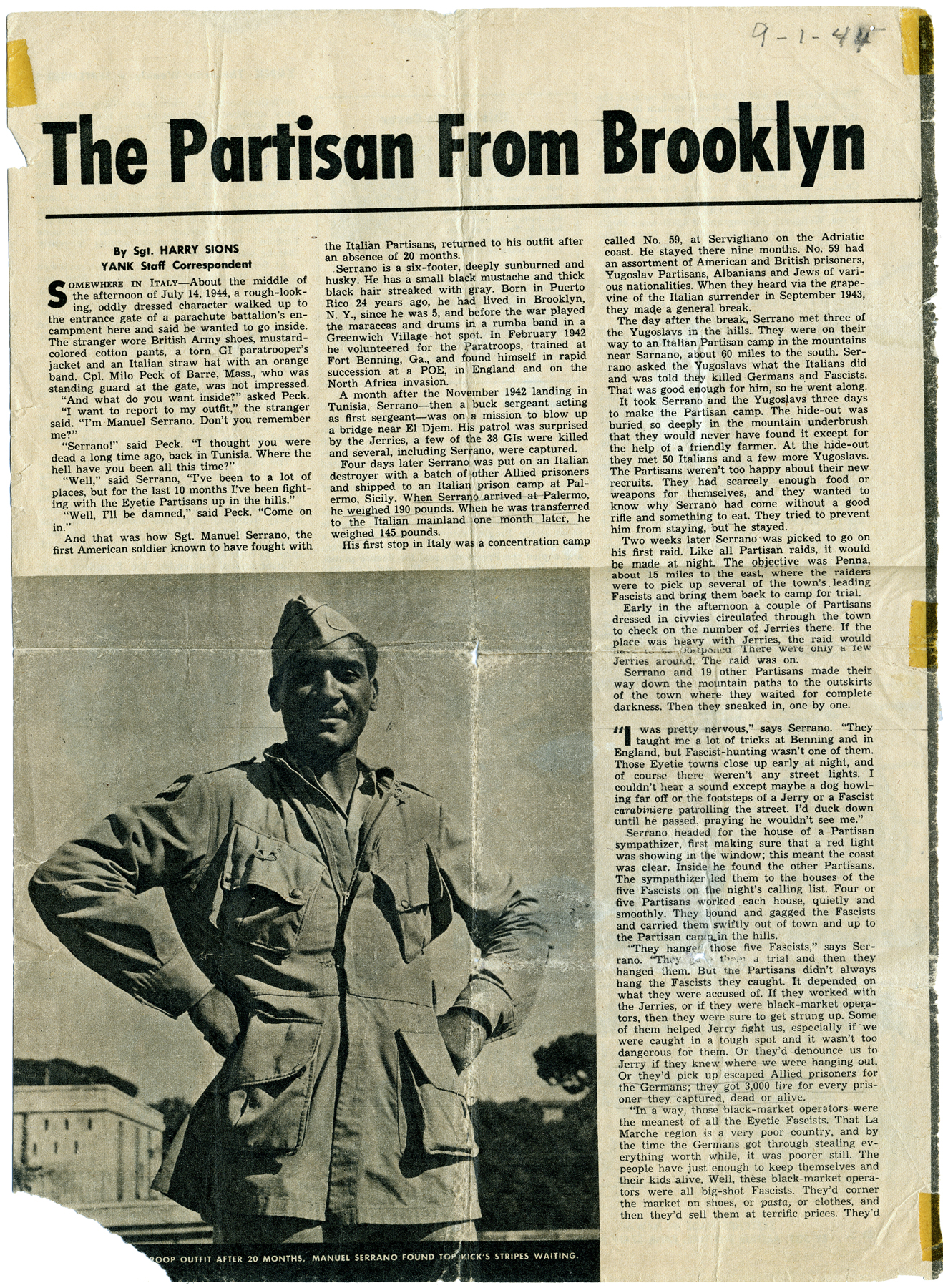
The Partisan from Brooklyn

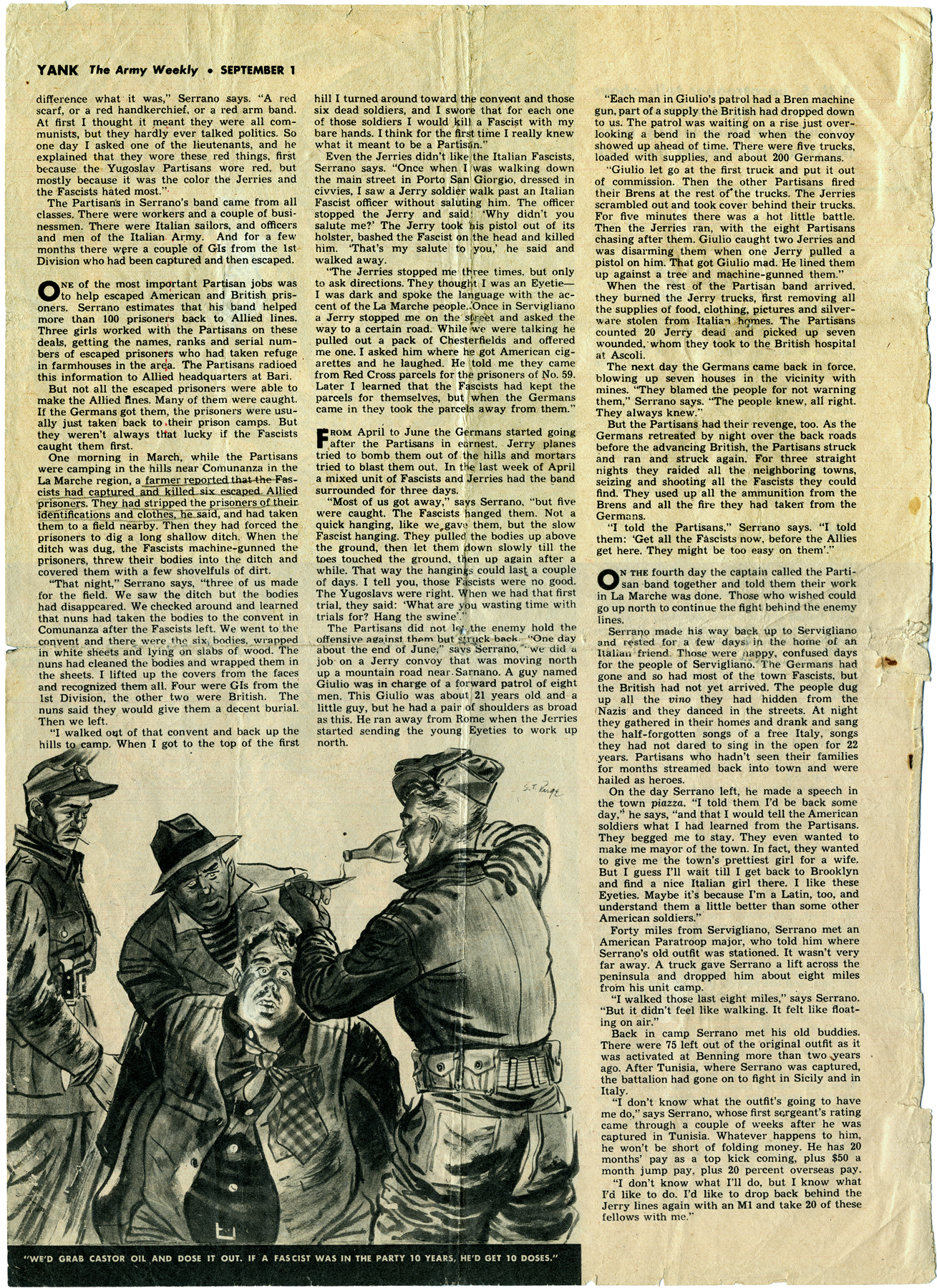
My father, Armie Hill, kept a clipping from Yank magazine for many years. The article, dated September 1, 1944, is “The Partisan from Brooklyn,” by Sgt. Harry Sions. It tells the story of Manuel Serrano’s involvement with the Italian Partisan underground movement after his escape from Camp 59. Links to the three-page article are below.

What I know about Manuel Serrano is limited to information available through his enlistment and POW records at the National Archives:

Manuel S. Serrano was born in 1919. He enlisted in the army on February 5, 1942 at Fort Dix, New Jersey. His term of enlistment was “for the duration of the War or other emergency, plus six months, subject to the discretion of the President or otherwise according to the law.” He is listed as single and his education is given as “grammar school.” According to the record, he was Puerto Rican and a resident of King’s County, New York.

Serrano’s POW record at the Archives indicates he was a first sergeant in the Army Parachute Infantry, and that he served in the North African Theatre. The record confirms he was a prisoner at “CC 59 Ascoli Picenzo Italy 43-13.”

Yank magazine was published weekly by the U.S. Army during WW II. The magazine was written entirely by enlisted rank soldiers and it was available, for five cents per issue, to servicemen overseas.

Robert Dickinson Killed in Action

After his escape from Camp 59, gunner Robert Dickinson of the Royal Artillery spent time with an Italian family in Gassino in northern Italy. He joined the Partisans in October 1944, and fought with them against the German army until March 3, 1945, when he was mortally wounded. This article from the August 25, 1945 Lincolnshire Chronicle provides details of his death.

Robert Dickinson Taken Captive

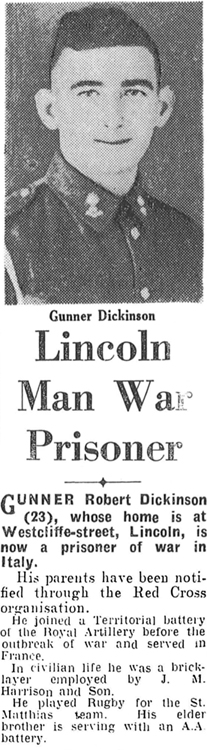
Robert Dickinson joined the Royal Artillery in 1938. Following the outbreak of the war, he saw action in France and the Middle East. He was taken captive in Libya in November 1941 and was sent to Camp 59 in January 1942.

A letter to Robert’s family from the “Officer in charge of Records” confirmed his POW status, and on February 20, 1942, an article in the Lincolnshire Echo provided the local community with news of Robert’s captivity.

Sympathy of a Senator

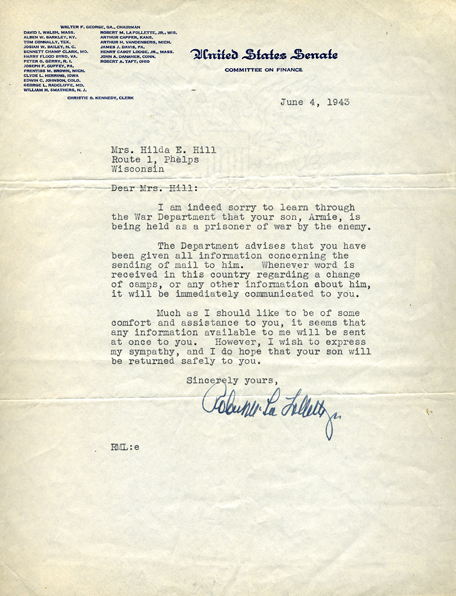
In June 1943, U.S. Senator Robert M. La Follette, Jr. of Wisconsin wrote this letter to Hilda Hill expressing his sympathy and encouragement.

Robert M. La Follete, Jr. was elected to Congress in 1925 to fill the vacancy that resulted from the death of his father, Senator Robert M. (“Fighting Bob”) La Follette, Sr. “Young Bob” La Follette, as he was known, served in the U.S. Senate for over two decades.

In 1946, he ran unsuccessfully for reelection against Joseph McCarthy. He lost the 1946 election by about 5,000 votes.

News of a Captured Son

This first word to reach Hilda Hill of her son Armie’s capture was a record of a broadcast by short wave radio from Berlin on March 24, 1943. Note that Armie’s name is given incorrectly as “Arnold” and “Arnie.”

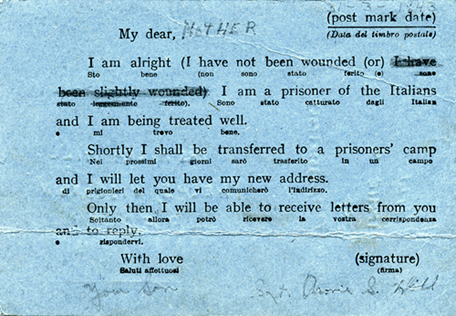
The following postcard, sent from Camp 98 on Sicily, is dated March 31, 1943. The mimeographed form that accompanied the card was from Colonel Howard F. Bresee of the Prisoner of War Information Bureau in Washington, D.C.

This later correspondence from Colonel Bresee does not give a great deal of information, but it must have been a reassurance all the same.

Honoring Raymond Cox

Ethel Stafford speaks of her father, Raymond Cox, World War II prisoner of war, on November 2, 2006 at Fairland West Elementary School in Proctorville, Ohio.

At a Veterans Day 2006 assembly, Raymond E. Cox received a posthumous honor: the Prisoner of War Medal, a military decoration of the United States Armed Forces.

Eloise Cox accepted the medal on behalf of her husband.

The event was covered by The Daily Independent of Ashland. The article “WW II vet receives posthumous honor” is available online. The article tells the story of Raymond Cox’s emprisonment and escape, and how he was sheltered for nine months at an Italian farm by the family of Primo Mecossi.

The Prisoner of War Medal was authorized by Congress and signed into law by President Ronald Reagan in 1986. You can find more information about the medal at the “Prisoner of War Medal” entry on Wikipedia.

Escape—Armie Hill’s Second Account

armiesid-7-1942_r150.jpg

This official military ID was issued to Armie on July 31, 1942, one month before he left the U.S. for the invasion of North Africa. Armie carried the ID during his imprisonment and during his crosscountry escape.

Armie’s Second Account of the Escape

Of the two audio recordings of the POW experience that I made with my father, Armie Hill, this is the second, taped in 1987. Some stories from the first account are repeated here, but there are new details, too. The recall of some of the same events, such as the encounter with the man with the butcher knife in Roccafluvione and the crossing of the Pescara River, are subtly different.

Here is Armie’s 1987 account of the escape. It is a continuation of the entry describing the camp entitled “A First-Hand Account of Camp 59.”

“It was a bright moonlit night. All of a sudden there was shooting at the main gate and somebody got on the loud speaker and said, ‘The Germans are here taking over the camp.’

“He said, ‘Get out of here any way that you can. Try to get out!’ And he added, ‘God be with you.’

“I looked around. The guys were all milling around. They were running to the front gate. I had noticed someone had made a hole in the wall at the back. I think the Italians had helped to dig it out. They used big sledgehammers or something to knock the hole through the back wall. The Germans were there—they had just arrived there.

“I didn’t know who to go with and but I figured I was going to get through there, get outside the gate. I had quite a bit of food with me when I got outside. A bunch of us stood around. I told them, ‘We’re all safe here for now. But the best thing will be to get away from here fast as we can.’

“They said, ‘Let’s all go.’

“I said, ‘We can’t all go together, or surely we’ll all get caught. The best way is to break up into small groups. The best way is to break up into pairs—and each go in a little bit different direction. Some of us will get through.’

Continue reading

Escape—Armie Hill’s First Account

After the signing of the Armistice between the Allied and Italian forces in September 1943, security was relaxed in Camp 59 and the prisoners broke out and fled into the countryside. Armie Hill was among the men who escaped camp through a hole that had been battered in the prison wall.

Armie’s Escape Map

In his dissertation on “Allied Prisoners of War in the Region of the Marche and Prison Camp at Servigliano,” Giuseppe Millozzi explains that British Captain J.H.D. Millar had kept hidden during his captivity a copy of a British SAS (Special Air Service) “escape map” of Italy. The maps had been printed on large handkerchiefs.

At the time of the breakout, copies of this map were hastily drawn. When Armie left the camp he had the following map, drawn on prison aerogram stationery. Most likely this map was copied from Captain Millar’s original map. Note that rivers were drawn in blue pencil and roadways in red.

Armie’s First Account of the Escape

I made two audio recordings of the prison experience with Armie Hill, who was my father. The first recording we made in 1976 and the second in 1987. Armie felt that he had left too many details out of the first recording, and so years later he was willing to retell the story and fill in those additional details.

Here is the 1976 account of the escape:

“The night of the escape was a mass confusion. I don’t really know how the escape came about, but at 10:30 in the evening men were running through the camp, calling out, ‘They have come to take us to Germany.’

“Someone must have taken control of the gate, and someone had battered a hole in one wall that was large enough for a man to escape through. Many of the men had slipped through this hole soon after the confusion began. I had been without food and water at Kasserine when I was separated from the army. I knew enough to prepare for this escape. I found two canteens—a British one and an American one—and I filled them with water. I found a sack and threw all the food I could find into it, and then I then crawled through the hole.

“On the outside the confused men didn’t know which way to go. I told them to just begin walking—to get as far away as possible before day. I felt it would be wise to either pair up or travel alone, but not to move in large groups. Numbers are easily noticed and captured, and if one or two were caught at least we wouldn’t all be recaptured.

“I saw Ben Farley. We decided to travel together. Ben was a Kentuckian. He and I hadn’t gotten along especially well earlier. Ben was among the men I had charge of in the camp. Once I was passing tobacco to the men and I had some black tobacco, which no one wanted. Ben said he’d take it. So the next time I passed out tobacco I gave the black to him and he was angry and said he didn’t like it.

“Ben hadn’t taken along supplies, so I gave him one of my canteens.

Continue reading

Letters Home

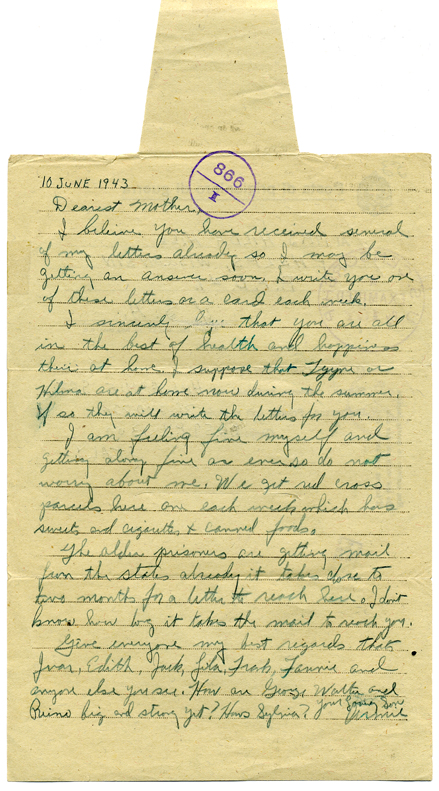
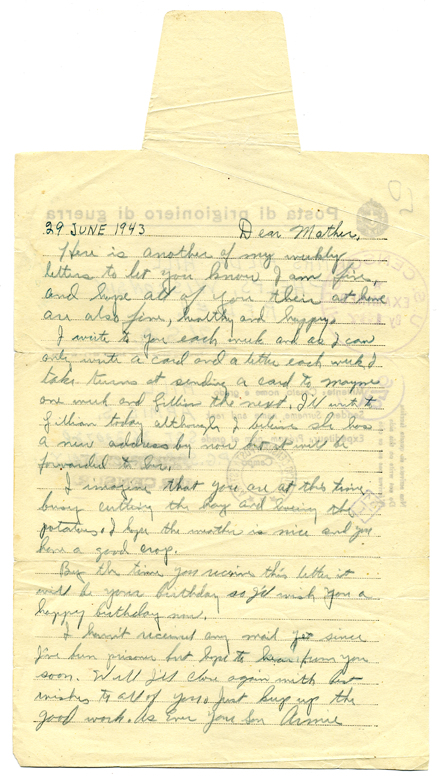
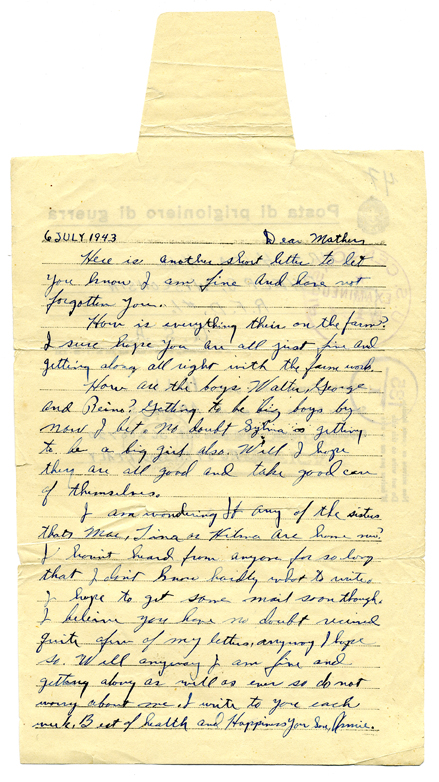
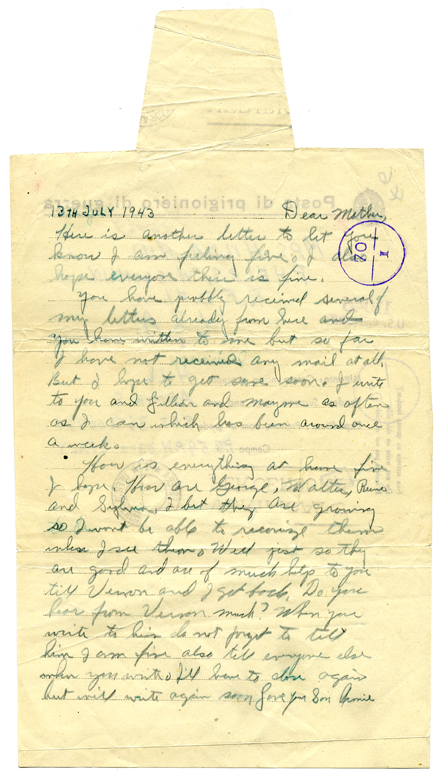
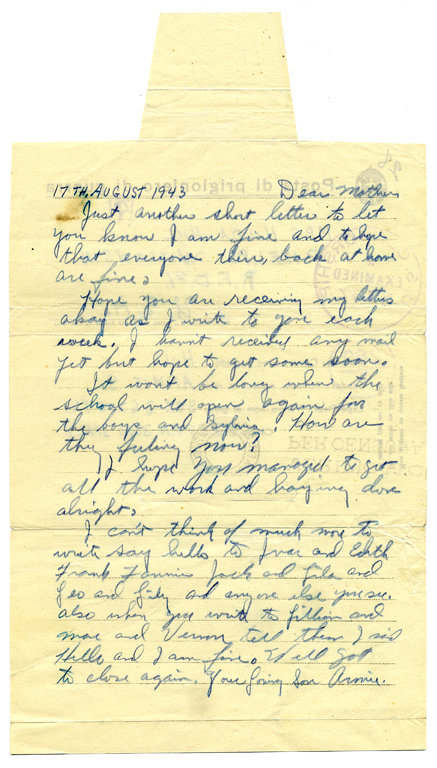
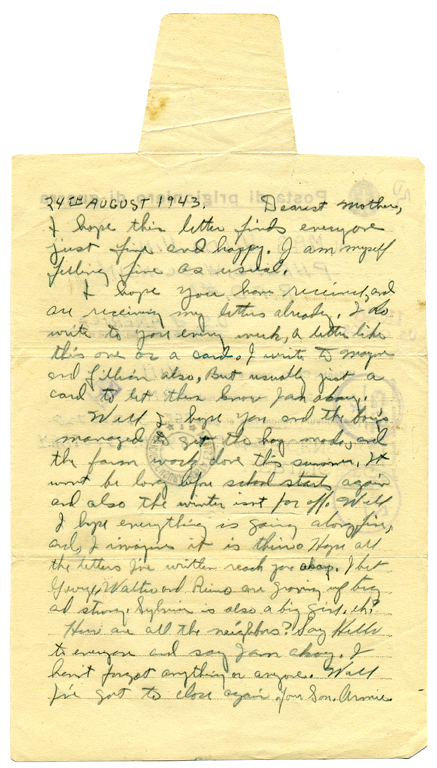
The following letters were sent by Armie Hill to his mother from Camp 59.

ahill_let_jun-10-43.jpg ahill_let_jun-15-43.jpg ahill_let_jun-29-43.jpg ahill_let_jul-6-43.jpg

ahill_let_jul-13-43.jpg ahill_let_aug-17-43.jpg ahill_let_aug-24-43.jpg

Armie was a son of Finnish immigrants Jack and Hilda Hill. Jack and Hilda met in Saint Louis County, Minnesota and lived in various farming and logging communities in Upper Michigan and northern Wisconsin. Armie was born in a Michigan logging camp.

Armie was the third of 10 children born to Jack and Hilda, and the eldest son. When his father died unexpected in 1937, Armie, then only 19 years old, took on a major role in caring for and supporting his family. In August 1938, Armie, who had been working since he graduated from eighth grade, purchased 40 acres of cleared land for a small family farm. With help from his brother Vernon and uncle Ivar, he built a log home for his mother.

Armie received an induction call in December 1940 and reported to duty the following month. He left home expecting to return in a year, but when the Japanese attacked Pearl Harbor in December 1941, Armie suddenly found himself in the Army for the duration of the war. Vernon went into the service, too. The absence of her two eldest boys was a great hardship for Hilda Hill.

Armie’s letters from Camp 59 betray a longing for the Wisconsin farm and a lonesomeness for family and neighbors. He imagines what is going on on the farm, “cutting the hay and hoeing the potatoes.” He inquires about his siblings. Armie’s four oldest sisters (Lillian, Mae, Tina, and Hilma) had left home and were working in Chicago and New York City. Ivar and Edith and Frank and Fannie were Armie’s uncles and their wives.

Armie mentions receiving Red Cross parcels once a week and offers reassurance that he is being well cared for.

Continue reading