Author Archives: Dennis Hill

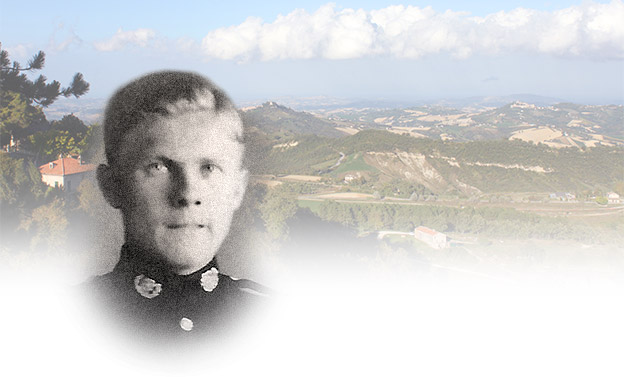
Dr. Domenico Lunghi—A Safe Harbor for Four Former PG 59 POWs

I’ve recently received a great deal of help and guidance from Massimo “Max” Piacentini, a researcher at the Istituto Pavese per la storia della Resistenza e dell’età contemporanea.

In 1991 Bill Armitt (right) took his wife Hilda back to the scene of his escape, where they met with Dr. Domenico Lunghi (at left)—photo by Hilda Armitt, courtesy Victoria Theatre Archive

Istoreco (istorecopavia.it), founded in 1956, is part of the national network of the Ferruccio Parri Institute. An important leader of the Italian Resistance, Parri understood the importance of preserving the documents of the resistence for posterity. In 1943 he charged his friend Giuseppe Bacciagaluppi with creation of the Ufficio Assistenza prigionieri Alleati of the CLN (Comitato di Liberazione Nazionale, or National Liberation Committee). The organization saved more than 1,500 Allied escaped POWs by guiding them to Switzerland. Documents relating to these saved POW are preserved in Fondo: Bacciagaluppi at the Istituto Parri of Milano. Istoreco of Pavia keeps documents such as the arrest records of POWs in Provincia di Pavia and an archive of oral sources, including interviews with local helpers. 

“My current research,” Max explained, “concerns the Pow camps in the Pavese area and the helpers who offered assistance to the fugitive prisoners after 8 September 1943. In the course of my research, I came across several Pows from camp PG 59 who were transferred in the spring of ’43 to the labor camps of Pavese, in particular to PG 146/23 Landriano.

Continue reading
The Artistic Sergeant D. Stredder Bist 

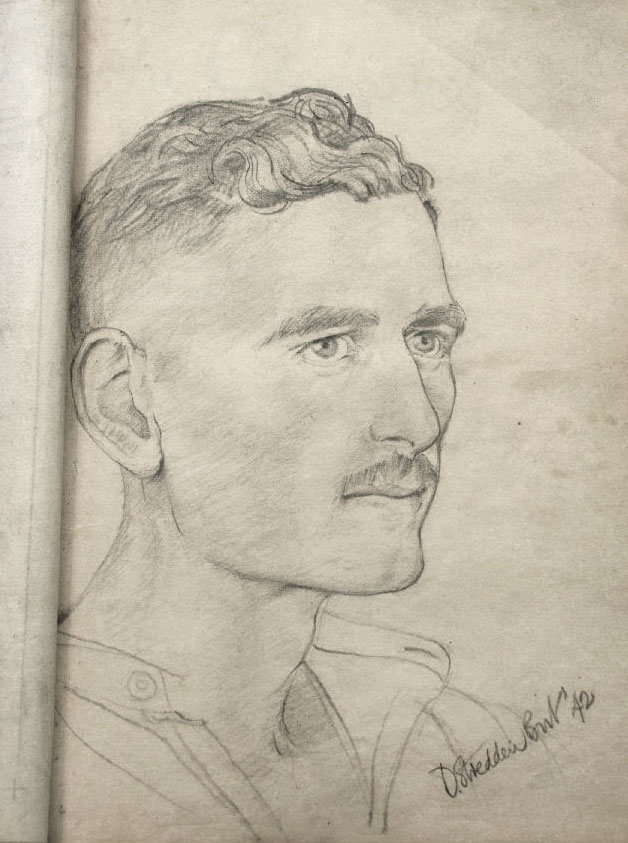
Portrait of Robert Dickinson by D. Stredder Bist, 1942

Robert Dickinson’s prison camp diary, Servigliano Calling, is filled not only with details about Robert’s daily life as a prisoner (a daily activity log, letters and cards sent and received, parcels received, lists of contents of Red Cross parcels, and more). It contains items of artistic merit—34 poems by several PG 59 camp poets, with titles in beautiful calligraphy and hand-lettering—often accompanied by clever illustrations. 

The most impressive illustrations are the front cover, the title page, and a full-page portrait of Robert signed by Sergeant D. Stredder Bist.

Continue reading

Robert Dickinson—A Banner Year for Discovery

Robert Dickinson

Although we are only six months into 2023, Steve Dickinson will no doubt look back on this year as a banner year for discovery of information about his uncle, POW Robert Dickinson.

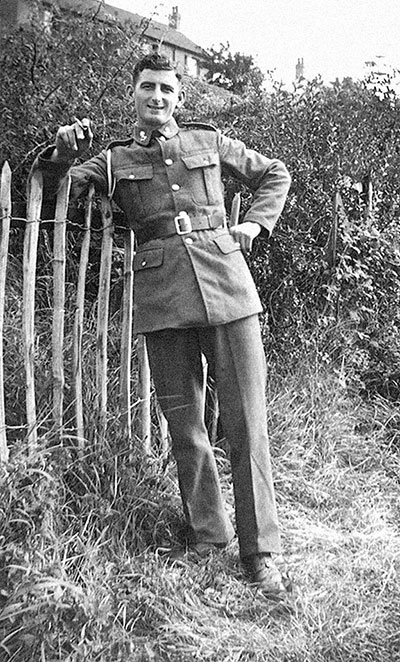
Robert Dickinson (Lincoln, UK) joined Lincoln Territorial Battery 237, Royal Artillery, as a gunner in 1938. He first saw action in France, where in 1940 he was involved in the evacuation from the beaches of Dunkirk. He then served in North Africa, where he was taken prisoner in 1941.

Robert was interned in PG 59 Servigliano (18 January 1942–24 January 1943), PG 53 Macerata, and finally PG 112/IV in the Piedmont region of northern Italy, from which he escaped in 1943.

For 13 months, Robert was sheltered by the Bauducco family of Gassino Torinese. In October 1944 he joined the local partisan resistance and fought against the fascists and German forces. He was killed while fighting with the partisans on 3 March 1945. 

Robert is buried in Milan Commonwealth War Cemetery.

After Robert’s death, the diary he kept, Servigliano Calling, was sent to his family in Lincoln. It reached the family in November 1946, some 18 months after Robert’s death.

The authorities provided the family with general information concerning Robert’s death, but for years Steve has yearned to know more about his uncle’s final months and greater detail about his death. 

At the end of the war, the deaths of many POWs killed while on the run were investigated as war crimes. Steve wondered—had Robert’s death been investigated? 

We didn’t know the answer. Until this year, that is.

Continue reading

Una Bella Passeggiata (A Walk in Wartime Italy)—Installment 5

© Michael Page · Permission to share the memoirs of Arthur Page, Una Bella Passeggiata (A Walk in Wartime Italy), has been granted by the family of Arthur Page.

Read also  “Arthur Page’s Memorable Walk,” “Una Bella Passeggiata (A Walk in Wartime Italy)—Installment 1,”  “Una Bella Passeggiata (A Walk in Wartime Italy)—Installment 2,” “Una Bella Passeggiata (A Walk in Wartime Italy)—Installment 3,” and “Una Bella Passeggiata (A Walk in Wartime Italy)—Installment 4.”

Chapter 20—The Valley of the Cremona

From the beginning of our sojourn in the Cremona Valley, we two ex-POWs gradually merged with the neighbourhood. Neighbours became aware of us, began to pass the time of day with us, talked about us in their homes or with other neighbours. Many people came to know of us, coupling a protesting Piet Van Rensberg with me as the ‘due inglese di casa Tamburrini’ (the two English of the Tamburrini Family). He gave up, as a bad job, explaining the difference between an inglese and a sud africano.

Continue reading

Una Bella Passeggiata (A Walk in Wartime Italy)—Installment 4

Read also  “Arthur Page’s Memorable Walk,” “Una Bella Passeggiata (A Walk in Wartime Italy)—Installment 1,”  “Una Bella Passeggiata (A Walk in Wartime Italy)—Installment 2,” and “Una Bella Passeggiata (A Walk in Wartime Italy)—Installment 3.”

© Michael Page · Permission to share the memoirs of Arthur Page, Una Bella Passeggiata (A Walk in Wartime Italy), has been granted by the family of Arthur Page.

Chapter 15—The Americans Drop In

Since the beginning of January ’44, Allied offensives against the Gustav line had been going on. They halted at Monte Cassino. On January 22nd came the landings at Anzio but 35 miles from Rome. The American commander was overcareful in advancing and a great opportunity was lost. February was spent in making the bridgehead safe for the Allied troops who had landed. On February 15th the monastery at Monte Cassino was bombed and shelled, but the Germans held on. In the fighting for the monastery the 1st German parachute division were heavily engaged and fought tenaciously. When I was recaptured at the Gran Sasso the previous September, the young German who spoke 5th form English had been in that division; I wonder if he survived.

Continue reading

Una Bella Passeggiata (A Walk in Wartime Italy)—Installment 3

© Michael Page · Permission to share the memoirs of Arthur Page, Una Bella Passeggiata (A Walk in Wartime Italy), has been granted by the family of Arthur Page.

Read also “Arthur Page’s Memorable Walk,” “Una Bella Passeggiata (A Walk in Wartime Italy)—Installment 1,” and “Una Bella Passeggiata (A Walk in Wartime Italy)—Installment 2.”

Chapter 9—Vicissitudes

I left the Caprese Michelangelo district and decided to continue in an easterly direction in order to place myself alongside the main crenella or ridge of the Apennines proper and then use its southerly direction to bring me to the front line. I was entering the Val Tiberino, the valley formed by the River Tevere (Tiber), and would have to cross this and the Strada Statale which hugged its course in order to carry out my intention. The Tiber, of course, flowed down to Rome—exciting thought—and the road, too, joined the Via Flaminia at Terni and this ancient route was the old entrance to the capital. With thoughts of helmeted and kilted Roman legions, Horatio, toga clad citizens and the like running through my mind I cross the Tevere a few kilometres south of the townlet of Pieve San Stefano.

Continue reading

Una Bella Passeggiata (A Walk in Wartime Italy)—Installment 2

© Michael Page · Permission to share the memoirs of Arthur Page, Una Bella Passeggiata (A Walk in Wartime Italy), has been granted by the family of Arthur Page.

Read also  “Arthur Page’s Memorable Walk” and “Una Bella Passeggiata (A Walk in Wartime Italy)—Installment 1.”

Chapter 5—Sempre Giu Alle Montagne

From the first moments of being taken prisoner we, who had been expecting imminent death or dreadful wounding, were given a sudden and unexpected reprieve. As one German said to me, “For you the war is over, but I go on and on.” The neutrality of camp life seemed to confirm that, as in 1914–1918, being a POW meant immunity from the perils of war for the duration, that we were meant to return to wife, girlfriend, or mother. As prison became less disagreeable and its monastic nature appeared to distance us from the struggle against Naziism, so we slowly accepted its placid regime and grew less inclined to consider re-entering the fight to rid the world of totalitarian frightfulness. Belsen was not known to us and the Holocaust barely a whisper. Now, at a stroke, we were back in it as though the drive and spirit of our old company commander, despairing of our inertia, had booted us back to duty.

Continue reading

Una Bella Passeggiata (A Walk in Wartime Italy)—Installment 1

© Michael Page · Permission to share the memoirs of Arthur Page, Una Bella Passeggiata (A Walk in Wartime Italy), has been granted by the family of Arthur Page.

Preface

I can claim no experience in authorship of any extensive written work beyond responding to my Tutors’ demands in Teacher Training College days for a pocket thesis on some facet of education and an attempted booklet aimed at introducing Geology to 14-year-olds. The first was accepted as adequate and the second judged to be too ponderous for 14-year-olds to stomach.

Continue reading

Arthur Page’s Memorable Walk

Arthur before deployment, with his first wife and his sisters, mother, and brother Roy

In March 2015, I published a short post on Camp 59 Survivors about British Sergeant Arthur Page. (See “P.G. 59 Prisoner Arthur Page.”)

Arthur in uniform, circa 1939

Five years later, in December 2020, I received a surprise comment on the post: 

“I am proud to be this man’s son, forever in our thoughts.” 

I was thrilled and wrote immediately to the commenter, Arthur’s son Mike, saying I would very much like to know more about his father.

Continue reading

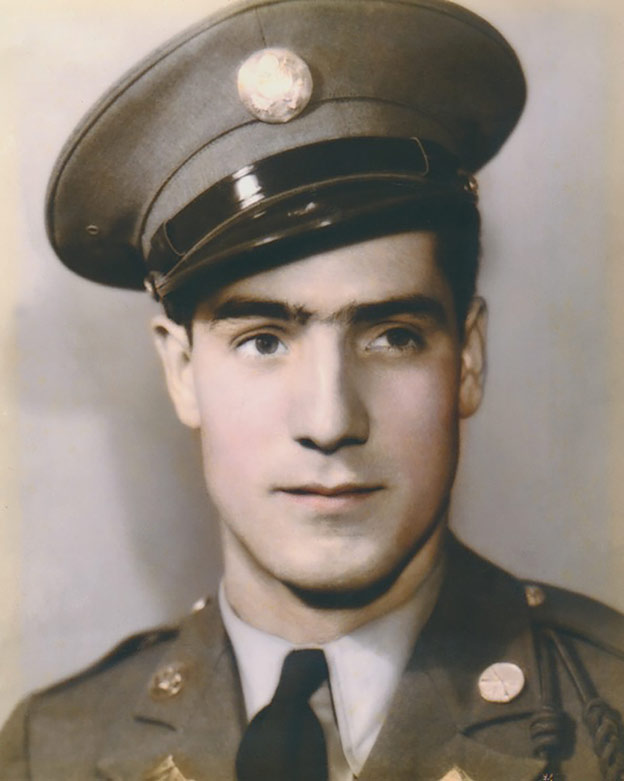
Brayno “Frenchy” Reome

photo of Bryan Reome
Sergeant Brayno Reome

This is the very first post on Camp 59 Survivors concerning Brayno Reome. 

However, I first was in contact with Brayno’s grandson Andrew in 2013—a full decade ago—and I have been in communication with Andrew and his father James since then. I quoted Andrew concerning his grandfather’s reluctance to speak about his war experiences in a 2018 post, “To Talk or Not to Talk.”

I’m eager to post more about Brayno in the future. Here is Andrew from 2013:

“My name is Andrew Stockton. I live in Cicero, New York, and I recently came across your web site while searching for information on my grandfather, who was a prisoner of war during World War 2. 

“Brayno Reome was my mother’s father.

“Although there is not a Brayno Reome listed on your prisoner list, I observed a “Tex” Reome of Malone, New York, as listed in a deck of cards [see “Dual Purpose Deck of Cards”], which I assume to be my grandfather. He [seems to have gone by] a nickname during that time which he probably wished to forget after that experience.

Continue reading