
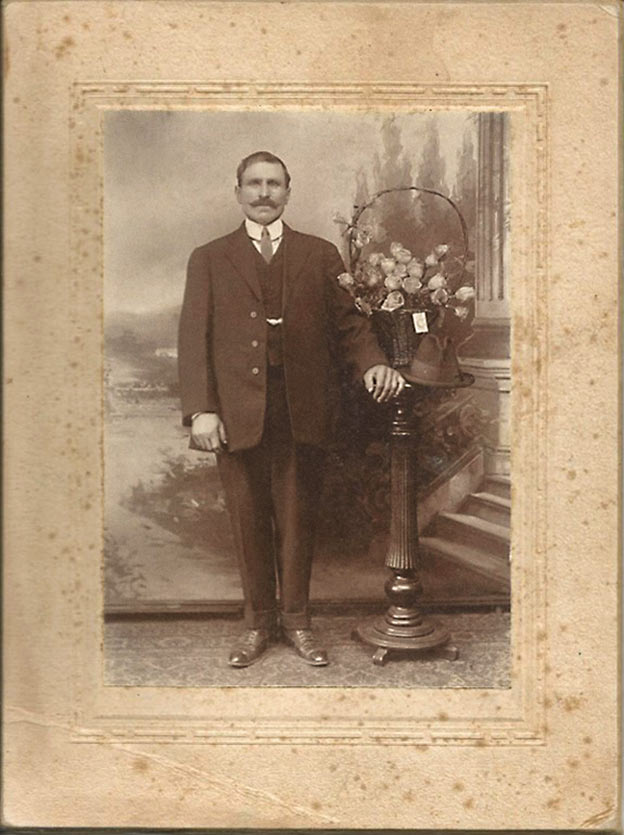

Growing up in American, I’ve been aware all my life of the many contributions Italian immigrants have made to the fabric of American culture. However, until recently I was not familiar with Italian seasonal migrant labor in the early 20th century. These “birds of passage” found temporary employment in the U.S. in order to provide for their families in Italy, eventually returning to their homeland.
Migrant workers often worked alongside permanent Italian immigrants in booming U.S. industries such as mining and steel production.
Italian Migrants
Historian Joan L. Saverino, in her publication “‘Domani Ci Zappa’: Italian Immigration and Ethnicity in Pennsylvania,” writes: “[Most Italian immigrants to America] were contadini, a word variously translated as farmers, farm hands, or peasants. Even an expression used by Italian immigrants to indicate work the next day, ‘Domani ci zappa (Tomorrow, it’s work)’ suggests that these immigrants formerly made a living as farm laborers or lived closely connected to the agricultural cycle. The use of the verb ‘zappare,’ is translated literally ‘to hoe.’”
Regarding Italian migrant workers, she writes:
The ‘pull’ factors of emigration—the wide-spread use of the steamship, the stories of returning emigrants, advertising by transatlantic transportation companies in the villages, and the actual economic opportunities offered by the United States—contributed as much to the high rates of emigration as conditions within Italy itself. The specificity of who left, when, and exactly why and where they immigrated depended on many factors, and was regionally and even village specific. The typical emigrant was a young, unskilled man from a rural area who intended to earn enough money to return to his home village, purchase land, and comfortably live out his days there. Also, those who emigrated were not usually the poorest of the poor, for they could never manage the fare. Many were seasonal migrants (referred to as ‘birds of passage’) who returned to Italy several months out of the year.
Note: “‘Domani Ci Zappa’: Italian Immigration and Ethnicity in Pennsylvania,” is part of a series titled Exploring Diversity in Pennsylvania History created by the Historical Society of Pennsylvania with the Balch Institute for Ethnic Studies. It was published in Pennsylvania Folklife (Autumn 1995). You can read the full document, with descriptions of Italian-American life at: hsp.org/sites/default/files/legacy_files/migrated/pafolklifefinal.pdf
A Falciano “Snowbird”
Which brings me to Antonio Ferretti, a resident of the village of Falciano who during the war sheltered several American escapees from PG 59. (Read “Antonio Ferretti—A Welcome in Falciano.”)
Antonio’s helper claim requesting Allied compensation for assistance rendered to POWs mentions he sheltering eight POWs on the night of 2 October 1943 and provided full meals to the eight for one day—as well as tobacco and liquor. He and other villagers continued to feed and care for the men after they had been moved to the greater safety of remote caves.
October 2nd was apparently the escapees’ first night in Falciano. It’s easy to understand why they approached Antonio; he spoke English—and he had lived in America!
Antonio’s great grandson, Gian Paolo Ferretti, told me Antonio worked in or near Pittsburgh, Pennsylvania, around 1908–14. He made multiple trips across the Atlantic between Pennsylvania and Italy.
I found evidence of Antonio Ferretti’s arrival in New York on the Statue of Liberty–Ellis Island Foundation website. There are many listings for passengers named Antonio Ferretti on the site, coming from different areas of Italy—although some don’t give a specific place of origin. One sure record is for an Antonio Ferretti of Acquasanta (Falciano is a village within the comune of Acquasanta Terme, Italy). This Antonio traveled to the U.S. departing from the Port of Naples and arriving at the Ellis Island Immigration Station in New York City on 29 June 1913. The Ellis Island record indicates he was 46 years old and born in 1867. It also notes he was married at the time.
“My great grandfather was married and had two daughters when he went to America,” Paolo confirmed. “Antonio had two wives. The first was Domenica Massei and the second Antonia Bucci, the mother of my grandmother Giovanna.
“He first went to the United States more or less in 1905, and he went there three or four times. He payed for his first trip by working on the ship.
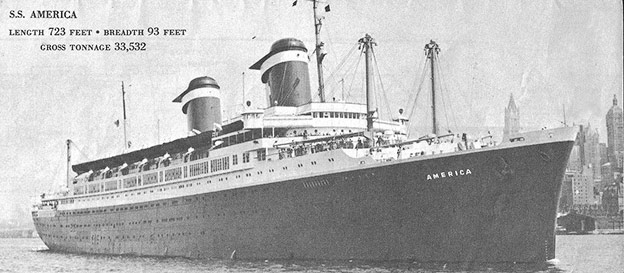
The ship Antonio traveled on in 1913 was the S.S. America. Here is a description of the steamship from the Deep Roots genealogical site:
The S.S. America … was built in 1908 by Cantieri Navale Riuniti Muggiano company and was launched for La Veloce on November 1st, 1908. It was used primarily on the New York service. In 1912, the vessel was purchased by Navigazione Generale Italiana and began Genoa to Naples to New York to Philadelphia routes. The S.S. America mostly stayed on the transatlantic service until 1924 when it was transferred to the South American service. She was scrapped in 1928.
Regarding Antonio’s birthdate—given as 1867 in the Ellis Island record—Paolo notes, “There are many mistakes in the old documents. My family thinks he was born in 1866. He enlisted to army with the 1866 class. However, on his grave his birthdate is 1886.
With money Antonio earned in America he was able to expand his fortunes in Italy by purchasing land near Falciano, including an area Paolo calls ”the chestnut wood.”
He explains, “The house of my family was in the heart of Falciano. It was attached to the other houses. On his coming back from America, Antonio bought a lot of property near Falciano.”
The Ferretti property is more or less three kilometers from Falciano. It was only accessible by a footpath in 1943, but today there is a road that takes you to about one kilometer from the chestnut wood.
“The local caves were converted to stables and farmers sometimes slept inside them,” Paolo says. “People owned mostly sheep and pigs, and sometimes cows. They all owned a donkey to carry wood, wine, and other products such as potatoes. Only one cave is on the Ferretti property—the one in the chestnut wood. The other cave [where POWs slept] is nearer to Falciano.”
Post-war Falcianesi Immigration to America
Giuseppe Gagliardi, president of the Falciano historic preservation group Le Ville sul Tuffo, has researched the movement of Falcianesi to America after the war, most of whom seemed to have settled in the Pittsburgh area.
He learned that sometime in the 1950s Rosaria Cappelli sent $47 from America for the feast of St. Anthony. Here is a list of former Falciano villagers from whom she collected the money:
Gaetano Brandimarti
Chiara Brandimarti
Cecilia Brandimarti
Giovannina Mercuri
Luigi Gagliardi
Antonia Ventura
Enrica Palombini
Nazzareno Brandimarti*
Annunziata Massei
Josephine Cappelli (daughter of Rosaria Cappelli)
*Brigida Gaspari, wife of Nazzareno Brandimarti, also lived in Pittsburgh.
Giuseppe suggests it would be nice to re-establish contact with children and grandchildren of Falcianesi in America. If descendants of the Falciano immigrants happen to see this post, I hope they will leave a comment so I can help to make this connection.
 Camp 59 Survivors