
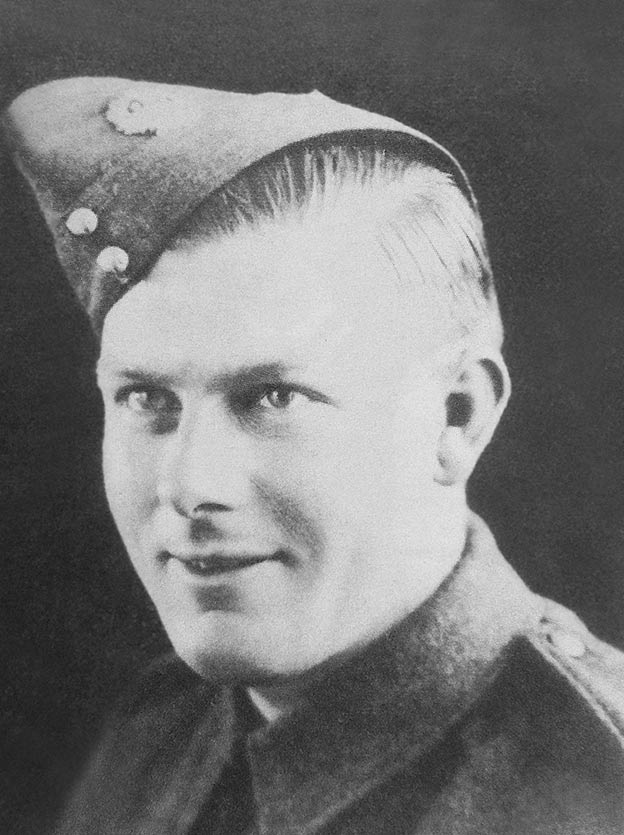
Not too long ago Steve Dickinson connected with the family of Ron Dix.
It was a happy reunion of sorts. Steve’s uncle Robert Dickinson and Ron Dix were prisoners in Italy together, and after their escape from PG 112/4 Turin they were sheltered by the Bauducco family for 13 months. After the 13 months, they left the Bauducco home and fought with the Aldo Brosio partisan brigade. Both Robert and Ron were killed fighting with the partisans.
The Dix family has shared photos and information about Ron with Steve.
A newspaper item in the Saffron Waldon Weekly News (18 September 1942) reads:
MISSING NEWPORT BOY Now a Prisoner in Italy
Corpl. R. L. Dix of the Essex Regiment, M.E.F., of Cambridge Road, Newport, who was recently officially reported missing since July 1st, is now officially reported a prisoner in Italian hands. His mother has received a postcard and a letter from him stating that he is well and uninjured and that he has already received Red Cross parcels. He was drafted to the Middle East at Christmas, 1940. Corporal Dix, who was educated at the Boys’ British School and later at the East Anglian Institute, was before joining-up in April, 1940, acting head gardener at the county gardens, Chelmsford. He has played football for Walden Town, is a keen sportsman, and declared his intention of continuing his studies in horticulture through the medium of the Red Cross.
A second newspaper item from the Saffron Waldon Weekly News (21 May 1943) describes the internment of a Corporal H. B. “Jim” Thomas; it includes a mention of Ron Dix.
Although the article does not state which camp the POWs were in at the time, it was likely PG 53, as Red Cross records indicate Ron Dix and H. B. Thomas—and also Robert Dickinson—were interned in PG 53 in 1943.
Here is the text of the article:
News of Prisoners. — In a recent letter received by Mr. and Mrs. B. S. Thomas, of Brooklands, Wenden, from their son Corpl. H. B. (Jim) Thomas, who has been a prisoner of war in Italy for about a year, he tells how much the Red Cross parcels are appreciated by the boys, and some of the things they make from tins, etc., contained in those parcels. “The latest,” he says, “is a new fire for boiling water for tea”; he has fixed a fan to blow up the fire, as on a blacksmith’s force [forge]. “They are the latest craze here,” he adds, “and I intend to get it home when I come, to let you see the sort of things we make.” Corpl. “Jim’s” mugs made from tins are very popular, and are always in great demand by the boys. Sometimes his stock of tins runs low, the parcels do not always arrive regularly, “but,” he says, “you should see the boys cheer up and smile when they do arrive.” Last Christmas they made cakes with bread, raisins, a little butter, and “a few other things mixed in,” and iced them with powdered milk. While in the Middle East, Corpl. Thomas invented a contraption from petrol tins which heated water for the boys’ baths and at the same time saved fuel. Corpl. Thomas says that a companion in his camp is Corpl. Ronald Dix, son of Mr. and Mrs. L. Dix of Newport.
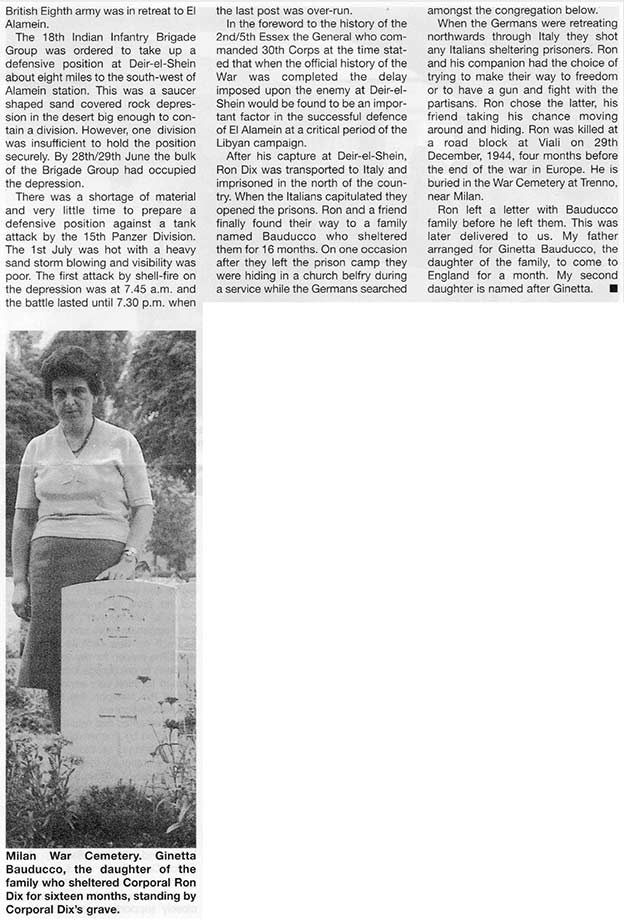
In 1999, Ron’s sister Dorothy Hyde wrote a brief account of Ron’s life. Her article was published in a local newspaper, the Newport News:
Corporal Ron Dix and the 2nd/5th Essex Battation
By Dorothy Hyde
Newport News [Essex, England]
Summer 1999
Ron Dix was born on 31st August 1917 at Broadstone, Dorset, where the Dix family lived during World War One. Leonard Dix was employed at the Royal Naval Munitions factory at Holton Heath as an engineer.
After the war the family returned to Saffron Walden. Leonard Dix went into business with his cousin running the garage of H and L Dix in Newport.
Ron was educated at the village school until he was eleven. He then went to the Boys British School at Saffron Waldon where he came under the influence of Bob Strong, the master who taught gardening. The school looked after the gardens at Bridge End. A close relationship developed between Bob Strong and Ron.
Ron was a Boy Scout. When he was given a drum, and his friend Stan a bugle, to play in the Scout Band, they decided to practise together in our meadow beyond the orchard. My father refused to let them do so, claiming that it would scare our cow, so they used to go up Bury Water Lane to the Meads and practise there.
After leaving school at 15 (a year later than the law required in those days) Ron worked at Shortgrove to gain experience. He also played football in the Newport Football team.
Ron went to the East Anglian Institute at Chelmsford on a two year Horticulture Course. During the course the students prepared the ground for the fruit orchards at the new college site at Writtle (now Writtle University College). By the time Ron completed the course war had been declared.
While awaiting call-up Ron was in charge of the County Gardens at Rainsford End, Chelmsford, on a temporary basis.
After initial training at Wooler in Northumberland Ron went overseas, to Sierra Leone, South Africa, and Iraq, with the 2nd/5th Essex Battalion.
The 18th Indian Infantry Brigade Group, which included the 2nd/5th Essex Battalion, was ordered westwards from Iraq in June, 1942, as reinforcements when there was a general withdrawal of the Eighth Army in Libya in front of the advancing Axis forces under General Rommel.
The three infantry battalions of the Division were moved by rail on 25th June across Egypt. The 2nd/5th Essex train reached the small station of Galal in the evening of 26th June close to the front line. That night they were bombed and 2nd/5th Essex lost two killed and four injured.
Early on 27th June all trains were returned eastwards to El Alamein. Tobruk had fallen on 21st June and the Axis army had crossed the Eqyptian frontier on 23rd June. The British Eighth army was in retreat to El Alamein.
The 18th Indian Infantry Brigade was ordered to take up a defensive position at Deir-el-Shein about eight miles to the south-west of Alamein station. This was a saucer shaped sand covered rock depression in the desert big enough to contain a division. However, one division was insufficient to hold the position securely. By 28th/29th June the bulk of the Brigade Group had occupied the depression.
There was a shortage of material and very little time to prepare a defensive position against a tank attack by the 5th Panzer Division. The 1st July was hot with a heavy sand storm blowing and visibility was poor. The first attack by shell-fire on the depression was at 7.45 a.m. and the battle lasted until 7.30 p.m. when the last post was over-run.
In the forward to the history of the 2nd 5th Essex the General who commanded 30th Corps at the time stated that when the official history of the War was completed the delay imposed upon the enemy at Deir-el-Shein would be found to be an important factor in the successful defence of El Alamein at the critical period of the Libyan campaign.
After his capture at Deir-el-Shein, Ron Dix was transported to Italy and imprisoned in the north of the country. When the Italians capitulated they opened the prisons. Ron and a friend finally found their way to a family named Bauducco who sheltered them for 16 months on one occasion after they left the prison camp they were hiding in a church belfry during a service while the Germans searched amongst the congregation below.
When the Germans were retreating northwards through Italy they shot any Italians sheltering prisoners. Ron and his companion had the choice of trying to make their way to freedom or to have a gun and fight with the partisans. Ron chose the latter, his friend taking his chance moving around and hiding. Ron was killed at a road block at Viali on 29th December, 1944, four months before the end of the war in Europe. He is buried at the War Cemetery at Trenno, near Milan.
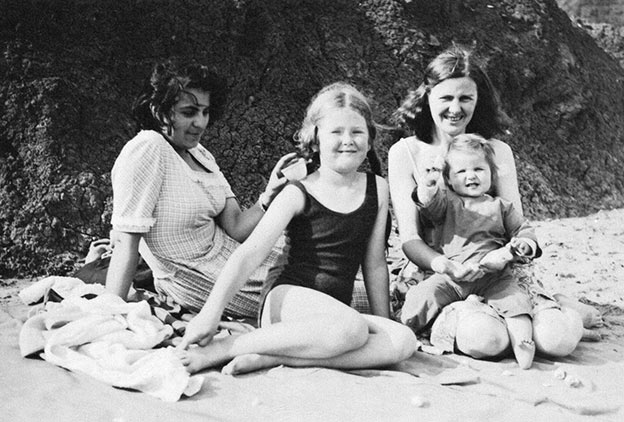
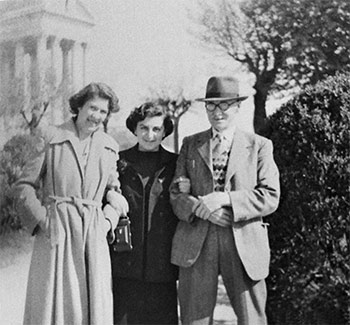
Ron left a letter with [the] Bauducco family before he left them. This was later delivered to us. My father arranged for Ginetta Bauducco, the daughter of the family, to come to England for a month. My second daughter is named after Ginetta.

Steve questions whether Ron and Robert were hiding in the church, as Dorothy writes. He notes that on 16 September 1943 Robert wrote in his diary (he and Ron were staying with the Bauducco’s at that time): “5 POWs caught in the church!” That event may be what Dorothy was referring to.
Much new information has recently come to light, including the war crimes investigation into Robert’s death (see “Robert Dickinson—A Banner Year for Discovery”) and Maria/Ginetta Bauducco’s Allied Screening Commission helper claim (“The Bauducco Family “Helper” Compensation Approved”).
In her article, Dorothy suggested that Ron and Steve went separate ways after their departure from the Bauduccos.
Steve says, “I do not believe Robert and Ron separated after leaving the Bauducco family. The new information suggests they both joined the Partisans in October ’44 after being handed over by the Bauduccos to a Partisan called Carlo of Castelnuovo Don Bosco. Gina states this on her Allied Screening Commission application.”
Concerning Ron’s death, Steve found a passage in a book online that offers an account of an armed conflict involving the Aldo Brosio brigade on 28 December 1944—the date when Ron Dix was killed.
The book is Nuovi Quaderni di Giustizia e Libertá 5–6 / Gennaio–Agosto 1945 / Casa Editrice “La Fiaccola” Milano [New Notebooks of Justice and Freedom 5–6 / January–August 1945 / Publishing House “La Fiaccola” Milan].
Janet Kinrade Dethick kindly translated the passage from Italian for Steve. It describes the Aldo Brosio attack to take hostages on the Quarto-Alessandria road:
In December, after the roundup, trucks of armed fascists often ventured into the region; with the resumption of activity, and with successful actions along the roads, this activity disappeared in a few days. Nor did they dare, after the end of the year, to venture into the peripheral area unless with a large deployment of forces (over a thousand men), so that even from the military point of view the desired aim was achieved.
At the end of the year, on 28 December, a column of about forty volunteers from the “A. Brosio” Brigade carried out an action on the Asti-Alessandra highway near Quarto to take hostages. When significant German and fascist enemy forces (about 250 men) arrived to surround them, they went into battle. Courageously, they opened a passage through the enemy, capturing a machine gun by assault, and then retreated in an orderly fashion—always under fire. The result of two and a half hours of fighting was over twenty enemies killed, whereas we lost five brave partisans and four wounded. This clash, in addition to testing the resurgent fighting forces, demonstrates the high spirit of heroism of our men. There was Felice’s epic gesture: after being hit in the right hand by an explosive bullet, he threw his crushed finger at the enemy and resumed shooting with his pistol; or that of the three who succeed each other at the machine gun in a short space of time to replace a previous comrade who had fallen while shooting; or that of the Commander who saved with an accurate burst of fire the comrade who was already in front of the firing squad.
On the last day of the year, when burying the fallen, alongside the sadness of those who knew them, was the certainty of having rediscovered the call to duty and their own indomitable courage.
Ron is listed on the memorial to the partisans in Viale; however, on the monument his name was incorrectly recorded as John, with no surname.
Steve pointed out: “Ron is listed on the monument as having been killed at Quarto along with four others—Salvatore Mauro, Marco Magliano, and Mario Musso. Dario Maccagnani was injured in the conflict and died soon after in the Viale hospital.
“Ron is recorded as being killed the 29th, but I guess that was when his death was recorded, or it’s an error.”

(Read also “Robert Dickinson—The Ongoing Journey” for more information about the Bauducco family.)
 Camp 59 Survivors