
I’ve recently received a great deal of help and guidance from Massimo “Max” Piacentini, a researcher at the Istituto Pavese per la storia della Resistenza e dell’età contemporanea.

Istoreco (istorecopavia.it), founded in 1956, is part of the national network of the Ferruccio Parri Institute. An important leader of the Italian Resistance, Parri understood the importance of preserving the documents of the resistence for posterity. In 1943 he charged his friend Giuseppe Bacciagaluppi with creation of the Ufficio Assistenza prigionieri Alleati of the CLN (Comitato di Liberazione Nazionale, or National Liberation Committee). The organization saved more than 1,500 Allied escaped POWs by guiding them to Switzerland. Documents relating to these saved POW are preserved in Fondo: Bacciagaluppi at the Istituto Parri of Milano. Istoreco of Pavia keeps documents such as the arrest records of POWs in Provincia di Pavia and an archive of oral sources, including interviews with local helpers.
“My current research,” Max explained, “concerns the Pow camps in the Pavese area and the helpers who offered assistance to the fugitive prisoners after 8 September 1943. In the course of my research, I came across several Pows from camp PG 59 who were transferred in the spring of ’43 to the labor camps of Pavese, in particular to PG 146/23 Landriano.
“My family in 1943–45 hid and assisted two of them. My wife’s mother, Rita, with her aunt Carolina hid and took care of the English infantryman Raymond W. Barned, who had come from the terrible camp PG 66. He lived hidden in their house like a son from 8 September 1943 to 26 April 1945! Aunt Carolina was arrested, but they could never find her prisoner. Instead, the family of my maternal grandparents hosted and hid Scottish corporal John Reid for more than a month. He returned to our country in 1994 to thank the family and review the places of his imprisonment.
“He became our great friend and even now—after he has been dead for some years—we are in constant contact with his daughter Morag.
“While the western part of the province of Pavia (called Lomellina) has already been extensively studied by my friend Professor Giuseppe Zucca, who is the author of two books on the subject, the eastern part where I live (called Pavese) has never been studied. So two years ago I began this research, which is now in full swing. I have identified so far about forty Pows in the Pavese area.
“On your site I found the story of the four Pows hidden in Ceranova by Dr. Domenico Lunghi.”
In a post concerning these four former PG 59 internees, who were among the subjects of the 1971 Victoria Theatre musical documentary Hands Up—For You the War Is Ended!, Dr. Lunghi is described as having assisted Bill Armitt, John “Jock” Attrill, Frank Bayley, and John “Jock” Hamilton.
“I have known personally dott. Lunghi,” Max said. “He was the doctor of my family, but he never talked to anyone about his story as a helper! He is still remembered as a highly esteemed and very humane doctor.
“For me it was a great and beautiful discovery, and I’m now waiting for the Friends of the Victoria Theater Archive to send me the transcripts of the interviews, as per the precious indications on your site.
“As my research is still ongoing, I can only anticipate these facts:
“In 1943, dott. Domenico Lunghi, as a young doctor who visiting his patients, kept in touch the families of the helpers and with the agents of the CLN (Comitato di Liberazione Nazionale—the partisans of Pavia).
“The Lunghi family had a dairy, so there was no shortage of milk and cheese for the four Pows.
“I think on the Lunghi farm there were also cows and pigs. The first supplied the raw material for the casone (the dairy, in local dialect); the second were raised by the processing of waste, and they supplied the most important food in the peasant diet in those years: the salami.
“The presence of farms and livestock in the town was no problem. Ceranova was a very, very small village (around 500 inhabitants) made up of various farmhouses. Almost all the inhabitants were peasants and, I think, this is why the story of the Pows of Ceranova is different from the other Pows stories I collected. In fact, the Ceranova Pows faced escape to Switzerland alone—without guides or documents. For these four men it was a very dangerous journey that lasted three weeks.”
In contrast, Max said, “My friend John Reid over the course of a day reached Switzerland from Milano! The problem with Ceranova was its isolation from Milano and the absence of commuter workers who could have accompanied the Pows. But, this is just my hypothesis—only the interviews [of the Victoria Theater Archive] will tell us how things really went.
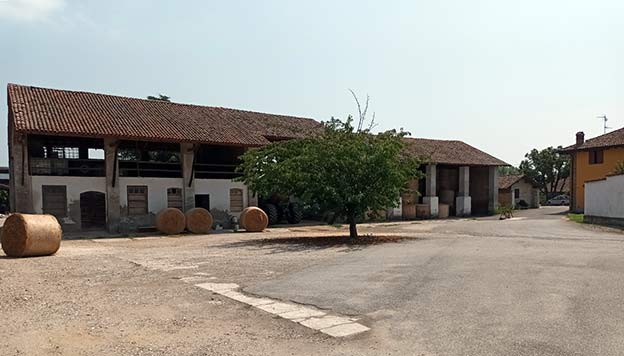
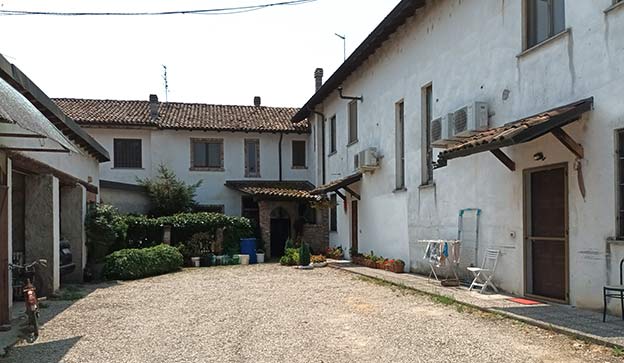
“I identified the casa padronale [manor house] where the Lunghi family lived. I think the Pows were hidden in the loft, but they’ve spoken about a small room.
“In the period when the Pows were hidden in dott. Lunghi’s farm, all the members of the Pavia CLN were arrested and deported, so a very difficult period for the Pavese Resistence had begun. This fact made it even more difficult for dott. Lunghi to establish contact with the organization. I think that’s why two of the four Pows stayed for a long time.
One parting though from Max: “Before 8 September 1943 and the great escape, a work team of prisoners from the Vairano camp went to work in Ceranova everyday.”
Bill Armitt, John “Jock” Attrill, Frank Bayley, and John “Jock” Hamilton had indicated in their repatriation reports that they did farm work during their internment at PG 146/22 Vairano. Perhaps they had worked at the Lunghi farm, and so knew the Lunghi family before their escape from Vairano. Like many others Pows in the work camps of northern Italy, they may have sought refuge with their master.



The Alexander Certificate awarded to Dr. Lunghi reads:
This certificate is awarded to Lunghi dr. Domenico as a token of gratitude for and appreciation of the help given to the Sailors, Soldiers, and Airmen of the British Commonwealth of Nations, which enabled them to escape from, or evade capture by the enemy.
H.R. Alexander
Field-Marshall,
Supreme Allied Commander,
Mediterranean Theatre
1939–1945
Regarding other transferees from PG 59, Max said, “I came across many other Pows from the Servigliano camp who were transferred to Pavese work detachments. Everyone escaped from the Vairano camp PG146/22, and almost everyone then escaped to Switzerland: A. J. Balchin, M. Brady, G. H. Claricoats., D. W. Clark, H. Dance, M. W. Doney, J. B. Jowet, K. R. S. Sprake, R. B. James, and Frank Pemberton.
These three Pows I didn’t find in your list: Richard Killian, Leslie Moore, and Joseph Mountford.
Max shared this story of a related incident.
“On 17 July 1944, several Pows were still hidden in Sant’Alessio, near Lardirago and Ceranova. There was a town festival and, incredibly, the Pows joined the village youth swimming in a little river.
“Someone complained about them and a terrible roundup began. The Nazifascisti seriously injured a Pow, who was rescued by the local partisans. They called dott. Lunghi to heal the wounded, but the Pow was too seriously injured, so dott. Lunghi organized hospitalization in Pavia, where he worked. The Pow was carried under a pile of hay on a farm wagon and saved by the doctor. In the same roundup, the Nazifascisti captured another Pow from Servigliano camp and they vented their anger against some young local ‘sbandati’ [stragglers].
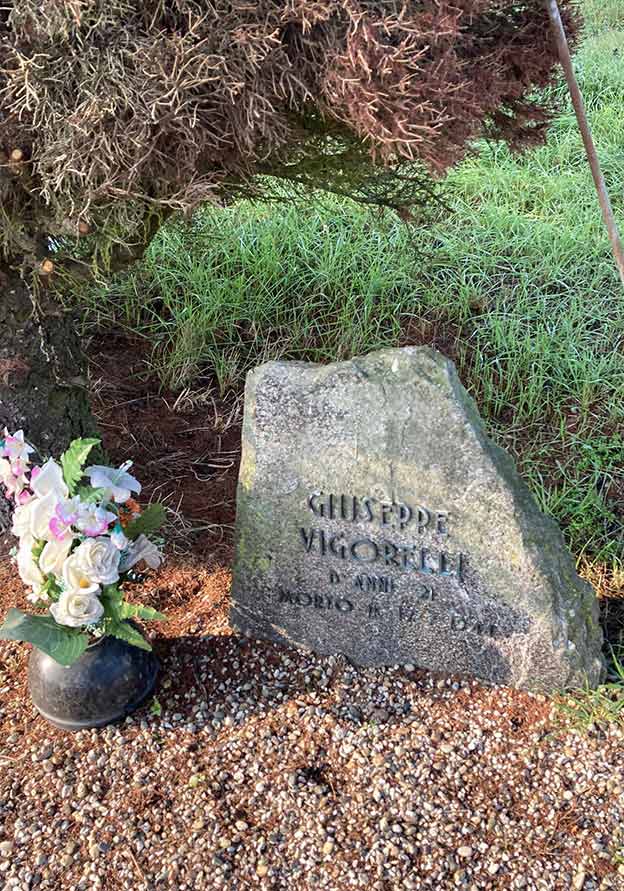
“In cold blood they killed one of them, Giuseppe Vigorelli, who was twenty years old. A small local monument in Sant’Alessio is a memorial to this very sad fact.”
 Camp 59 Survivors