
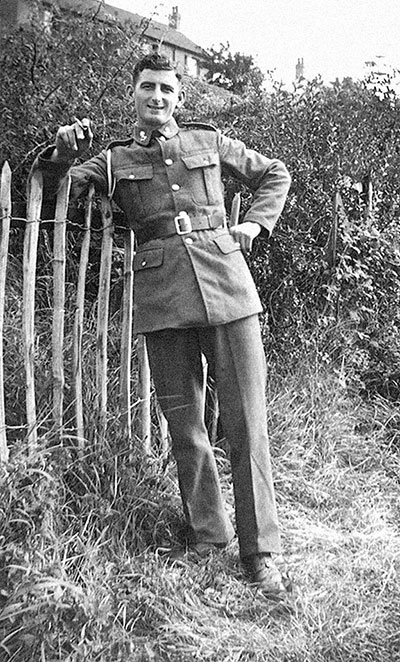
Although we are only six months into 2023, Steve Dickinson will no doubt look back on this year as a banner year for discovery of information about his uncle, POW Robert Dickinson.
Robert Dickinson (Lincoln, UK) joined Lincoln Territorial Battery 237, Royal Artillery, as a gunner in 1938. He first saw action in France, where in 1940 he was involved in the evacuation from the beaches of Dunkirk. He then served in North Africa, where he was taken prisoner in 1941.
Robert was interned in PG 59 Servigliano (18 January 1942–24 January 1943), PG 53 Macerata, and finally PG 112/IV in the Piedmont region of northern Italy, from which he escaped in 1943.
For 13 months, Robert was sheltered by the Bauducco family of Gassino Torinese. In October 1944 he joined the local partisan resistance and fought against the fascists and German forces. He was killed while fighting with the partisans on 3 March 1945.
Robert is buried in Milan Commonwealth War Cemetery.
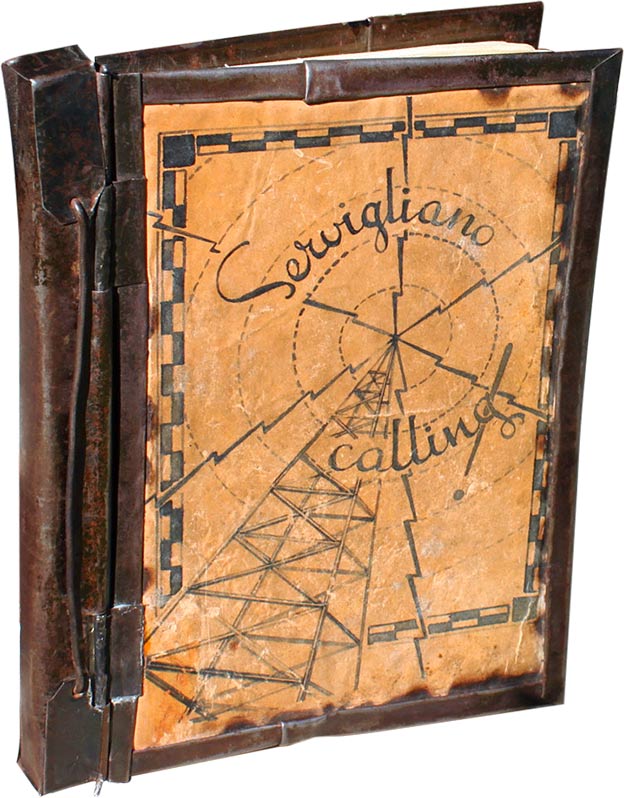
After Robert’s death, the diary he kept, Servigliano Calling, was sent to his family in Lincoln. It reached the family in November 1946, some 18 months after Robert’s death.
The authorities provided the family with general information concerning Robert’s death, but for years Steve has yearned to know more about his uncle’s final months and greater detail about his death.
At the end of the war, the deaths of many POWs killed while on the run were investigated as war crimes. Steve wondered—had Robert’s death been investigated?
We didn’t know the answer. Until this year, that is.
At the four-day event in Servigliano to commemorate the Italian Armistice this September, Steve will be gifting Servigliano Calling to the archives of Casa della Memoria, the Italian association dedicated to preserving and sharing the history of Camp 59.
“I knew at some point I would have to make a decision on the next custodian of Robert’s diary,” Steve said, “And having no children, I had never been sure where it should go.
“I had in my mind mid last year to pass the diary the care of Casa della Memoria in Servigliano, and this decision was finalised when I visited Robert’s grave again in late September 2022. I think Robert would approve, after all he called the diary Servigliano Calling, and it came to my mind that Servigliano had been calling!
“I had pretty much given up hope on finding more information on Robert’s life, nearly 80 years after his death, but the ‘Diary Gods’ must have approved my decision, as events have unfolded this year.”
In January, I ordered Janet Kinrade Dethick’s excellent new book Some Corner of a Foreign Field: Deaths Behind the Lines in Italy 1942–5. As soon as it arrived, I thumbed through the index for any reference to Robert.
I was rewarded with this short—but thrilling—passage:
“Escapers who were killed in action and whose deaths were considered not to be war crimes include … Corporal Ronald L. Dix and Gunner Robert Dickinson, both of whom were concentrated into Milan from Viale communal cemetery on 13 December 1945. However, in this instance the Corps of Military police did open an investigation (WO32/22163 National Archives) into Robert Dickinson’s death.”
I could hardly wait to share this news with Steve!
“I had always suspected that there had been a war crimes investigation into Robert’s death,” Steve said, “as a document was found at Kew Archives that stated an investigation had been closed, but I could find no further information at the time (around 2012).”
“‘Oh my—why could I never have found that previously?’ I thought. There was a reason! Due to the content, it was on a 70-year withhold period and was only opened to public in 2017!
“I quickly contacted Kew, where a document check was completed and the file was found to be fully intact. A copy was ordered, without the distressing images stated on the front cover. Some weeks later the report was sent, and now I have a good account of the events of 3 March 1945. Robert was injured, shoulder and leg, and not able to walk. Heavily outnumbered, the partisan group (Aldo Brossio brigade) had to withdraw early afternoon. The commander of the group, ‘Bartolomeo Cassetta – Battle name Malino,’ carried Robert for 3 km, at which point Robert knew he was limiting their ability to withdraw and asked to be hidden in a ditch. They hid him, with a weapon some distance away from him, and said they would come back in the night to collect him. Four partisans returned at 4 a.m. to find Robert dead where he had been left, murdered—stab wounds to the neck and chest, and he was shot in the back of the head. At this point I knew I would need to order the photos included in the report to confirm witness statements. Three photos of Robert’s body prior burial were sent, which have helped regarding witness statements made in the investigation.
“I contacted author Janet Dethick, and she has helped me immensely.
“I wanted to know about Robert’s burial in Viale prior to his burial in Milan.
“Janet had initially believed Robert was buried in Turin, as was Ronald Dix, and their bodies were moved to Viale, and that finally they were taken to Milan War Cemetery. This information came from Fulvio Borghetti’s diary, but she has since it found to be incorrect. Viale was the first burial for both.
“The Viale comune registrar was contacted, and he said there were stories of two English being buried in their cemetery, but no documentation survived. However, he did say they were contacted by a gentleman in 2001 regarding a request regarding the siting of a monument to the 17 that fell from the Aldo Brossio brigade, which Robert was part of. The mayor welcomed it, and today there is a monument in the commune. It turns out the Italian gentleman provided one of the witnesses’ statements in the war crimes investigation, a Eugenio Morero.
“Clearly, he remembered Robert some 55 years later, to have a plaque to his memory. Sadly, he died two years later, in 2003. When making the statement on Robert’s death he was 18!”
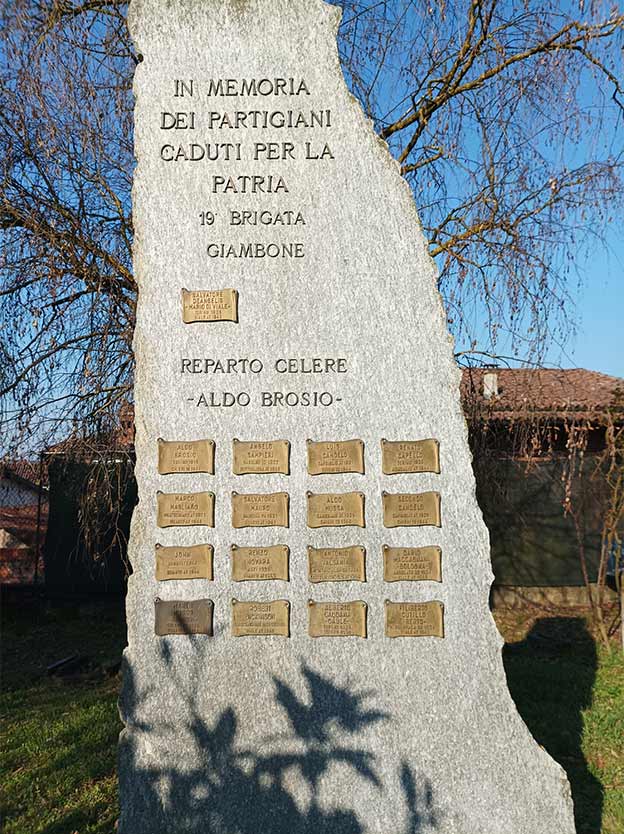
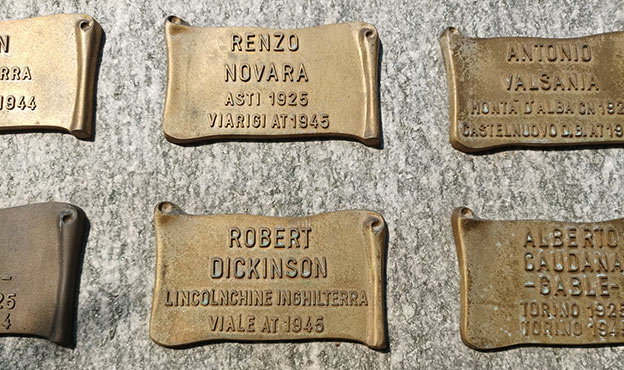
“There is so much more that I have found out, including the name and address of the Italian lady that sheltered Robert and Ronald Dix,” Steve said. “I knew there was another POW, but I was not aware that the other was Ron Dix. At least they are not far apart now, both being buried in Milan Commonwealth War Cemetery—only a few metres apart.
“I last visited Robert’s grave last September while in Italy on a business trip—it’s such a peaceful place. I wish I had known then of Robert’s relation with Ron Dix. I recall seeing Ron’s grave, but not knowing their close connection at that time.”
According to Steve, in the diary there was no mention of a Bauducco man of the house. There was, however, a lodger—who knew nothing of the two escaped POWs being housed beneath the same roof. For the first six months of being hidden, Robert and Ron were not able to leave the house in daylight!
“I had thought that Robert may have protected the identity of the house owner (in case diary got into wrong hands), as he only refers to her as ‘The Good Lady.’ The penalty for hiding escaped POWs being death!
“I’m not sure the diary travelled with him from Gassino, as one of his last comments was that he could take nothing, and the diary and photos were being buried in a tin box—Robert’s last entry being 3 September 1944. If he had taken it, I am sure that there would have been further records, as there was room available.
“His last six months had been somewhat of a mystery as to his whereabouts, just the occasional letter and nothing really detailed about what he was up to.
“In some ways I’m pleased my father was not alive to hear of Robert’s fate. Being 15 years the younger, Robert was his hero. Sadly, my father never made it to his grave.
“Ron is mentioned in the diary, just days after the armistice, and I’m guessing this day would have been the first meeting with the Bauducco family!”
Sep 11th [1943]

6 O’clock in the morning; hearing shots Ron and I went to look where and what; joke only 200yds from the camp; crept up to 2 women and a girl and they brought us civvy clothes and took us home. Hell of a job passing fascists; my trousers being a foot short. In a big room and the people will feed us till the English arrive, a week like this and the boys will be here. Food: roast chicken, eggs, rice and grapes.
Janet shared a letter with Steve, written to home by Ron Dix, that she had accessed from an Italian archive (ISORETO, Turin). In the letter, Ron mentions Robert, how the two of them had been sheltered by Ginetta Bauducco for a year, and how “In the event of my death, I would like you to compensate these good people,” in spite of the fact “the dear lady herself will listen to no requests of ours to attempt to repay her after the war if we return.”
Janet wrote to Steve, “Fulvio Borgetti was given the task of collecting all the compensation requests for the region of Piedmont by the CNL, the Committee for National Liberation. On the 16th May 1945 a request went out inviting ordinary citizens to submit a claim. The notice appeared in the papers, but I do know that some citizens did not see it or chose not to reply.
“I have a copy of ALL the claims submitted to Borghetti. (Borghetti File in the ISORETO, Turin). The copies were sent to me by Professoressa Claretta Coda. There is no claim from the Bauducco family of Via Armando Diaz, 29, Gassino Torinese.
“The head of the family was Ginetta, as evidenced in the letter home from Ron Dix, also in the Borghetti file. It appears that there were two daughters, the elder daughter Gina, and Nelly, to whom Borghetti refers in his diary.”
Janet explained to Steve that Nelly Bauducco was the sixteen-year-old daughter of the family who sheltered Robert. She was the person who took charge of his diary after his death. Fulvio Borghetti’s diary states that the young Bauducco was in love with Robert and did not want his body returned to England, and that she wished to keep the diary. After review by Captain Jack Saggers (the UK officer responsible for the Piedmont region Allied Screening Commission) and Fulvio Borghetti, the diary was returned to Nelly, but only on the condition that she return it to family. Some 18 months later it arrived with Robert’s family, where it has stayed ever since.
Borghetti called his own diary the Diario Clandestino (Secret Diary). It is housed in the ISTORETO museum in Turin and has been widely quoted by Professoressa Claretta Coda, with whom Janet has been collaborating for quite some time. Janet had translated what Borghetti had to say about Nelly and Robert’s diary—which appears in Professoressa Coda’s book (written in Italian) Helpers & POWs.
Janet said, “On reading Borghetti’s diary again, I have decided that it was Saggers who gave Borghetti the awful news about about Robert having being attacked by police dogs, rather than Nelly, from whom this information might have been withheld.
“In a letter from Saggers to Borghetti dated 1946, Saggers writes about the sending of the diary to your family.
“It appears from Google that the farmhouse at 29 via A.Diaz is no longer there and newer housing has been erected in its place.”
Steve said, “I guessed the farmhouse was no longer there. I walked the Via Armando Diaz when I visited. I left leaflets (in Italian) in shop windows, but never managed to get any news. The owner of the local street coffee shop thought probably too much time had now passed by. The camp could not have been far away, as Robert mentions the canal close by and I crossed over it.”
On receiving Robert’s report from Kew, Steve observed, “The witness statements are pretty aligned.
“Robert had received a shot to the leg and shoulder and was immobilized. One of his comrades carried him for 3km, but due to being heavily outnumbered and injured himself, Robert told him to leave him in a ditch with a firearm. Germans/fascists found him, and he received further wounds that proved fatal. When found by the partisans he had been shot in the back of the head and he had chest wounds. The partisans buried him in Viale. He was wearing a U.S. uniform—which I was already aware of.”
Steve reflected on a passage in Robert’s obituary. “Never really picked up on it before—he was left in a ditch and ‘received further wounds, which proved fatal’. It never crossed my mind on what could have been the cause of those further wounds.”
Steve shared the report with Janet. She commented, “I’m pretty sure that the fascist SS killed Robert. The Germans usually took the ex-POW partisans they captured prisoner and then shot them publicly, often after having interrogated them and kept them in gaol overnight.
“I wouldn’t be sure that Robert had the gun actually in his possession when he was found. An Allied serviceman’s uniform was usually a guarantee against his being shot, but the possession of a weapon condemned him to death. He would have known this and would have done his best to get rid of it.”
Steve said, “I had thought about the gun a little. There is some confusion, as it was referred to both as a (British) Sten gun and a Russian rifle—completely different. I wonder—did Robert have both? I’m sure the attackers would have thrown his gun out of arm’s reach.”
Janet noted that while witness Bartolomeo Cassetta did not see Robert’s dead body: “He describes him as having been wounded in the leg and shoulder during the battle with German SS troops.”
In his statement Casserta said, “Almost immediately after, I left I saw ‘German troops’ enter the ditch where he was lying and surround him.” Casserta himself was taken prisoner by German troops on 7 March. At the end of his account, he states that they were fighting “German and Italian SS troops, together with some Siberian soldiers.”
“The statement provided by young partisan commander Eugenio Morero is very concise and complete.” Janet said. “He describes Robert’s initial wounds (leg and shoulder) and those caused by his attackers—the back of his head and throat. The only part of his account which does not tie in with Cassetta’s is the position of the rifle, which he says was found ten metres from Robert’s body. (This might have been due to the fact that the killers had actually moved Robert, or that he himself had managed to move a short distance.) Morero refers to the ‘Siberian element’ amongst the troops they were fighting, but says it was impossible to know exactly which troops were responsible for the crime.
“A third witness, Adolfo Arturo, on 25 May presented himself to the Allied Military Government Headquarters in Piedmont (AMG) and spoke to Major Westwood. He said that after the action he returned to the spot where Robert had fallen and had found him lying dead with his eyes gouged out. In his official statement of 7 June he changed his story, saying he saw Robert after he had been brought into Viale. He repeated the part about the eyes.”
Janet commented, “I would not describe him as being objective—he was Robert’s friend—and he was going for the maximum effect. The fascists did gouge out eyes in Yugoslavia during their occupation of the country, and the ‘Siberian troops’ did commit a series of atrocities against Italian civilians. The war had ended in Italy, but the civil war was just beginning. Accusations, both true and false, were the order of the day. I cannot accuse Arturo of inventing this story about Robert’s eyes, but it would not surprise me if I found out that he had done so.”
In the photographs, Robert’s body is on an undertaker’s stretcher, partially enveloped in a shroud, ready to be interned in a loculo, or burial niche.
“To be honest, I was expecting a lot worse. I think the partisans may have exaggerated a little,” Steve said on reviewing the images. “I cannot see that his eyes were gouged out. One side of the face is bloodied and potentially beaten. He was definitely not torn apart by a pack of dogs.
“Robert said in his last letter he was thin. I suppose a year in Servigliano and then some months in other camps, plus a year with the Bauduccos, took its toll.
“At least having reviewed the images now makes the investigation seem complete and settles my mind. I’m guessing these were taken before Varesio Vincenza cleaned the body for burial. I’m sure once cleaned up he looked little different in death.
“Whilst I never thought Varesio Vincenza’s letter to be 100 percent factual, she definitely knew of the events: shot in leg, hidden in ditch, found dead in the night. She said Robert and a friend were killed that night and she cleaned both bodies. I think I may have identified the friend.”
Steve had found a form on the website of the Istituti piemontesi per la storia della Resistenza that allows researchers to search their archives for information on partisans: http://intranet.istoreto.it/partigianato/ricerca.asp
Here Steve learned that Guilio Salvagiotto was killed in Cortazzone on the same night as Robert. He was in Robert’s brigade.
“I think the partisans may have been trying to retreat to their base,” Steve said, “which I suspect was Viale—with both Robert and Ron being buried there. It must have been a tough time for Robert, as he would have been aware of Ron’s death in December ’44.
“On the site, I also managed to find all the partisans detailed within the investigation report. As the war in Italy finished in early May ’45, all had survived the war and were living when the investigation was completed.”
On website of the ANPI (Associazione Nazionale Partigiani d’Italia), Steve found the following information about Eugene Moreno, the partisan who, decades after Robert’s death, ensured that he was memorialized on the monument in Viale:
Eugene Morero
Piedmont

Born in Bricherasio (Turin) on 14 July 1927, died in Pinerolo (Turin) on 25 March 2003, national councilor of the ANPI.

At only sixteen, to fight for freedom, Eugenio Morero joined the IV Garibaldi Brigade. Arrested by the fascists in the Pinerolo area, the boy was transported to Turin and locked up in the barracks in via Asti. The tortures to which the fascists subjected him were useless; not only did Morero not give information on the location of the partisan groups under the command of Pompeo Colajanni “Barbato”, but evading surveillance managed to escape. From Turin he fortunately moved to the Asti area, where he joined the Mobile Operations Group of the commander “Nando”, of the GL “Brosio” Brigade. For his courage he was soon entrusted with the command of a detachment, which he led with great skill until, during an action against the Nazi-fascists, he was wounded in the limbs. Despite this, the boy did not abandon the fight, participating in the liberation of Asti and Turin. After the war, Eugenio Morero’s commitment to defending democracy, freedom and workers’ rights would never fail
.
 Camp 59 Survivors