
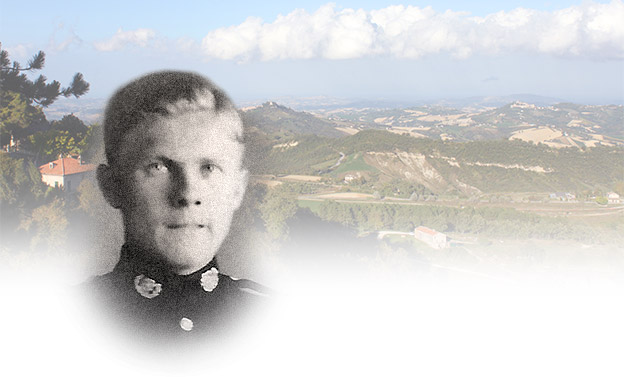
© Michael Page · Permission to share the memoirs of Arthur Page, Una Bella Passeggiata (A Walk in Wartime Italy), has been granted by the family of Arthur Page.
Preface
I can claim no experience in authorship of any extensive written work beyond responding to my Tutors’ demands in Teacher Training College days for a pocket thesis on some facet of education and an attempted booklet aimed at introducing Geology to 14-year-olds. The first was accepted as adequate and the second judged to be too ponderous for 14-year-olds to stomach.
What reason can I have for attempting this book so belatedly? Firstly, I suppose, my younger son, seeking a ‘party piece’ at my expense at a family gathering, easily urged the gist of the story out of me by constantly topping up my whisky glass and asking questions. Thereafter he persuaded me that it was a tale interesting enough to write down rather than it be forgotten. Then, lots of old men make pretence to write a book. I myself thought it might offer me a change from playing golf. Also, I have always longed to pay tribute in some form to the Italians who helped the freed prisoners of war between 1943 and ’45. Finally, a touch of arrogance comes into it—but I anticipate ‘a fall’.
It all happened nearly fifty years ago, so how can I remember it all? I quote our best writer, “Old men forget: but all shall be forgot. But he’ll remember, with advantages, the feats he did that day.” I have tried to restrain the inclusion of too many ‘advantages’, but otherwise the incidents I have used are as clear to me now as of yesterday, albeit my recall of today’s mundane matters weakens by the day. Probably it is too far back to attract attention. Michael assures me otherwise, but he is my son. But he will not lay a bet on it.
In 1989 (it was a year in which occurred some further, but thankfully minor, English football hooliganism in Italy), when on a train journey to revisit my wartime friends the Tamburrini family, an Italian gentleman adjacent to me asked were I on holiday. “Not exactly,” I replied, “I’m revisiting one of my Italian families.” This obviously aroused his interest for he spent the remainder of my journey pursuing the subject of their relationship with me.
It turned out that he was a news reporter and, although I never did see his article, much as I would still like to, I later learnt that the gist of it was to make the recent football squabble appear insignificant when compared with the Anglo-Italian friendships that had endured since the war.
The article pleased me in that, in a small way, it gave some public recognition to a ‘contadino’ family for its wartime generosity to an alien who, for all they knew, might have been trying to kill some of their kin not so long before. Much has been written and said of the nationwide spirit and effort of the British public during their ‘Finest hour’ in 1940, and rightly so. It seems to me that the responses made by the farming community (contadini) of Central and Northern Italy when 80,000 plus liberated prisoners of war were thrust among them while a vengeful Wehrmacht and fascist power stalked the land is equal to this. But little has been made of their heroic national episode.
In writing my story I wish to remind people, if only my family and friends, that those thousands of POWs when once out of prison camp were beyond the responsibility and help of any friendly power. What happened? The contadini, in the name of simple humanity, took on that responsibility. They fed us, housed us, nursed us on occasion, and sometimes even clothed us. They shared us out among themselves in rough and often unequal fashion as need showed itself, took us into their homes and families with no expectancy of reward or glory. Above all, they put their families at risk in the doing.
North of the front line there was no government to ask them to do this. Rather they had a dictatorship and foreign aggressor who told them in no uncertain terms that they were not to do it.
Theirs was a spontaneous feat of selfless heroism and generosity on a national scale sustained over a period of up to a year and a half. Many paid a severe price for doing it, but the majority, though scared for their loved ones, continued to do it.
The eighth of September 1993 was the fiftieth anniversary of the Italian Armistice, which brought about the beginning of this historic effort that undertook the burdensome responsibility for a rag-tag army of released Allied soldiery. It passed almost unnoticed. It called for an occasion that would have summoned representatives from all the Allies and Italy. I am sure it would have attracted many aging escapers, evaders, and their Italian ‘helpers’.
But these are an old man’s dreams. At least I shall tell of them in my book. Their goodness, some of them, their bones, are still there, a hope in Mafia-ridden Italy.
The goodness of the contadini—including those whose bones only remain—are a hope in Mafia-ridden Italy.
Dedication
To the country folk of Central Italy whom we liberated prisoners of war encountered on our road south to reach the Allied troops, and who did not pass us by on the other side but recognised us as ‘neighbours’ and helped us on our way. And to those who paid the ultimate cost in so doing, such as:

The two brothers of the Fiaddino family of Capracotta, near Castel di Sangro, for helping escapers cross the front line: executed by shooting.

Michele del Greco, a shepherd, who helped as many as 56 escapers cross over: sentenced to death on 27 November 1943.

Alcide Cervi, arrested with his seven sons for harbouring five POWs. Alcide escaped prison by good fortune after a RAF bombing raid. His sons: executed as hostages.

Signora Cervi died of grief November 1944.

and to the memory of so many others.

       ‘But a certain Samaritan when he saw him had compassion on him.’

A tutti i contadini dell’Italia centrale che noi prigionieri di guerra abbiamo incontrato per caso sul nostro cammino verso sud per raggiungere le truppe alleate e che non ci hanno lasciati da parte, ma ci hanno conosciuti come amici e perciò ci sono venuti in soccorso per rendere possibile il ritorno alle nostre destinazioni.

       ‘Ma un certo Samaritano quando lo vide provò compassione per lui’.
Author’s Note
I am ex-sergeant Arthur Page, enlistment number 5501857 and served in the Hampshire Regiment from 1939–46. After being a weapon training instructor at Albany Barracks, Parkhurst, I was transferred to the 2nd Battalion in 1940 and was at first in Y and then in X company. On 21st November 1942 we landed in Algiers a week after the initial landings. I was in Lieutenant Jones’ platoon.
The Battalion had left the 1st Guards Brigade and, on arrival in Africa, joined the 78th Infantry Division. For a week we enjoyed new and novel surroundings in Maison Carree, a small town not far from Algiers, during which time there was occurring a foreboding build-up of German military strength in Tunisia, our next territorial objective after securing Morocco and Algeria.
The enemy were building a new force in readiness for an imminent, powerful counter offensive toward Medjez-el-Bab and Beja. Reinforcements, mainly elite parachute regiments, guns and tanks were being flown from Sicily and Italy to add to the Afrika Korp’s strength already there. The armour included the brand-new, as yet untried, ‘super’ tank, the ‘Tiger’. These ‘Tiger’ tanks were to make their debut in a trial of strength with the un-armoured Hampshire ‘Tigers’ for the battalion now took train for destination Medjez-el-Bab. The Hampshires were so nicknamed after the tiger incorporated in the cap-badge to symbolize the long spells of duty in British India.
By November 29th we had detrained there and become part of 11 Infantry Brigade already at grips with the enemy. That night we relieved the 6th Northamptons forward of Tebourba. This our company did in complete darkness. It is at this stage I start my story which deals only briefly with the battle and mainly with life on the ‘wrong’ side of the battle line in Italy well after its conclusion.
Chapter 1—Battle and Aftermath
“Sarge! There’s something coming along the railway line.” My platoon runner’s voice came from our observation post in the roof of a deserted farmhouse. I ran up the stairs, clambered into the loft beside him, looked through the small gap we had made in the tiled roof, and grabbed the binoculars and focused along the railway line which came towards and through our company centre. There was my first sighting of the enemy in North Africa.
To effect this meeting, we had sailed from Liverpool in convoy through the calms and storms of the mid-Atlantic, landed in Algeria, journeyed by train from Algiers to Medjez el Bab in Tunisia, made a dash by lorry convoy along what the RASC drivers nervously called ‘Messerschmidt Alley’, then debussed at a modest town named Tebourba within 20 miles from the city of Tunis itself. The drivers were clearly thankful to get there unmolested by the forenamed aircraft, as the Luftwaffe were mere minutes flying time away at Tunis Airport. (It is a small world. On retiring I settled in the village of Docking, Norfolk, and there found that two of my new near neighbours had connection with the Tebourba Gap battle: Colonel Eagle once of the Signal Corps who was at Corps H.Q. in Medjez el Bab, and T/99164 Driver Ken Playford R.A.S.C. attached to 26th Armoured Regiment who helped drive some of us from Medjez to Tebourba via ‘Messerschmidt Alley’, and eventually continued driving up through Italy).
We continued on foot to bivouac in an orchard situated between Tebourba and the next town further east, Djedeida. We dug shallow fox holes in the anticipation of possible bombing. A sudden aircraft warning shout sent me diving literally for my hole, but some blighter had pirated it and my face met his boot. I was not pleased. It was only a German Storch apparently taking an idle interest in us, but more likely counting our heads. Our mounted Bren guns discouraged him.
Then, after dark, leaving Battalion HQ behind, the four rifle companies filed forward to dispose themselves defensively ahead. Our company took position on the Battalion’s right flank, astride the same railway line we had recently detrained from further back; next stop Tunis, no doubt, as it was only 20 miles further on. Two platoons and company HQ took position to the left of the line and mine to the right. Many of the telegraph poles which edged the line were down as the result of earlier action, and as we crossed the rails in the dark our boots could not fail to kick the countless wires that joined them, no doubt sending tinkling sounds and vibrations all the way down to ‘Jerry’. To have telephoned them would have done no better. Sixty or seventy yards further on we came to a farmhouse and yard in front of which we disposed ourselves and dug in.
Next morning at stand-to, as dawn slowly lightened the day, our situation was revealed to us. Parallel to the railway and winding gently flowed a quite wide river, the Medjerda, which, just short of our company positions, changed course abruptly to flow in front of my platoon’s weapon slits. This gave us extra protection from any future frontal attack. No German assault would cross that without boats or bridging: comforting thought.
The platoon’s three sections of ten men each were dug in some yards short of the riverbank and partly camouflaged by the scrub that lined it. Platoon HQ consisted of the platoon officer, myself as platoon sergeant, radio operator, platoon runner, anti-tank rifleman, and a two-inch mortar man. These men we placed partly in a downstairs room of the deserted farmhouse and partly in a slit trench just outside, near the room’s French window. This faced to the left of our platoon front and towards our company line. The land that surrounded the farmyard was well tilled land and fairly flat, so retreat across it would be completely in the open; was not so good. The terrain north of the railway line was more undulating. To our platoon front the land rose gradually to a ridge from which we guessed that Jerry had a good view of us.
We were assured that we were now the most forward unit of General Anderson’s First Army and in the attempt to beat the Afrika Korps to Tunis had over-stretched our communications, had received a bloody nose and so, come what may it was our duty and honour to wait for Jerry and hold him for three days; the rest would have the honour of making a tactical withdrawal! It was a repeat performance of 1940, when the battalion leapt forward into Belgium only to join a retreat, but this time there would be no Dunkirk.
Now the waiting was over and there was the Wehrmacht in the early afternoon sunlight advancing in files either side of the railway line, concealed from all eyes except ours in the OP up in the roof. I could see clearly three platoons trudging meaningfully forward, one platoon after the other as bold as brass. No response came from company HQ on the field telephone or the radio, so I sent my runner sprinting over with the news. Before he had returned, I was back at the OP and saw a section of our lads from the centre platoon dashing up the railway line to disappear round a curve into a cutting, and within moments there came a confused rattle of small arms fire. The Battle of Tebourba Gap had started. It was my 24th birthday: December 1st, 1942.
We had arrived on the Saturday night. On Sunday there had been duels with the heavier mortars, and their 88s had probed us. I can recall plenty of air activity from the Luftwaffe. Lockheed lightnings, twin-fuselaged jobs, appeared on our behalf but always it seemed to us well after an attack had fizzled out. But one must remember that in responding to our calls for support they had a long way to come, whereas the Luftwaffe were almost our next-door neighbours.
My memories of the battle are now rather mixed, some of them hazy, some of them crystal clear. We were obviously facing experienced, well-trained infantry. In very short time after the opening shots, they had extended into attacking order. Then they proceeded to give us a lesson on how to make a frontal assault. In this extended order, each man made his own isolated individual rushes forward, but never showing himself for more than two or at most three seconds. Never did two or three men show themselves at the same time and always well spread out, never grouped. Thus, there was too little time to lay good aim with small arms. There are only two kinds of infantryman, the quick and the dead. The Germans were definitely quick, and therefore good survivors of small arms fire. It was time for our two-inch mortar.
Being considered a dab hand with this instrument, I myself ran with it and jumped into a crater about twenty or thirty yards behind the centre section’s rifle pits. I shared it with the mortar man, who brought the bomb cases and a dead mule, fat bloated with heat and time and with four stiff legs pointing skywards. I remember feeling sorry for it with a brief flash of thought; it was not his war and it seemed so unfair. I can remember, too, shouting exultantly whenever I thought I had delivered a useful bomb. Damn it!—were they not trying hard to kill us?
Jerry’s forward movement was covered by a mortar and 88 mm bombardment and Spandau fire from the high ground slightly to our right front. When shrapnel spun near you it was with the high-pitched whine of a banshee. The bullets whispered over your head. Yet you heard this amid the screaming whistle of falling bomb, the rifles’ crackle, the controlled chatter of the Brens, the frenzied rattle of the Spandaus, punctuated with the heavy detonation of bomb and shell.
One had always considered that civilians just did not feature in front-line fighting. Their role was that of refugees moving back from the advancing enemy, often getting in the way, their suffering and despair an upsetting influence on the lads moving up. It was different at Tebourba. The farm area in which the platoon had been positioned had doubtless been evacuated by a French Colonial family according to general rule, but it was quite evident that the Moorish people who had worked it, or perhaps taken it over, were still about. On the first morning they walked among our positions quite fearlessly, unmolested by the opposition, selling eggs and other produce to the lads. This we found peculiar, but we purchased the stuff as a welcome addition to our diet.
By the time the initial attack commenced, they had disappeared and were far from mind but, while serving the two-inch mortar in the crater, I saw an extraordinary sight. Directly in front of me, a bit behind the rifle pits, were one or two small outhouses. Whilst fully engaged in our urgent affairs, an 88 mm armoured piercing shell completely pierced one of these. A good-sized hole abruptly appeared in the wall with a crash and smash of masonry, followed immediately by a flurry of white feathers—a fluttering of many escaping Tunisian chickens and the exceedingly rapid evacuation of three or four white-robed Tunisian adults. We saw no more of them, and they did well not to return.
Eventually Jerry withdrew, probably in good order for we saw little of his going. We thankfully lit up our cigarettes and relaxed for a moment before doing the aftermath chores, ammunition checks, reloading Bren gun magazines and the like. We had been dealing with a probable probing attack intended to gather information for the sterner assaults to come. The Battalion, with ever decreasing numbers, would keep the Germans occupied for another three days as yet, allowing the forward elements of the First Army to build up and stabilise amongst the hills and djebels that rose to our rear in the Long Stop Hill area, where the rest of our brigade, the Grenadiers and Coldstreams, would do sterling action and go in to the attack shouting “Remember the Hampshires” when better times came.
Nighttime came, bringing some sleep and some reaction to the strain and effort of the day. Craving rest, you could drop off in moments and soon be immersed in fretful dreams but be instantly awake at the slightest alarm, with adrenalin running high, senses fully alert, stomach churning, badly digested army biscuit scraping one’s chest with a spiteful heartburn.
Came the sound of German tanks moving up to await the morrow. Stomachs tightened again; minds struggled with imagery of the fight; Boys anti-tank rifle against mobile cannon and tons of steel. Forget it! Sleep for God’s sake, while you can.
Ackerman—the platoon runner and my good, dependable foxhole mate—was the first to go next day, with the agony of a hit in the stomach by a piece of shrapnel. After stand-to, we had gone out to peruse the ground to our right which, being protected by the river and being an expanse of flat, open farmland with no cover, was dangerous to occupy or attack over. Thus, our immediate right flank was in the air with any defense lying much further back from the flat area—or so I assumed. Ackerman reckoned that there might be a sniper infiltration out there. I had to return to the platoon, but ‘Acker’ opted to watch for a while.
The enemy fire had been gradually increasing, and I had hardly entered the farmhouse when someone in the slit trench just outside yelled that Ackerman was hit. I crawled back to him. The slightest movement caused him great pain. He was only my height and build, we were bantam five-feet-fives, but he was dead weight. He suffered much pain before we got him back to the farmhouse. It was not like the films at all, where you slung a conveniently unconscious comrade over your shoulder and bravely strode off through shot and shell.
We covered a single, finger-sized, slightly suppurating hole, quite neatly round, with a field dressing. The stretcher bearers, two of them, had raced bravely from Company HQ, one of them arriving so badly out of breath he had to rest before resuming the way back. He must have been out of condition from shipboard and train journey inactivity. We tried to cheer Ackerman up, saying that he would soon be in a hospital bed with lots of lovely nurses around him, and that he would miss the tank attack. Alas, we were soon to be so occupied that evacuation of wounded beyond Battalion HQ was not possible. I missed Ackerman badly—very badly.
We learnt later that, because of the breakthrough of the German armour, the wounded could not be transported out of danger and were, as a consequence, placed in a situation when the survivors of these assaults were surrounded. It appears they were in the centre of a lager, or defensive ring, quite open to mortar fire which eventually fell upon them. They had to endure a second time, but were this time in a helpless case. Many were killed, or wounded a second time, and I believe that ‘Acker’ was one of the former.
The Germans had our situation sized up pretty thoroughly and plastered our positions, gradually building up their attack which promised to be a strong one. The whole line was bit by bit drawn into the German infantry attack, but the tank assault seemed to be building up along or near the line of the railway and so we only had the infantry to our front to occupy my platoon. As the combined tank and infantry attack developed, we began giving flanking fire as best we could.
The armoured titans remorselessly were piercing our company centre. We could clearly see the following German infantry and were given some good targets. The tanks continued to probe forward and so the anti-tank rifle took on the tanks to no apparent effect. They continued to lumber forward, but no!—three tanks peeled off to turn their attention our way and neutralise our firepower which could at least bother their infantry. They may have had their attention attracted, but certainly were not hampered by our anti-tank bullets tapping on their armoured plating. I recall, as a new recruit, our instructors assuring us that, even if the Boyes AT bullet failed to penetrate enemy armour it would cause its inner wall to flake, thereby putting the tank’s occupants off. I had even put the same propaganda out myself. These tanks were not put off. As they remorselessly came forward, they sprayed us with machine gun fire. When a tank halted we would wince, for this meant it was our turn, our turn to share the cannon fire. They converged on our farmhouse, the rifle pit outside was abandoned and about five alarmed Hampshires retreated inside the building as the tanks nonchalantly but viciously encouraged our surrender or our demise. The attack was unhampered by any artillery or mortar fire from our rear.
I dashed through the house to the door on the far side to seek means of further withdrawal, but it had been too strongly barricaded by previous military occupants and would take ages to break down. We were trapped. Plaster and masonry were falling among us as a tank continued firing at close range. I received a large chunk of farmhouse on my helmeted head. The firing stopped and, amazingly, German infantry suddenly swarmed outside.
With our weapon slits taken in flank by infantry who had made their way forward through the brush that grew along the bank of the river—enfiladed also by fire from the tanks, closely behind which came further infantry—the platoon had not had much of a chance. Even a prompt withdrawal as soon as the tanks turned our way would only have led us on to the flat, open fields beyond the farmhouse; and one does not withdraw that promptly—or think that fast.
The room was in rather a state, as were its occupants. Lee–Enfields, light machine guns and a Boys anti-tank rifle had proved no match for cannon and armour. Standing in open ground, the tanks actually looked vulnerable to shellfire, but we learned later that the single anti-tank gun allocated to our sector was knocked out in the opening moments of the assault. Meantime these tanks had effectively covered the rapid flanking attack, seemingly quite unmolested by our sustained Boyes anti-tank rifle fire: checkmate.
Thus came surrender and shame. We assumed the dubious status of prisoner of war, the fellow who did not die taking one with him, who knew you did not win wars by putting your hands up but did it anyway. If only those anti-tank rifles had been anti-tank cannon—excuses, excuses. Not that we thought such thoughts at the time. Tired, dazed, still in shock, I felt bloody lucky to be still alive. As we stood outside being relieved of weapons, I even began to think that I might survive the war. But then our three-inch mortars firing from Battalion HQ opened up on us, as though to remind us of the degree of our perfidy. This would have been welcomed earlier but now it was too late to help us. Our own bombs crashed down among us, blanketing our over-run position. With the instantaneous reaction common to all infantrymen responding to such a situation, German and Briton alike dived for cover. I shared a bomb crater with another Brit and three Germans. We lit up our cigarettes and waited upon events. One of the Jerries, spotting my dagger (my sharpened Rover Scout sheathe knife) in my gaiter, lent over, relieved me of it, tossed it out of our shell hole whilst wagging an admonishing finger at me and said “Nicht gut”, as though it were a disqualifying weapon and I was caught out cheating. When orders to move came we separated from the Jerries. In parting one called out in accented English, “For you the war is over; we must go on and on.” He did not sound all that happy.
So our part in the battle came to an end. As events had turned out, the platoon’s choice of position may appear, in retrospect, unfortunately chosen from the start. The rapidity of the final onslaught which pierced Company centre at once changed our situation. In moments the river which so far had helped our Platoon’s defence against frontal assault lay now behind our backs. The flatter terrain around the farm area gave the German tanks clear field of fire. They advanced unmolested but for our small arms’ fire. Thus, they pinned us down; there was neither room nor time for manoeuvre.
No orders came from Company command which, I feel sure, had been too occupied with the immediacy of the sudden, ferocious weight of armour that pierced its position. Their radio and field telephone were, doubtless, rendered non-operational at a stroke.
On reflection, our sole course may have been to counterattack on our own initiative before the tanks swung left to trap us against the river but, though ably and bravely led by our leader, there had been hardly time to react that quickly or foresee the need for such a move.
Later, as the remnants of the company were collected together by our captors, our commander Captain Thomas, wounded but still full of fight, exhorted us to remember that it was our duty to attempt to escape and renew the fight. I gave him little heed at the time. We were marched to and through the city of Tunis. In the streets the French Colonial citizenry showed us concern and compassion in their eyes, but it was not until some Moorish elements began to pelt us with stones and garbage—God or Allah more likely knows why—that I began to reflect seriously on what the captain had suggested. Given time, some of us would take him up on it.
Next day we were marched to the airport which had been bombed overnight by Allied aircraft. There were sufficient craters on the runways to make landings and take-offs rather hazardous. To our delight, we actually witnessed one plane become a belated victim of the night’s attack by hitting a crater before it could become airborne. But the German effort prevailed, and soon a regular shuttle service of the three-engined Junker 52s became evident, bringing in re-enforcements from Italy and taking out wounded personnel.
Soon some of us were packed on to one of these craft with some German wounded and members of a British parachute regiment captured in a drop meant to secure enemy airstrips near Bone. While the engines were warming up, we passengers were constrained to move as far forward in the main compartment as possible to aid quick tail airlift and early take off, thus helping to avoid bomb craters. In the circumstances we were happy to cooperate. On gaining height, I found myself seated next to a very young ranker in the Luftwaffe on whom I tried my schoolboy German and ascertained that we were heading for Sicily. When he commenced munching something, I applied my first scrounging for survival technique. “Ich habe keines zu essen fur drei tagen gehabt”, I slipped in amongst other odd attempts at communication, which is to say I had not eaten for three days. This was very nearly the truth for our last proper meal had been in the night after the first German attack since when we had eaten the occasional army biscuit. The ‘something’ he munched turned out to be a type of processed cheese, foil wrapped—a form of German army ration possibly of which I gained a chunk.
I was beginning to relax in the enjoyment of my first ever aeroplane trip when suddenly the radio operator, who sat in the main compartment but facing the panel which separated it from the pilot’s cockpit, became agitated and vociferous seemingly conveying news or instruction to the pilot. What followed, to my limited flying experience, could only be construed as panic. To the horror of all, the small fleet of 52s we accompanied split up in all directions. Our plane dived for the sea. Surely my stomach stayed aloft? Surely we were under attack. “Achtung spitfeuren”, I shouted to my German neighbour. He was as scared as I was. Thus we continued our way, consequently arriving at Sicily at very low altitude, flying between the higher peaks and over towns at just a few hundred feet up—for me, a novel and exhilarating experience. We landed safely at an aerodrome belonging to the ‘Regio Aeronautica Militare’ or Royal Italian Air Force and after being herded into a convenient area near its periphery we were soon surrounded by large numbers of air force personnel.
Their curiosity broke, if not all bounds, certainly the bounds of British Regimental if not even RAF Station discipline. They came running from all points of the airfield to surround and gawp at us for such length of time that their duty obviously called but faintly if at all. Our revered and respected Sergeant Major would have had the lot of them back on duty so fast their feet would have not have touched the ground, and with ‘Jankers’ to follow. But they continued to discuss this ragged, dirty and surprise sample of the ‘enemy’, gesticulating and chattering at such speed as astounded us. They regarded us not with hostility, but genuine interest, although their manner appeared to us rudely personal; so their looks were returned by our glares. They seemed to regard us as ‘their’ prisoners, which we resented somewhat. By Axis arrangement we were destined for Italian, not German, prison camps. When captured we were hungry and since then had been given no food at all, so we were ravenous. It was natural, therefore, that one’s thoughts centred increasingly on food and my imagination conjured up an issue of Italian spaghetti at least. It was not to be. Not being on their ration strength, they would spare us nothing.
Afternoon brought with it, however, some quite high-ranking German officers who engaged our officers in conversation. That gave them the opportunity of raising the subject of food; as a result German organisation responded with generous speed. Soon a German field kitchen (just like the one I recalled from a scene in the World War One film ‘All Quiet on the Western Front’) drew up beside us and we queued for a dole of thick potato soup, dealt out with some difficulty for we had to share what mess cans and spoons that still remained in our possession. For this we marked Jerry’s effort with ‘ten out of ten’. All this smacked something of the peculiar mutual respect and comradeship shared between Wehrmacht (not SS) and British front-line troops, sharing dangers and adversity.
The occasional Italian Fighter pilot would suddenly treat us to an unrehearsed display of his aerobatic skills. The object of the exercise I believe, apart from unabashed showing off, was to make us duck. This, of course, we tried not to do although it looked bloody reckless and unnecessarily dangerous to me. It was a circus-like display that no British RAF station commander would have suffered without a most speedy and spiteful disciplinary reaction. We longed for some degree of pilot error that would cut one of these clowns down to size, but none came. In my eyes the fighter craft we saw seemed small and unwarlike in appearance, as did their personnel. We were kept on the airfield in the pleasant December sunshine most of the day, but as dusk approached lorries took us up to an infantry barracks in a nearby town. These deposited us on the edge of the parade ground, just inside by the guardroom. Whilst waiting there we were attracted by the tramp of many feet and unisoned singing coming from the busy street outside, and in marched a company of cheery infantry to the sound of their martial air. They marched at almost light infantry pace, with rifles carried at a very low wobbly trail and eyes looking everywhere but dead ahead. We sighed in critical fashion at their lack of smart marching discipline. In a barrack room we slept in relative warmth and luxury on huge beds which lined each side of the long narrow room. I had never seen such beds before. They were made of varnished wood and were wide enough to sleep half-dozen men side by side on the one bed. There was no bedding and in lieu of pillows the polished bed planks curved into a long bolster-like shape at the bedhead. Each bed looked rather like a very wide Victorian sofa, except for its lack of upholstery. We slept quite comfortably.
Chapter 2—Sicily
The next night was the reverse of comfortable. Late afternoon found us taken to a place high up on a mountain slope where snow lay on sheltered patches. Here we were handed over to the guards of our first official ‘campo concentramento’. No preparation had been made in anticipation of our arrival of by now a fairly large group of men. With darkness almost upon us we were counted into a huge, bare marquee where, feeling our way through the darkness, we found neither bedding nor bed on the floor an inch or two deep in soft mud. Here we shivered throughout the night, unfed that day except for a ladle of acorn coffee at the barracks, reflecting upon a probable grim future.
Nights were long so, before daylight, we were served with a half-mug of acorn coffee by British kitchen personnel by light of electric torch. These torches made queer rasping noises, for their light was dependent on the rapid depression and release of a sprung lever which activated a form of dynamo incorporated in the torch, so boosting its battery. The faster one worked the lever, the brighter shone the torch.
The next night we slept in the same marquee, but on a palliasse each man had stuffed with straw drawn from a huge stack, and with two blankets per man. For nightwear we took off our boots and for pillows we used anything we might be lucky to have in excess of the clothes we wore: In most cases that meant our boots or the occasional side pack.
By the end of that day, we had experienced our first daily basic prison camp routine. First came ‘il conto’—the parade of prisoners for counting; a lengthy process. At mid-morning occurred the bread issue; each man received a roll of good bread about the size of the then-halfpenny English roll, plus an inch-sized cube of cheese. By mid-afternoon came the issue of a ladle of vegetable and macaroni soup (a minestra) which completed the daily food ration. The rest of the time was your own unless you were on the frequent working parties.
On that first day, in addition to the usual routine, we had been ‘processed’, our particulars taken and basic needs issued, such as a spoon, canteen and bedding. Officers went to a different compound. From a large heap of old Italian uniforms you could take a tunic, trousers or shirt as needed. My trouser leg had a twelve-inch rip in it resulting from the fighting, but on examining the pile I was put off as it was quite obviously teeming with lice; I decided to make do with what I wore.
This campo concentramento was literally a camp. It was completely tented but for military and administrative quarters, kitchens, and the like. Washing and latrine facilities were alfresco and crude with inadequate water supply. The usual barbed wire fence surrounded the camp with adequate guard platforms. On the peripheral fence’s inner side was a marginal strip of ‘no man’s land’ about 4 or 5 metres wide with cautionary notices, ‘pericolo del morte’ (peril of death) translated only with a black skull printed with it. Inside each compound were rows of double-walled marquees. There was a camp canteen, but to benefit from it we would have to wait for an issue of camp money.
There was an abundance of vermin in the camp that one could label as personal or general vermin. The former were lice, of course, which readily took to us because of the camp conditions. Lacking razors, most prisoners grew beards and with lengthening hair this all helped the lice. The general type of vermin one could hear at night in the form of mice and rats running behind your heads inside the double tent walls. They made occasional forays amongst us to seek food or share the comfort of your blankets. I recall a night when I woke to feel a hand on my shoulder and, on turning, I disturbed it so that the ‘hand’ jumped off and scuttled away.
The meagre diet soon reduced our weight by a stone or two. We were the weight watcher’s envy. Hunger affected us in other ways. In the early days on morning count chaps began to faint as they stood waiting, generally for quite long periods. These we carried into special ‘horizontal’ rows to facilitate speedier counting by our tormenters. One was always hungry, especially in that initial period before your stomach shrank to a size more appropriate to your food intake. You talked, dreamed, and fantasized food. On working party one carried, placed, and broke rock and rubble as hard-core for the soft, muddy camp tracks. This made severe demands on debilitated men and caused much fainting, real or feigned. What a holiday camp we had though compared with our comrades really suffering on the Burma railway. But the work was to cause a mutiny despite our becoming immune to it all as days passed.
In the first day or two one witnessed fights over the remaining scraps of ‘stodge’ (minestra) left in the dixie until POWs themselves quickly enforced a discipline to avert this. Watches and rings were swapped over the wire in exchange for bread or cigarettes; a nocturnal business. Some chaps who felt their hunger desperately were to be seen trying to scrounge from the cooks who, naturally, ate well and even searching the large pit alongside each kitchen, where waste was thrown. Cabbage stumps were the main targets which, when washed under the tap, or trimmed with a pocketknife, could give a much-needed mouthful. After a week or so hunger pains were felt less and less.
However, there were a few prisoners who, to some extent, sadly resembled the Japanese-held POW. These were to be found in the dysentery compound, and many of the worst cases were South Africans who had been there since soon after their General Klopper surrendered Tobruk. Truly speaking, this camp was only a temporary stop for most prisoners before sending them on to more permanent residence. Yet these poor chaps, serious dysentery sufferers looking like walking skeletons, were still here; correction—some were no longer here having died. One was buried within a few days of our arrival; the Italians supplied the firing party and the officers compound the priest. So the word went round, “Don’t go into the dysentery compound, for you only come out with full military honours, feet first.” There were always a lot of malingerers and genuines on sick parade, but one did not report willingly with dysentery; you were found out.
It was not long before there was a cigarette famine among the prisoners. A cigarette ration was promised but was slow in appearing. If one inquired the Italian reply was always, “Domani” (tomorrow). After many ‘domanis’, ‘oggi’ (today) finally arrived and a ration of the cheap Populare brand was received; strong, cheap maybe, and nasty, but a joy to the smoker.
We were granted another treat. One day I returned from a spell on working party to be told to report for an issue of ‘camp pay’. This was a currency specially printed for camp use which it seemed was debited to one’s government by some tortuous accountancy and was eventually charged to your Service pay account back in Blighty. It was not long and I was in the camp canteen, run by three French Colonial Soldiers, prisoners like ourselves, drinking a glass of local wine and buying dried figs off a string, dried prunes, and jam so solid one ate it like soft toffee. This was a great end to the day.
Christmas Eve arrived but it was the same as any other night, killing time in the long, dark evening, in a tent with no lighting, when one of the Hampshires asked if he might sing something to us. I knew the chap well. He was, like me, a Londoner called up on the same day as myself. He was artistically inclined, painted in oils, and followed the Sadlers Wells drama and ballet and such. He reported for Army Service in very baggy, green corduroy trousers, colourful shirt, and jacket and either cravat or silk ‘choker’ considered ‘way out’ in those puritan days of grey flannels and plain shirts and tie, trilby, bowler or flat cap. Permission granted, he chose to sing Gounod’s Ave Maria. We listened quietly; our silence seemed to spread beyond the tent as did his voice. It went extremely well and when he finished an ovation swelled from us, our adjacent neighbours, even to the sentries. Bless the bloke. He had aroused some Christmas spirit. It continued into the next day with smiles and ‘Buon Natale’ from the guards and we received a Christmas orange and double-thick soup. A few Italian civilians imbued with the same spirit made the gesture of climbing from a village way below and were granted permission to pass through the wire, Italian hand to British hand, to a few prisoners their Christmas offerings. We began to see the Italian in a different light.
Except for the camp interpreters, the average POW was slow to show respect for Italian commissioned ranks, preferring to pretend not to notice them. This attitude would enrage the camp commandant. He was a short, squat individual, not unlike ‘il Duce’ himself in appearance, or perhaps his trying to imitate Mussolini’s mannerisms accounted more for the similarity. He was quite fond of strutting around the camp with the sole purpose of putting British military etiquette to the test. “Salute! Salute!” he would call in one of his few words of English, and if response was not quick enough many a squaddy would be hauled off to the ‘cooler’ by one of his minions to repent for the rest of the day. This, together with his demands for labour to improve the camp’s roads, fanned a resentment among us which, in the end, burgeoned into revolt.
Grievances about this labour had been a matter for heated argument since soon after arrival. Much reference had been made to ‘Geneva Convention’, ‘helping the enemy war effort’ and the favourite conviction was that our rights included double rations for a ‘working prisoner’. Our lads who worked in the camp kitchens did eat well and later on, in other prison camps this argument was borne out because those who were lucky enough to have regular daily administrative tasks such as camp police, office work, cleaning, etc., received double bread ration however sinecure the task. Thus it was that one day, on being paraded for working party, the victims chosen for the day’s work refused to march off.
Their obstinacy was such that finally ‘Il Comandante’ himself with full entourage of officers was called to the scene. He was so enraged that all British sergeants and WOs were rounded up and marched into a field on the edge of which were appropriately placed machine guns. There we were joined by the British officers. There we were harangued, through an interpreter, by the commandant, who assured us that we had no rights, that he was God and that if we did not get our men working ‘danazione subito’—damned quick—some of us would be selected for a firing party.
We were certain the whole circus was a bluff and yet it was an intimidating and awkward situation. Our senior officers and WOs parleyed with him, and I believe representative ‘workers’ consulted. With a grudging assurance that working conditions would be reviewed the mutiny was called off and an entertaining morning concluded. Future parades for work were left more under British supervision thereafter with a consequent easing of the time and motion system.
Early in 1943 we were moved to mainland Italy.
Chapter 3—Capua
Campo Concentramento 66, if I remember the number correctly, was somewhere in the outskirts of Capua, a town not too far north of Naples. It was purpose built with not a tent in it. We were well housed with improved facilities. Our huts had electricity so the deadly evenings in the dark were gone! It was very large with hut areas for British, Australian, New Zealand, South African, coloured, and Indian POWs, although they could mix otherwise. It was large enough to hold the masses of men dumped there and cope with their basic needs, but little else. It was too large to cope with the problem of killing time. When I hear today’s youngster utter his favourite whinge “I’m bored”, that is where I want to send him for it was the dullest period of my whole life.
Although not the case in our previous camp the usual practice in most POW camps was for the senior officer (in officers’ camps) or warrant officer (for other ranks) to be responsible for the discipline and conduct of the camp’s inmates and for the routine requirements for each day. This camp was so big that our WO1 and his aides had the task similar to the running of a small town. They delegated lesser responsibilities to others who, in turn, appointed coveted jobs in the camp kitchens (a favourite), hospital staff, various, maintenance and cleaning jobs, and so on, all of which carried extra rations. The safekeeping and issuing of Red Cross parcels was a further responsibility. Consequently, one heard grumblings about favouritism, graft and so on.
To make matters worse ‘they’ had issued certain ‘don’ts’ and to ensure that the ‘don’ts’ were not done they appointed a British military camp police force with appropriate arm bands. So fires for brewing tea were banned, trading with or bribing sentries was made illegal, ‘Italian’ camp property was protected (e.g., using pieces of bed slats for fires). All this added rancour and mutterings about ‘traitors, spies’, etc.
In Sicily it had simply been us against ‘them’, the latter being the Commandant and all his men but, in this camp, ‘them’ signified an Italo-British administrative junta. Many thought prison camp was restrictive enough without an extra police force of our own men. It was not a happy camp.
Meantime ‘they’ got on with the gigantic task of coping with the arrival and departure of large numbers of men occasioned by successive battles, for the camp was, I suppose, a collecting and distribution centre with all the problems a fluid population can create. They had little time and dearth of material for arranging recreational activity to combat the malaise of boredom and apathy. The minority with administration jobs were lucky to be thus supplied with some purpose and occupation to break life’s monotony. The rest had little to do except chat, dream or doze away the long waits between meals (both of them). I cannot remember seeing a bat, ball or book. The few Bibles personally owned were in great demand even by the agnostics as a means of passing time. A few fortunates had a well-thumbed pack of cards or an even rarer pocket chess, or one could join the interminable queue for ‘aqua-potabile’ (drinking water).
Some material and spiritual help came from outside. The Pope sent a posse of priests led by a monsignor or two (I can truly say a heavenly inspiration) bearing blessings, religious gifts and, to answer a great need, two piano accordions! Our remote organisers quickly organised constant musical visits to the huts to break the evening monotony.
But ‘their’ internal camp restrictions did preclude a great opportunity for breaking monotony, which brings me on to the Red Cross Parcel. We had heard of them vaguely before reaching Campo 66, but ‘they’ organised one parcel between two fellows to be issued within the first hour of entering. Since captivity our diet had almost completely lacked sugar. This first parcel was a special Christmas issue with an extra sweet content. Straight-way the sugar lumps, sweets and chocolate were consumed. The effect on sugar starved systems was unforgettable as the sugar surged through the blood stream. It was as though a thousand worms wriggled through our cheeks.
Oh, those parcels! To us much needed extra food, a morale lifter and a link with home; to the Italians a source of envy, doubt and wonder at Britain’s material strength; to the Germans all that and an impudent denial of U-boat success in the battle of the Atlantic—an advertisement of Allied efficiency that overflowed into their beleaguered Europe.
But those parcels also contained important therapeutic value in the fight against ennui. There were tins of food at least to be heated, at best to provide more inventive and exciting meals and stews. There were batter mixes, tinned puds and other deserts designed to challenge the cooking instincts of bored, hungry men. Above all there was the ritual of the teapot (in our case a tin can billy) to be enjoyed and results relished, a habit as strong in a British POW as in a Japanese and equally as fulfilling. There’s no better joy for a squaddie than having a cuppa tea when you fancy it. But they were deprived of all this, not by Italian but British camp authority restriction.
All tea packets were confiscated to go to mass kitchen brewing providing a mug of tea at their convenience in lieu of the horrible morning coffee and in the evening. Other foods you could hand into the kitchen to be heated in the ovens by the cooks. Much better to do it oneself. In our next camp the full potential of the parcel was acknowledged and means found to give it full rein. I accept that, being a much smaller and more intimate camp, it was easier to do whereas in massive Campo 66 the temptation was to organise in mass; but they failed their inmates in not taking the trouble to find a way.
So far there had only been two escape attempts to my knowledge that had been successful in part. In Sicily a paratrooper had penetrated the wire and had ‘enjoyed’ a few hours liberty before recapture. From Capua one of the Hampshires, a company sergeant major, escaped through a narrow sewer, boarded a train, locked himself in a toilet but was recaptured after covering a fair distance.
Most of us in the Hampshire batch were glad to leave this camp and cross Italy to, what turned out to be, a far better billet.
Chapter 4—Servigliano
We detrained at Porto San Giorgio, a small fishing port and one of the many peace-time seaside resorts that lined the Adriatic coast, this one being halfway up the leg of Italy. From there we continued our way by a narrow-gauge railway in miniature, open carriages hauled by a small locomotive all reminiscent of the little Welsh lines, such as the Tallynyn, now used only for tourist traffic. The Italian lines alas have mainly disappeared. We puffed our way inland, passing the town of Fermo, to then followed the course of the River Tenna, one of the plethora of rivers that flowed eastward from the Apennines down to the sea. We unloaded at a valley townlet, Servigliano, on the edge of which was our new home.
At a guess I would say that our new accommodation might have been a dis-used army barracks. It was a small, compact establishment surrounded by a solid wall not barbed wire fencing. It had an air of permanence and age. Guards ushered us through large wooden gates into a courtyard lined by offices, store, guardroom and such centred by a large flagpole. Formal sentries at the main gate and outside the commandant’s office supplied a regimental appearance. The commandant, a grizzled, elderly, pleasant spoken gentleman, gave us a gracious speech of welcome and introduced us to the camp leader, a blunt, capable looking regimentally smart WO1 typical of the regular British army. He assumed charge of us and, helped by his staff, conducted us through another wall into the main camp area. This was criss-crossed by a layout of straight streets of ancient Roman design with their lines of large huts. Between each pair of huts, wooden built, was a brick-built wash house and latrine, and each pair of POW dwellings had a tap stand with ample, low built sink for the ‘dhobying’ (laundering) of clothes. The widest road led through the centre with ample margins on either side for parading for morning count. At its far end was the camp leader’s office, shower house, kitchen etc, in one corner the hospital buildings and in another an open space from which, even at this moment, rose the smoke of a number of peculiar looking fires. The inmates by each fire were brewing char. Things looked good.
Outside the camp a short walk from the main gate was what we took to be the main part of the village. It was a large quadrangle edged by four long terraces of small, mean dwellings all of a pattern and occupied by Italian families. Its simple, utility style of construction smacked of ‘married quarters’ but this is surmise. Here and there beyond this unusual cluster of housing were other, more usual, cottages and further afield the contadini farm dwellings. Being in the Apennine foothills, we could see one or two walled hilltop towns, the largest, Monte San Giorgio, seeming to glower down from above us. I longed to explore their antiquity.
It was not till almost day’s end that we were finally through the reception processes, placed on a hut roll, given bedding and, carrying this and the inevitable Red Cross cardboard box holding our few possessions (except illegal items of course), took possession of our only private bit of space—our bed. There were a few hundred other private spaces in the hut which was also shared by a colony of bats high up in a loftless roof, and the Servigliano bug!
These lived in the wood of the beds, constructed eight beds to a stand of four up four down. The bugs appeared with nightly regularity as body heat and blankets warmed up your bed, advancing over bedding to the attack in section formation. We newcomers were still lice-ridden but, with the facilities in this new camp and the onset of spring and its warm, poor man’s weather needing little clothing, we had every chance of ridding ourselves of this scourge at long last.
Next morning, we were eager to examine the tea brewing system. So it was that we were introduced to the ‘blower’, the most useful invention ever to improve the quality of prison camp life. It was an Australian invention and he or they who provided it should be given knighthoods even at this late stage. It was made with powdered milk tins (Red Cross parcels again) used whole or beaten into shape and fixed together by hammering. From a tin lid a multi-bladed fan was cut, fixed on a wire spindle, and fitted into a cylinder (a whole can) so that the spinning fan would induce air into the cylinder to escape through another hole in the top of the cylinder into a beaten tin fireplace big enough to hold a few small pieces of wood. On top of this would be held your billy tin of water for heating. The fan spindle was wound at speed by being belt driven from a spindled wheel and winder handle. The belt was hat band leather or boot lace, etc. A blacksmith from some Australian blighty must have built the first one, bless him. It brewed a can of tea in moments. Cooperating with the wise request of our camp leadership, a benign commandant arranged for bundles of brushwood fuel to be cheaply sold in the canteen and hung on our bed posts for keeping. He also provided the brewing area. It was a sage move for it kept his charges happy and precluded much mischief thereby. At least one of these blowers is in an Italian military museum from what I am told.
Much time was spent in the Capua camp merely standing in queues. It was not so in this camp. By sensible arrangement the need for queuing was much reduced and length of queues made minimal. Red Cross parcels were issued with the Red Cross cigarette issue, straightaway saving one queue. In any case there was no need for much queuing, for these issues were made according to a camp roster, each man receiving their parcel once a fortnight on an arranged morning, quietly with no fuss during the hour before reveille, a few men at a time from each hut instead of whole huts parading together with consequent queue, noise, and disturbance.
There was separate allotment of food for each hut, and the occupants queued by an alphabetic roster to receive the daily meal of stew (stodge). The daily dole of bread rolls and cheese was counted out to each hut leader who brought it to each hut to give out. The rare mistakes at counting it out at issuing point were to the loss or gain of the leader. Showering and periodic delousing of clothes were carried out with similar lack of fuss and queue. Those who arranged this so wisely, well deserved successful business careers after the war.
We benefited from other amenities. Again, thanks to the Red Cross and government there was a limited store of military clothing in the camp for replacing much needed items of wear, including boots. My torn trousers were replaced. An issue of razors and blades restored the army’s clean-shaven look, and this was helped by the soap in the parcels and a camp barber. Servigliano was, relatively, a Shangri La.
Apart from the ‘cooking and brewing’ area there was other provision for recreational activity. The camp boasted a small but diverse library; there were several classes with a fair range of subjects, especially languages, (I chose to brush up on my German: I should have chosen Italian). A postern gate led into a field where one could share a bat and ball or pass a football about. Later we watched a match or two of football, rugby, and even baseball as American prisoners increased in number. A set of brass instruments gave scope to the instrumentalists and provided pleasure.
The Italian sun waxed stronger and the sky grew bluer by the day, and we had time to bask in it and settle down to a gentle routine of pursuits and duties that made little demand of us. The increasing heat and adequate but meagre diet did not encourage excessive effort. I became sole owner of a super blower with clay-lined oven included. Mail from home began to reach us and, due to the prompt effort of my wife and some luck, I was one of the first in my group to receive a parcel from the family back in blighty. This set me up in a change of underwear and summer drill clothing plus chocolate, cigarettes, and morale. Our efforts at personal cleanliness and at the laundering and lengthy airing of our old clothes gradually won the battle against lice, but not without a few of us, especially the blonde, delicate skin types, finishing the battle in hospital isolation because of lice-induced impetigo.
This ‘holiday camp, Butlin-style’ life was heightened by several incidents. One morning, after ‘count’, a rumbling came to our ears; from which direction one could not tell. Its noise increased until, with terrifying violence, earth and huts shook crazily, the bats were scattered from the ceilings and we in the huts scrambled pell-mell outside for safety amid a shower of dust and plaster. Then the noise and tremors—for earth tremor it was—slowly moved away leaving us awed and relieved to be unhurt.
At night the hut interiors remained illuminated and a two- or three-man patrol of Italian guards would meander through the lines of beds every so often. One night a certain six-foot paratrooper began to harass them with a series of surreptitious ‘raspberries’ to their increasing annoyance. So far so good, but on failing to espy their tormenter they grabbed the nearest man, sleeping and quite innocent, and dragged him off to the cells deaf to his protestations. He was an unassuming Hampshire lad but, by lucky chance comrade to a nearby Hampshire reservist of fighting proportions and boxing ability. He berated the paratrooper for allowing the miscarriage of justice and, after morning count, treated us to a controlled exhibition of fighting skill to stress his disgust.
Our excellent team of medical officers decided to inject us all against something or other. Fortunately AIDS was unknown, for the same few needles were used again and again. My turn came towards the end of the mass operation and the needle was by then so blunt (or so it seemed to me) that it hit my chest like a sledgehammer, nearly knocking me out with the pain.
So camp life wended its uneventful way but for such alarms and excursions while our more purposeful comrades in North Africa continued to fight, suffer, and die on our behalf. Where were Captain Thomas’s exhortations to escape? They were not completely forgotten. One day the morning count was repeated again and again until it was established that three British comrades were missing. Alas, before the much-extended parade was dismissed, they were intercepted well beyond the walls and escorted up the main street, between our ranks and to a well-deserved applause, and brought to face the Italian colonel and account for their peccadillo. It was known that some of our American co-prisoners in a hut conveniently near to the perimeter wall were tunnelling from a spot between a double wall, either the project had problems of delay, or it was more a ‘hobby’ activity, but it was taking a long time and was still in operation when the armistice came.
One evening a rugged visaged, regular Scottish army sergeant sprung a delightful surprise on us all. He had appointed himself major of the pipes and drums and, in secret, had been revising with volunteer pipers and drummers the beating of retreat. Apparently he was dissatisfied with the Italian camp soldiery’s idea of disciplined drill and wished to show them how the British Army did it. The pipes and drums were recruited from all quarters of the British Isles—from Scotland, England, Wales, and Ireland—but their drum major saw to it that it went off with a Celtic swing. They paraded in ironed, brushed, and polished battle dress (he could not manage kilts) carrying camp manufactured drums and ‘gazookas’ dressed up as pipes. Then they beat the retreat so well, counter marching and slow marching with such precision that it was a delight and a pleasure which heightened our national pride and left our guards wondering what the ‘diavolo’ was going on. I am sure that they were impressed. Needless to say, retreat was beaten frequently thereafter. But the time for leisure and amusement was drawing to a close.
Last year the battle of El Alamein had brought about the ‘end of the beginning’ and in 1943 commenced the ‘beginning of the end’. A secret radio had been supplying us with up-to-date news of the war’s progress and news bulletins were read nightly in each hut to receptive audiences. We were just preparing ourselves for another long, dragging wait when we were told of the victory in Africa. On July 10th came the news of the Sicily landings. August 16th brought real hope of the capture of Messina and clearance of the Wehrmacht from Sicily. By then we knew of Mussolini’s downfall. Escape attempts relaxed: we now expected ‘escape’ to come to us.
Surely enough, September 3rd brought to our ears the invasion of Italy proper. The announcement of the Italian Armistice soon after shattered our monastic-like existence and complacency, and our full attention was focused on the war. We expected to be rescued in days.
In no time we were saluting Italian officers with a noticeable alacrity, providing an armed quarter guard in conjunction with our new ally, and no longer treating our guards with veiled derision but sharing with them the bounty from our Red Cross issues. The Americans revealed their tunnel and our erstwhile guard’s attention was focused outwards to watch against the approach of the hated ‘Tedeschi’ (German).
The camp band played the national anthem of every Allied country, including Italy of course, all previously and expectantly rehearsed in private except, perhaps, for one. The celebrations expressed our feelings of relief and exultation at the rapid sequence of favourable events. These feelings continued while the expectation of a rapid German retreat was certain, or it seemed certain, in our minds. We felt assured of deliverance, and the Italian soldier recognised heavenly intervention which enabled them to quietly renege on the ‘Tedeschi’ and for each to pack up and go back home to his wife, family, and normality. But, of course, it was not to be that simple.
Whilst ‘Monty’ was still strongly expressing his wish for us to stay put and not impede his rapid advance with roving masses of POWs, Hitler had decided to impede it with a strong stand of the Wehrmacht in Italy, reinforced by more than a dozen fresh divisions from France and Germany. The ink was barely dry on the Allied-Italian Armistice of September 8th when Skorzeny rescued Mussolini from a hotel in the Gran Sasso. A demoralised Duce, under Hitler’s dire threats of making the Italian people Germany’s enemy, would be forced to reorganize Fascism to continue alongside the ‘Tedeschi’. As the German/fascist threat slowly became apparent, so the Italian soldier and the prisoner of war made up their minds. They would both slip away home. They were both (and I underline this) to receive the unstinting support of the average Italian family.
So within a few days of our first celebration of the Allied victories, with a German threat to the camp imminent, it was decided by our senior officer, one of the medical officers, ably advised by our camp leader, to abandon camp and to disperse into the hinterland. I should imagine that the last order carried out as an Italian unit under military leadership was for our one-time camp guards to oversee our departure from the camp. After that they quietly followed suit and went home themselves. With our departure commenced for me ‘una bella passeggiata in Italia’ or a pleasant stroll about Italy.
 Camp 59 Survivors